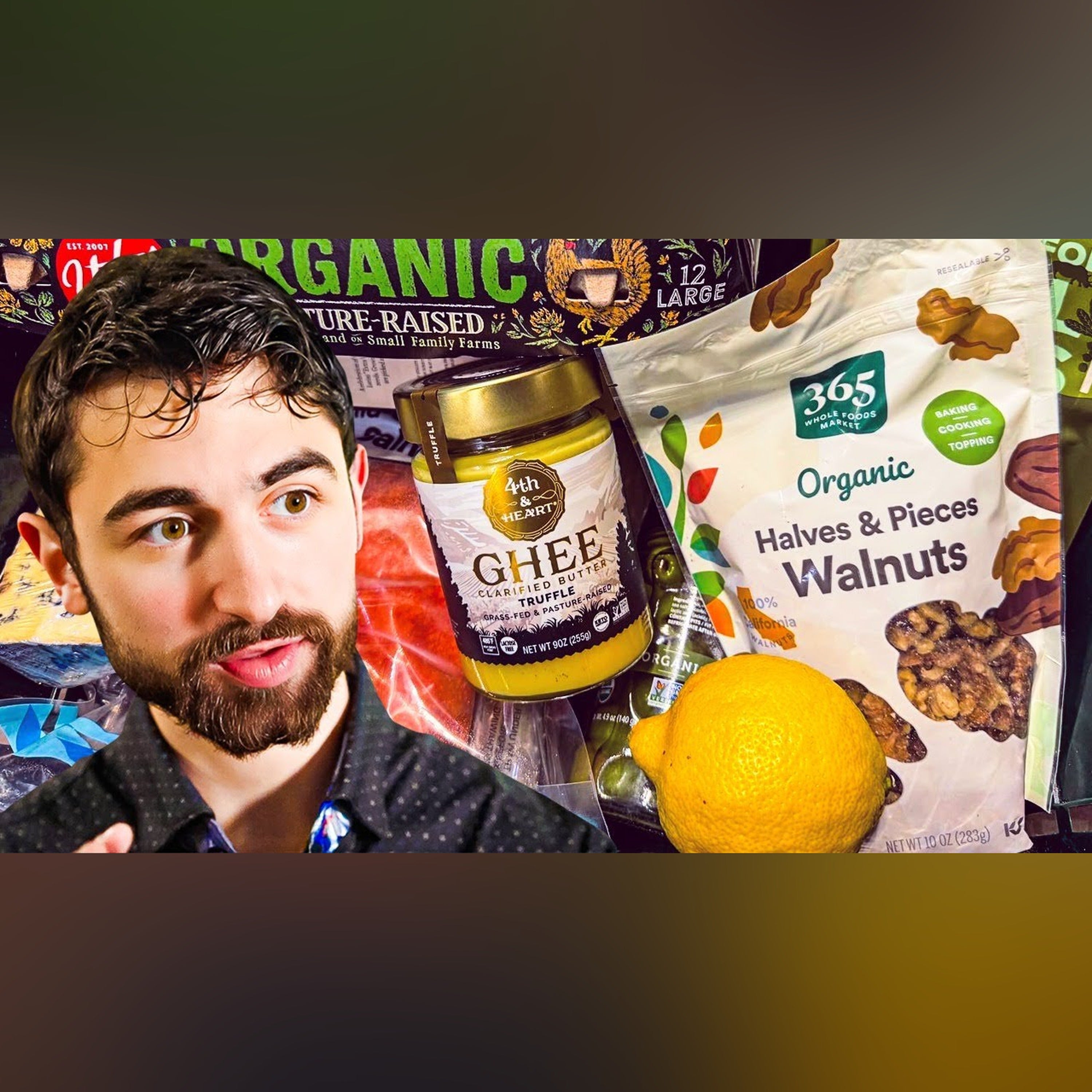
Follow the Money: Who Really Pays When Your Food Makes You Sick
28 min
Listen through the publisher, then discuss the episode here or arrange an in-person Roundtable. Your city determines where to meet.
Roundtables are designed for groups of four, with a shared subject and room for everyone to speak. Come for discussion, with no dating expectation.
When a food company breaks the rules, who actually pays? Because the obvious answer, the answer we all assume, is the company. They get fined. They get exposed. They lose our trust. But the deeper truth, the bitter truth, is that the person who pays first, and pays worst, is almost never the company. It is the kid eating a taco. It is the parent packing a lunch. It is the family that trusted a name on a bag and ended up in an emergency room. The company writes a check. You pay with your body. And today I am going to show you how those two things are quietly connected.
Episode information is provided by the publisher. Listening takes place on the publisher’s service.
Get the 200+ Page Optimal Living Daily Workbook (PDF) - Free. Want to turn today's episode into an actionable plan? Episode 3614: Kym Wilson shares how she left a corporate finance career to pursue scuba diving and a 2,000-kilometer pilgrimage, and the panic she felt when her savings fell behind her peers. She explains why she came to see that net worth and life's worth are different measures, and why the experiences that change us also ripple out to others. The takeaway is that the cost of neglecting a dream can be greater than the money it takes to follow one. Read along with the original article(s) here: https://tinybuddha.com/blog/value-following-dreams-dont-make-money/ Quotes to ponder: "When you answer the call to adventure, you never know where you will end up." "Your net worth is not your life's worth." "I know that one day, when I am old and dying, I won't regret the things I never had, but I will regret the moments I didn't seize and the adventures and growth I never experien
The world’s most astonishing science experiment, simply explained. On the border between France and Switzerland is the biggest science experiment humanity has ever built. Over a 100 meters underground, there’s a tunnel 27 kilometers long in a big loop under nearby homes, businesses, and farms. Inside that tunnel, scientists built a blue tube big enough to crawl through, and inside that tube, they put two pipes that they keep colder and emptier than outer space. Down those pipes, they fire particles smaller than atoms in opposite directions…. and push them faster and faster… until when they’re almost at the speed of light… they SMASH TOGETHER. This underground particle-smasher is also known as the Large Hadron Collider at CERN. It took thousands of scientists from over nearly 100 different countries $5 billion dollars and 30 years to plan and build. My question is: Why? Why did they do that??? Why spend so much money and time to smash particles underground? And now… why do so many scien
Why is the manosphere so appealing to young men? What does it actually mean to be a good man? To join our journaling club, with 10,600 + others, subscribe to my imperfect email - https://www.theimperfects.com.au/sign-up-to-our-newsletter/ Journalist Marc Fennell joins us in the studio to talk about the manosphere: what is it? what are its consequences? and how can we talk to our kids about it? Marc explores with Hugh, Ryan and Josh why the manosphere is so appealing to young men, especially those who think they have little value to offer, and Josh questions what his reaction would have been, if he had of been exposed to the manosphere at a vulnerable time. We look at ‘toxic masculinity,’ and the impact of being right versus making change, and in a moment of vulnerability, Marc discusses the importance of self reflection of your own behaviour. Chapters: Chapters 00:00:00 – Marc Fennell on the Manosphere [TRAILER] 00:01:01 – Ryan’s doppelganger (and media buff etc) 00:04:24 – The State o
Does your relationship feel like home, or does it feel like standing on the edge of something you might lose? In Part 3 of our Relationship Anxiety series, clinical hypnotherapist and former paramedic Martin Hewlett guides you through the process of teaching your nervous system that love doesn't have to hurt to be real. We explore the physical manifestations of anxiety—the tight chest, the 2:00 AM racing mind, and the "stomach drop" when a text takes too long—and provide the tools to "turn down the alarm" of your internal survival response. If you are ready to stop "cherry-picking" evidence of disaster and start building a foundation of trust, this session is for you. In This Episode, We Cover: The Science of Safety: Understanding how your nervous system confuses love with danger. Guided Visualization: A journey into your own "safe room" where you are already enough. Rewiring the Brain: Moving from worst-case disaster reels to the reality of small, daily kindnesses. Breaking the Cycle:
Keto Consult #13: This week Jennifer and I talk all about Food on Keto. We talk about Glucose Testing and how we can use Glucose Testing to biohack ourselves and figure out which Foods on Keto are good and which Foods on Keto are not so good. Amongst Food on Keto we get really into the Keto Diet and Cholesterol and debunk some of the common misunderstandings about Food on Keto and the Keto Diet and Cholesterol. Carbs on Keto, Glucose Testing, Keto Diet and Cholesterol, Food on Keto. We also discuss What is C Reactive Protein?, Why beginning the Keto Diet may make your Liver Enzymes High, Learning How to Fast, Igniting Autophagy and everything you need to know about the Dr. Boz Ratio! Thanks for tuning into my channel. Read more about this topic on my blog: https://bozmd.com/understanding-keto-food-pyramid/ BOOK-LINK - ANYWAY YOU CAN. AUDIBLE: https://adbl.co/2SLLfS1 PAPERBACK= (Affilate link) https://amzn.to/2JqglxS The two most common questions I get ... 1) "Doc, what BLOOD METER do y
For all references and a written breakdown, references and brands recommendations, see the Newsletter: https://staycuriousmetabolism.substack.com/p/ketosis-casein-and-chocolate-what?r=40ekz2 CHAPTER *Call our service line at 815-STAY-CUR (815-782-9287) *Learn more about the data, here: https://staycuriousmetabolism.substack.com/p/life-or-death-in-the-fine-print-the?r=40ekz2 I’ve been asked countless times to make a What I Eat in a Day video — and I’ve finally cracked, like an egg. In this video, I break down what I eat and the science behind every choice. This isn’t a “follow my diet” video — it’s a framework for how to think about food. Whether you’re low-carb, keto, or simply curious about how to optimize your nutrition, this breakdown will give you practical insights into how to make science-backed food choices. For my full shopping list and preferred brands (no affiliations), check out the linked newsletter (above). Referenced Content: How to Cook Eggs: https://youtu.be/Dhmq6F5M8kc
You are a dedicated parent, committed to giving your child the very best start in life. You fill their days with enriching activities, you read to them at night, and you ensure they feel loved and secure. When it comes to food, you navigate the grocery aisles with care, trying to make healthy choices. But the snack aisle is a battlefield. It's a dazzling wall of brightly colored packages, all featuring cartoon characters and promising delicious, convenient fun. You reach for the fruit snacks shaped like their favorite characters, the crunchy cheese crackers, the "all-natural" granola bars. They seem like harmless, easy solutions for a hungry child in a busy world. But what if these seemingly innocent snacks are silently derailing your child's development? What if the convenience you are buying today comes at the cost of their long-term physical, cognitive, and emotional well-being? The rise of processed snacks has created a generation of children who are overfed yet undernourished. The
You are standing in the grocery store, navigating a labyrinth of aisles stacked high with colorful boxes, bags, and cans. You reach for a loaf of bread that promises to stay soft for weeks, a box of crackers that will be crisp a year from now, and a frozen dinner that offers a complete meal with a three year shelf life. It feels like a modern miracle of convenience and value. You are a strategic person, a peak performer who values efficiency. This food seems to align perfectly with a busy, optimized lifestyle. But have you ever stopped to ask the fundamental question: What has been done to this food to make it last so long? And more importantly, What is the cost of that longevity to my own health and vitality? The truth is, the modern grocery store is not primarily a purveyor of nutrition. It is a warehouse. And for the manufacturers who supply it, the single most important metric is not how well a food nourishes your body, but how long it can survive in the complex, time-consuming jou
Leagues should limit financial advantages that make competition persistently unequal.
Share your view, then see how readers voted. No sign-in required. This poll is shared across stories.
Do you agree or disagree?
Common Quandary
A Common Quandary to discuss
Another conversation to explore, separate from this news story.
Your roommate's partner sleeps over six nights a week. Are they now a roommate?
Your roommate's partner stays almost every night, showers daily, and keeps food in the kitchen. They are pleasant and spend weekends elsewhere, but pay no rent or utilities. The lease limits overnight guests.
When does welcome presence become an obligation to contribute?