English-language podcasts

Fun Facts Daily

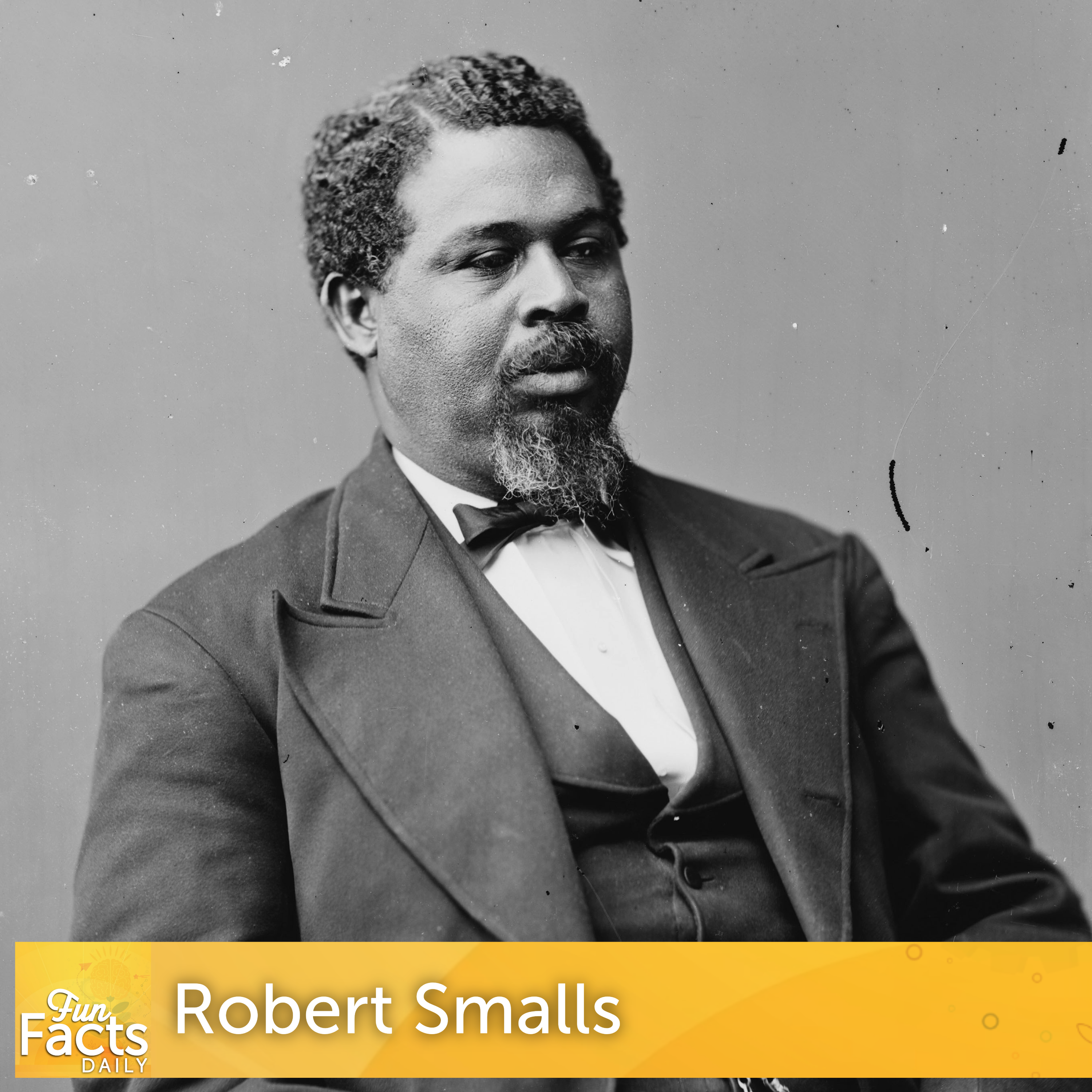
Fun Facts About Robert Smalls
18 min

Listen through the publisher, then discuss the episode here or arrange an in-person Roundtable. Your city determines where to meet.

Roundtables are designed for groups of four, with a shared subject and room for everyone to speak. Come for discussion, with no dating expectation.

Robert Smalls was an amazing hero of the American Civil War. He gained his freedom and helped the war effort by orchestrating a daring escape aboard the Confederate steamer CSS Planter in May 1862. Working as an enslaved wheelman aboard the ship the twenty-three-year-old Smalls took advantage of the ship's white officers sleeping ashore, disguised himself in the captain’s wide-brimmed straw hat, picked up his family and fellow crew members, and navigated past five Confederate checkpoints in Charleston Harbor to surrender the ship and valuable military intelligence to the Union naval blockade. Classified legally as a "contraband of war," Smalls received congressional prize money, met with President Abraham Lincoln to advocate for the enlistment of Black soldiers, and went on to pilot armed Union vessels. In December 1863, after refusing to surrender under heavy artillery fire in Folly Island Creek, he was appointed captain of the Planter, becoming the first African American to command a United States military vessel. Following the Civil War, Smalls championed civil rights, public education, and political reform throughout Reconstruction and the late nineteenth century. After being forcibly removed from a segregated streetcar in Philadelphia in 1864, he helped lead a three-year public boycott and lobbying campaign that resulted in Pennsylvania outlawing transit discrimination in 1867. Despite having been legally barred from learning to read as an enslaved youth, he mastered literacy as an adult and served as a delegate to South Carolina's 1868 Constitutional Convention, where he authored the resolution creating the state's first free, compulsory public school system. Smalls went on to serve in the South Carolina Legislature, won five terms in the United States House of Representatives, and purchased the Beaufort mansion where he had once been enslaved, later sheltering his former enslaver's impoverished widow until her death. His enduring legacy is commemorated across the military, including the Army vessel USAV Major General Robert Smalls and the Navy guided-missile cruiser USS Robert Smalls. Want to learn more? Fun Facts Daily is an Airwave Media Podcast.

Episode information is provided by the publisher. Listening takes place on the publisher’s service.

Listen at the source ↗

Featured places to meet in Palo Alto, CA

Explore these places and arrange a conversation through ThinkMatch.

City guide for Palo Alto, CA

More from Fun Facts Daily

Fun Facts Daily

Fun Facts About Clocks

18 min

From ancient sundials to modern atomic timekeepers, the history of clocks reveals how human societies have measured time with growing precision. Early mechanical clocks in the Northern Hemisphere adopted a clockwise motion to mirror the sweep of sundial shadows across the sky, while exceptions such as Prague's 16th-century Jewish Town Hall clock and La Paz's modified legislative clock demonstrate cultural and regional variations. Practical timekeeping milestones include Levi Hutchins's 1787 4:00 a.m. alarm clock, Antoine Redier's 1847 adjustable alarm patent, and the November 18, 1883 establishment of four North American standard time zones to replace chaotic local solar times across towns and railroads. Precision timekeeping spans from monumental pendulums to quantum-scale oscillators. London's Great Clock in Elizabeth Tower relies on a two-second pendulum regulated with pre-decimal pennies to adjust its daily rate by two-fifths of a second, whereas cesium-133 atomic clocks define the

Discuss this episode

Fun Facts Daily

Fun Facts About Your Nervous System

15 min

The human nervous system is an intricate, high-speed biological network comprising the brain, spinal cord, and an extensive web of peripheral nerves that regulate nearly every bodily function, sensation, and movement. Nerve signals travel at varying speeds depending on myelination, with insulated alpha motor neurons transmitting electrical impulses at speeds up to 268 miles per hour via saltatory conduction, while unmyelinated pain fibers transmit sensations at much slower rates. Specialized neural pathways, such as reflex arcs, bypass the brain entirely during emergencies, routing signals through the spinal cord and interneurons to initiate rapid protective muscular reactions in fractions of a second before conscious processing occurs. Beyond the central nervous system, the human body features specialized decentralized networks like the enteric nervous system within the gastrointestinal tract, which contains roughly 100 million neurons and produces the vast majority of the body's sero

Discuss this episode

Fun Facts Daily

Fun Facts About Zebras

16 min

Zebras are iconic African equines recognized worldwide for their distinctive black-and-white striped coats, which conceal jet-black skin beneath unpigmented white and pigmented black hair. Far from functioning as camouflage against large savanna predators like lions, whose visual acuity fails to distinguish individual stripes at distances exceeding 164 feet, these high-contrast patterns act as an effective optical defense against biting horseflies. The overlapping visual lines scramble the insects' flight mechanics, causing them to miss their landing and bounce off the coat. Because every individual possesses a unique stripe arrangement akin to a human fingerprint, researchers use automated pattern-recognition tools and databases to track populations across the three recognized species: plains zebras, mountain zebras, and Grevy's zebras. Beyond their striking appearance, these animals exhibit remarkable ecological behaviors and physical adaptations across diverse African habitats. Plai

Discuss this episode

Community Poll

Communities should actively welcome newcomers even when local services must adapt.

Share your view, then see how readers voted. No sign-in required. This poll is shared across stories.

Do you agree or disagree?

Choose one answer

Common Quandary

A Common Quandary to discuss

Another conversation to explore, separate from this news story.

You know the relationship is over, but the vacation is nonrefundable. Do you wait to break up?

You have decided to end a year-long relationship. In five days, you are both leaving on an expensive vacation that cannot be refunded or transferred. Your partner is excited and believes the relationship is thriving.

Can avoiding financial waste justify delaying a painful truth?

Explore this quandary