English-language podcasts

New Books in Anthropology

Good Sediment: Black Ecologies and the Politics of Restoration in Coastal Louisiana with Monica Patrice Barra ( U Washington Press, 2025)
69 min

Listen through the publisher, then discuss the episode here or arrange an in-person Roundtable. Your city determines where to meet.

Roundtables are designed for groups of four, with a shared subject and room for everyone to speak. Come for discussion, with no dating expectation.

Coastal Louisiana is losing land at an unprecedented rate, and in response, scientists and policymakers have turned to massive restoration projects to slow the erosion. Good Sediment enters this charged landscape, where the promise of ecological renewal collides with the lived realities of Black coastal communities in Plaquemines Parish. At the center ofGood Sediment: Black Ecologies and the Politics of Restoration in Coastal Louisiana (https://bookshop.org/a/12343/9780295754673) (University of Washington Press, 2026) is the Mid-Barataria Sediment Diversion, the state’s most ambitious and controversial project: a $2 billion engineering feat that would redirect the Mississippi River’s mud and silt into disappearing wetlands. For policymakers, the river’s sediment is salvation. For the Parish’s multigenerational Black communities, however, this “good sediment” carries profound risks, including flooding homes and undermining fishing livelihoods. Through ethnographic research, Monica Patrice Barra traces the multiple meanings of restoration as scientists, engineers, and Afro-descendant communities wrestle with what it means to “work with nature” in the shadow of climate change. She reveals how technical claims of environmental progress often sidestep questions of environmental racism, and how Black communities press instead for restoration that sustains culture, dignity, and intergenerational survival. Unsettling the assumption that restoration is inherently benevolent, Good Sediment reframes ecological repair as a political and cultural practice - one that must grapple with the racial histories embedded in the land. This vital work bridges environmental anthropology, political ecology, and Black studies to imagine restoration otherwise: as a project oriented toward protecting Black life. Monica Patrice Barra is Assistant Professor of race and environment with a joint appointment in the Department of Anthropology and the School of the Earth, Ocean & Environment at the University of South Carolina. She is a cultural anthropologist with an interdisciplinary background of cultural geography and American studies. Yadong Li is an anthropologist-in-training. He is a PhD candidate of Socio-cultural Anthropology at Tulane University. More details about his scholarship and research interests can be found here (https://liberalarts.tulane.edu/anthropology/people/graduate-students/yadong-li). Hosted by Simplecast, an AdsWizz company.

Episode information is provided by the publisher. Listening takes place on the publisher’s service.

Listen at the source ↗

Featured places to meet in Palo Alto, CA

Explore these places and arrange a conversation through ThinkMatch.

City guide for Palo Alto, CA

More from New Books in Anthropology

New Books in Anthropology

Death Glitch: How Techno-Solutionism Fails Us in This Life and Beyond with Tamara Kneese (Yale UP, 2023)

46 min

Since the internet’s earliest days, people have died and mourned online. In quiet corners of past iterations of the web, the dead linger. But attempts at preserving the data of the dead are often ill-fated, for websites and devices decay and die, just as people do. Death disrupts technologists’ plans for platforms. It reveals how digital production is always collaborative, undermining the entrepreneurial platform economy and highlighting the flaws of techno-solutionism. Big Tech has authority not only over people’s lives but over their experiences of death as well. Ordinary users and workers, though, advocate for changes to tech companies’ policies around death. Drawing on internet histories along with interviews with founders of digital afterlife startups, caretakers of illness blogs, and transhumanist tinkerers, in Death Glitch: How Techno-Solutionism Fails Us in This Life and Beyond (https://bookshop.org/a/12343/9780300248272)(Yale University Press, 2023), Dr. Tamara Kneese takes re

Discuss this episode

New Books in Anthropology

Gurus, Hucksters, Entertainers: How Influencers Reshaped Social Media with Angèle Christin (U Chicago Press, 2026)

63 min

In Gurus, Hucksters, Entertainers: How Influencers Reshaped Social Media (https://bookshop.org/a/12343/9780226830940)(University of Chicago Press, 2026), digital studies scholar Dr. Angèle Christin demystifies the content creator economy, explaining its long history and the pitfalls of its professionalization. Drawing on in-depth fieldwork with digital creators as varied as vegan YouTubers, dads of Instagram, and self-described drama commentators, Dr. Christin shows how individuals enter social media creation, how they make money, and how their online environments shape their content. Aspiring creators often dream of a better life in social media careers. Yet these dreams soon turn into exhaustion as influencers try to meet the contradictory demands of platforms, brands, and audiences. Over time, Dr. Christin shows, creators cluster into three types: hucksters, who work on behalf of brands; entertainers, who chase virality and platform payments; and gurus, who monetize the loyalty of t

Discuss this episode

New Books in Anthropology

Our Planetary Mirror: Earth Science and the Reimagining of Humanity with Boris Shoshitaishvili (U Chicago Press, 2026)

68 min

How to reimagine humanity on a planetary scale? Drawing on the key Scientific theories developed over the last century, in Our Planetary Mirror: Earth Science and the Reimagining of Humanity (https://bookshop.org/a/12343/9780226852140) (U Chicago Press, 2026) Boris presents an intellectual History and metaphorical analysis of the key terms (squarely embedded in the philosophical, religious, and spiritual traditions) as avenues to reimagine humanity. Hosted by Simplecast, an AdsWizz company.

Discuss this episode

Community Poll

Schools should restrict personal phone use during lessons.

Share your view, then see how readers voted. No sign-in required. This poll is shared across stories.

Do you agree or disagree?

Choose one answer

Common Quandary

A Common Quandary to discuss

Another conversation to explore, separate from this news story.

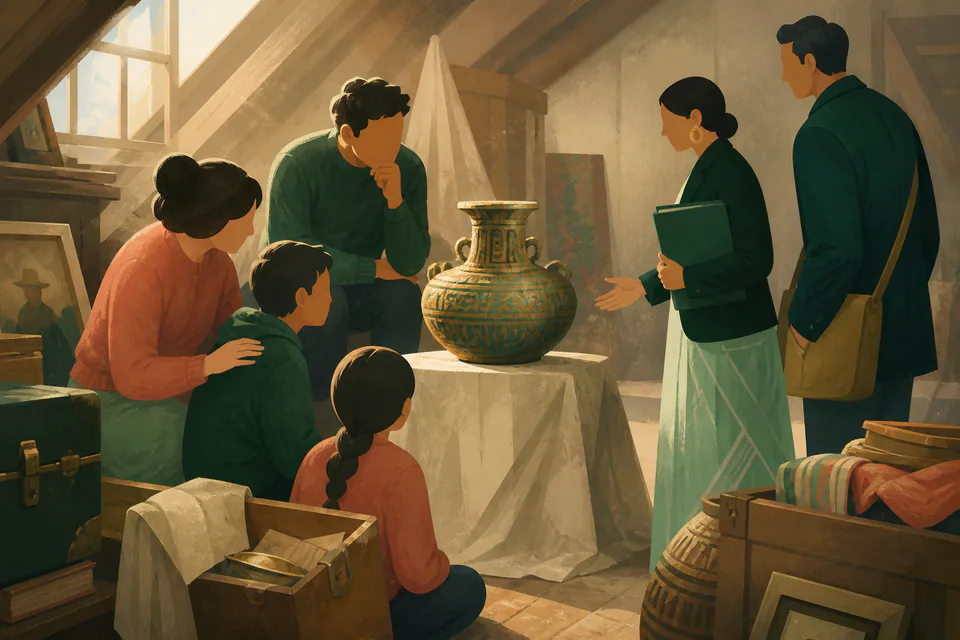
Your grandfather brought home an ancient artifact. A museum wants it back. Do you surrender it?

In your grandfather's attic you discover a beautiful ancient object he brought home while working overseas decades ago. Your family treasures it and his papers suggest the rules were murky. A museum from that country says it belongs to their collection and asks for its return.

Can a family inherit clear ownership of something acquired through unclear power?

Explore this quandary