English-language podcasts

New Books in Critical Theory

Our Planetary Mirror: Earth Science and the Reimagining of Humanity with Boris Shoshitaishvili (U Chicago Press, 2026)
68 min

Listen through the publisher, then discuss the episode here or arrange an in-person Roundtable. Your city determines where to meet.

Roundtables are designed for groups of four, with a shared subject and room for everyone to speak. Come for discussion, with no dating expectation.

How to reimagine humanity on a planetary scale? Drawing on the key Scientific theories developed over the last century, in Our Planetary Mirror: Earth Science and the Reimagining of Humanity (https://bookshop.org/a/12343/9780226852140) (U Chicago Press, 2026) Boris presents an intellectual History and metaphorical analysis of the key terms (squarely embedded in the philosophical, religious, and spiritual traditions) as avenues to reimagine humanity. Hosted by Simplecast, an AdsWizz company.

Episode information is provided by the publisher. Listening takes place on the publisher’s service.

Listen at the source ↗

Featured places to meet in Palo Alto, CA

Explore these places and arrange a conversation through ThinkMatch.

City guide for Palo Alto, CA

More from New Books in Critical Theory

New Books in Critical Theory

Monstrous Conceptions: A History of Race, Disability, and Reproductive Medicine in the United States with Miriam Rich (Columbia UP, 2026)

60 min

In the nineteenth century, American medical practitioners helped craft a new science of monsters. The term “monstrous birth” had long been applied to newborns with congenital conditions such as anencephaly. When practitioners redefined “monstrosity” in scientific terms, they claimed to be stripping away its fraught connotations. Instead, recast as a biological phenomenon, the monster gained new social and cultural salience. Monstrosity gave form to pervasive ideas about the meaning of racial difference, the fragility of racial order, and the peril of racial degeneration. Miriam Rich explores the history of monstrosity as a modern scientific category, tracing the practices that transformed newborn bodies into medical specimens across the nineteenth- and early twentieth-century United States. Monstrous Conceptions: A History of Race, Disability, and Reproductive Medicine in the United States (https://bookshop.org/a/12343/9780231553551) (Columbia UP, 2026) vividly examines experiences of

Discuss this episode

New Books in Critical Theory

The Souls of Jewish Folk: W. E. B. Du Bois, Anti-Semitism, and the Color Line with James M. Thomas (U Georgia Press, 2023)

54 min

The last 20 years or so have seen sociology engage in a deep ‘recovery’ of the work of W.E.B. Du Bois. In doing so, the astounding scholarly record of this Black American scholar has been subject to immense focus and debate. It is therefore, then, notable when someone comes along with a new angle for viewing Du Bois. This is what James M. Thomas does in his The Souls of Jewish Folk: W.E.B. Du Bois, Anti-Semitism and the Color Line (https://www.ugapress.org/9780820365077/the-souls-of-jewish-folk/) (U Georgia Press, 2023). Focusing on Du Bois’ time in Germany following his studies at Harvard Thomas shows Du Bois’ encounter with rising German anti-semitism and traces interesting paths of common theorising. This includes the ways ‘double consciousness’ emerges initially as a medical concepts applied to Jewish people, the different ways the ‘split self’ was theorised and the broader political events Du Bois witnessed beyond the class room. In our discussion, we trace what led Du Bois to Ger

Discuss this episode

New Books in Critical Theory

Until the Last Yoke Is Broken: The Constitutional Vision of Frederick Douglass with Bradley N. Rebeiro (Harvard UP, 2026)

54 min

In his celebrated address “What to the Slave is the Fourth of July?” Frederick Douglass denounced America’s hypocritical celebration of freedom. But he did not blame the nation’s founding document for enabling the evil of slavery. Rather, he proclaimed that “interpreted as it ought to be interpreted, the Constitution is a Glorious Liberty Document.” This was no mere rhetorical flourish. Examining Douglass not just as an activist but as a legal and political theorist,Until the Last Yoke Is Broken: The Constitutional Vision of Frederick Douglass (https://bookshop.org/a/12343/9780674301689) (Harvard UP, 2026) reveals that his abolitionism was guided by rigorous constitutional interpretation. Reconstructing Douglass’s method from his speeches and writings, Bradley Rebeiro shows that his approach both anticipated and challenged aspects of contemporary originalism. Like today’s originalists, Douglass saw historical meaning as central to constitutional analysis. But unlike today’s originalism

Discuss this episode

Community Poll

Platforms should prioritize preventing harassment even when this limits some expression.

Share your view, then see how readers voted. No sign-in required. This poll is shared across stories.

Do you agree or disagree?

Choose one answer

Common Quandary

A Common Quandary to discuss

Another conversation to explore, separate from this news story.

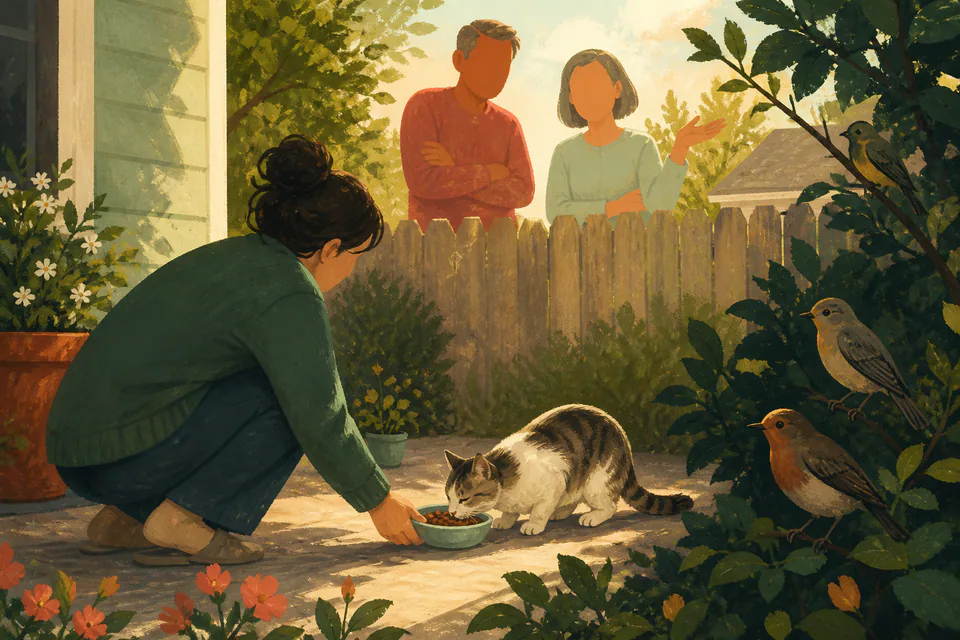
A stray cat adopts you—and starts killing birds. Do you keep feeding it?

A stray cat visits your yard daily and appears to depend on the food you leave out. Neighbors complain that outdoor cats kill birds and say feeding it encourages the problem without taking responsibility for the animal.

Does caring for one visible animal excuse harm to less visible ones?

Explore this quandary