Until the Last Yoke Is Broken: The Constitutional Vision of Frederick Douglass with Bradley N. Rebeiro (Harvard UP, 2026)
54 min
Listen through the publisher, then discuss the episode here or arrange an in-person Roundtable. Your city determines where to meet.
Roundtables are designed for groups of four, with a shared subject and room for everyone to speak. Come for discussion, with no dating expectation.
In his celebrated address “What to the Slave is the Fourth of July?” Frederick Douglass denounced America’s hypocritical celebration of freedom. But he did not blame the nation’s founding document for enabling the evil of slavery. Rather, he proclaimed that “interpreted as it ought to be interpreted, the Constitution is a Glorious Liberty Document.” This was no mere rhetorical flourish. Examining Douglass not just as an activist but as a legal and political theorist,Until the Last Yoke Is Broken: The Constitutional Vision of Frederick Douglass (https://bookshop.org/a/12343/9780674301689) (Harvard UP, 2026) reveals that his abolitionism was guided by rigorous constitutional interpretation. Reconstructing Douglass’s method from his speeches and writings, Bradley Rebeiro shows that his approach both anticipated and challenged aspects of contemporary originalism. Like today’s originalists, Douglass saw historical meaning as central to constitutional analysis. But unlike today’s originalism, Douglass’s goes beyond simply asking how the Constitution was understood at its ratification. Instead, Douglass insisted that whenever a constitutional provision is ambiguous, the interpreter must adopt whatever meaning best agrees with the natural rights affirmed in the Declaration of Independence. Rebeiro also shows how Douglass balanced this constitutional vision with pragmatism during Reconstruction. When political tensions pitted the fate of black suffrage against women’s suffrage, Douglass set aside the theoretically pure for the politically possible; as soon as black suffrage was secured, he returned to advocating for universal voting rights. “It was mine to stand for the freedom of people of all colors,” Douglass wrote near the end of his life, “until in our land the last yoke was broken and the last bondsman was set free.” Bradley N. Rebeiro is a legal scholar whose research spans constitutional law, political theory, and antislavery legal thought. He is an associate professor at BYU Law School and a research fellow at the Georgetown Center for the Constitution. You can find him on LinkedIn (https://www.linkedin.com/in/bradley-rebeiro-696342a9) and at the BYU website (https://law.byu.edu/faculty/bradley-rebeiro). Hosted by Simplecast, an AdsWizz company.
Episode information is provided by the publisher. Listening takes place on the publisher’s service.
PBS Member Stations rely on viewers like you. To support your local station, go to:http://to.pbs.org/DonateSPACE Sign Up on Patreon to get access to the Space Time Discord! We tend to imagine there are connectings between things that we don’t understand. Quantum mechanics and consciousness, aliens and pyramids, black holes and dark matter, dark matter and dark energy, dark energy and black holes. Usually there’s no real relationship whatsoever, but this last pair—black holes and dark energy being the same thing—has received some recent hype in the press. Let’s see if it might actually be true. Episodes Referenced Companion Playlist: Check out the Space Time Merch Store Sign up for the mailing list to get episode notifications and hear special announcements! Search the Entire Space Time Library Here: https://search.pbsspacetime.com/ Hosted by Matt O'Dowd Written by Matt O'Dowd Post Production by Leonardo Scholzer, Yago Ballarini, & Stephanie Faria Directed by Andrew Kornhaber Associate
Uploaded 20-11-18 View full lesson: https://ed.ted.com/lessons/the-life-cycle-of-a-neutron-star-david-lunney About once every century, a massive star somewhere in our galaxy runs out of fuel. No longer able to produce sufficient energy to maintain its structure, it collapses under its own gravitational pressure and explodes in a supernova. The death of that star is the birth of a neutron star: one of the densest known objects in the universe. David Lunney explores what, exactly, a neutron star is. Lesson by David Lunney, directed by JodyPrody. Thank you so much to our patrons for your support! Without you this video would not be possible! Sandra Tersluisen, Ellen Spertus, Fabian Amels, sammie goh, Mattia Veltri, Quentin Le Menez, Yuh Saito, Heather Slater, Dr Luca Carpinelli, Christophe Dessalles, Arturo De Leon, Eduardo Briceño, Ricardo Paredes, David Douglass, Grant Albert, Jen , Megan Whiteleather, Mayank Kaul, Ryohky Araya, Tan YH, Ph.D., Brittiny Elman, Kostadin Mandulov, Yanuar A
What can this human-like robot really do? You might know Atlas, the famous robot that does parkour and throws heavy objects in Boston Dynamics’ popular YouTube videos. I visited Boston Dynamics to challenge Atlas to a little friendly competition, to see what this robot can REALLY do. I wanted to answer a question I’ve had since I was a kid: When are all the robots coming? Like C-3PO! The Iron Giant! Sonny from “I, Robot”! Human-like machines that can help people do more than we can by ourselves. For most of my life, humanoid robots have seemed pretty far away. But recently? Not so much. Tesla with Optimus, Boston Dynamics with Atlas, NASA with Valkyrie, startups like Figure and many more are all making huge leaps in this field. In this video, we take you to the cutting edge of humanoid robots, to show you what they can actually do right now… and what you can expect in the robot future that’s coming. Chapters: 00:00 What is a humanoid robot? 01:16 Is Boston Dynamics Atlas real? 02:31 Wh
In this joint lecture, Gresham Professor of Physic Robin May and world-renowned puppet creator Steve Allen (Labyrinth, The Muppets, Fraggle Rock) discuss the science that goes in to bringing puppets to life, what our interactions with puppets mean for our understanding of human emotions, and how we may be able to use puppets to help tackle some of society’s most pressing challenges. This lecture was recorded by Professor Robin May and Steve Allen on 13th of October 2026 at Barnard’s Inn Hall, London. Professor of Infectious Disease at the University of Birmingham, and (interim) Chief Scientist at the UK Health Security Agency, Robin May was appointed Gresham Professor of Physic in May 2022. Between July 2020 and September 2025 he served as Chief Scientific Adviser at the Food Standards Agency (FSA). Professor May’s early training was in Plant Sciences at the University of Oxford, followed by a PhD on mammalian cell biology at University College London and the University of Birmingham.
When a young man moved into a Kentucky townhouse with his sister, he noticed something unusual near the top of the stairs: a handprint on the wall. There was nothing particularly frightening about it, but what happened when they tried to paint over it was difficult to explain. No matter how many times they covered it, the handprint kept coming back. And that wasn't the only strange thing happening in the house. Before long, he began hearing unexplained footsteps and experiencing an uncomfortable feeling that someone was watching him. He tried to find reasonable explanations, but the experiences continued, often when he knew he was alone. Then one night, he heard something that made the activity even more unsettling. Was the townhouse simply an old building with a few unusual quirks—or was something making its presence known? #RealGhostStoriesOnline #TrueGhostStories #HauntedTownhouse #MysteriousHandprint #GhostlyChildren #UnexplainedFootsteps #KentuckyGhostStories #ParanormalEncounters
Families inherit all kinds of things from one generation to the next—furniture, photographs, keepsakes, and stories that slowly lose their details over time. But what if something else gets passed down too? After her grandmother’s death, Karen brought several old family pieces into her home without giving any of them much thought. They were familiar things she had seen since childhood, tied to people and places she loved. Then one of them began stirring up memories nobody had talked about in years. And when her young son became frightened of something he couldn’t explain, Karen started asking questions about her family’s past. The answers suggested that whatever had entered her home might not have arrived recently at all. It may have been with the family for generations. #HauntedObjects #HauntedFurniture #GhostStories #FamilyHaunting #ShadowFigure #Paranormal #HauntedWardrobe #GenerationalHaunting #Unexplained #ShadowPerson #Hauntings Love real ghost stories? Want even more? Want even
In Britain at the end of the nineteenth century, the new sexual sciences—from anthropological accounts of religion as rooted in ancient fertility cults to psychoanalytic theories that explained religious experience in terms of psychosexual development—characterized religion as closely connected to the sexual. The outcome, as Joy Dixon argues in Sexual Heresies: Religion, Science, and Sexuality in Modern Britain (https://bookshop.org/a/12343/9781503646681), was a new sense that religion itself could be sexually suspect. One result was an increasing concern to police "sexual heresies" to produce a supposedly normal (healthy, monogamous, and heterosexual) religiosity. The overall effect was a narrowing of the sexual possibilities inside "orthodox" religion and the association of alternative forms of religion with dissident sexualities that continues to shape both religion and secularism today. Drawing on a wide range of materials from diverse elements of British society, this book emphasi
Historians of political thought interested in partisanship have long privileged the perspective of male canonical thinkers. Scholars have turned to Thucydides and Plato for insights on stasis, Aristotle on civic friendship, Niccolò Machiavelli on tumults, David Hume and Edmund Burke on political parties, and The Federalist on faction. Even political theorists who are primarily concerned with contemporary theories of partisanship often turn to these “usual suspects” to strengthen their otherwise largely non-historical arguments. Yet this narrow focus on canonical men has led scholars to neglect an important if counterintuitive perspective on partisanship which we find in the political thought of eighteenth-century women, for whom partisanship offered an unexpected but essential means to political inclusion. Partisan Virtue: The Politics of Inclusion in Eighteenth-Century Women’s Political Thought (https://bookshop.org/a/12343/9780198989349)(Oxford UP, 2026) by Dr. Geertje Bol focuses on
Inspired by the humanist and Catholic martyr Thomas More, David Albertson and Jason Blakely imagine a new politics of hope In Thomas More's Utopia, a traveler from the New World delivers a shocking message: on a lost island beyond the horizon, people live far better lives than in Europe. A leading intellectual of his day, More was murdered by Henry VIII in 1535 for refusing to sign a loyalty oath, but his utopian vision inspired some of the most consequential movements in the modern world. In their provocative manifesto Utopia for Our Century: A Manifesto of Hope (https://bookshop.org/a/12343/9780300278088) (Yale UP, 2026), David Albertson and Jason Blakely retrieve More's insights and apply them to our moment. Amid the decline of liberalism and the rise of authoritarianism, Albertson and Blakely resist the dystopian fears taking root in the twenty-first century. Utopian politics, they argue, can help us break free of today's entrenched polarities and recast what is possible. They retu
Patients should be able to compare expected treatment costs before choosing care.
Share your view, then see how readers voted. No sign-in required. This poll is shared across stories.
Do you agree or disagree?
Common Quandary
A Common Quandary to discuss
Another conversation to explore, separate from this news story.
You make a hilarious deepfake of a friend for their birthday. Must you ask first?
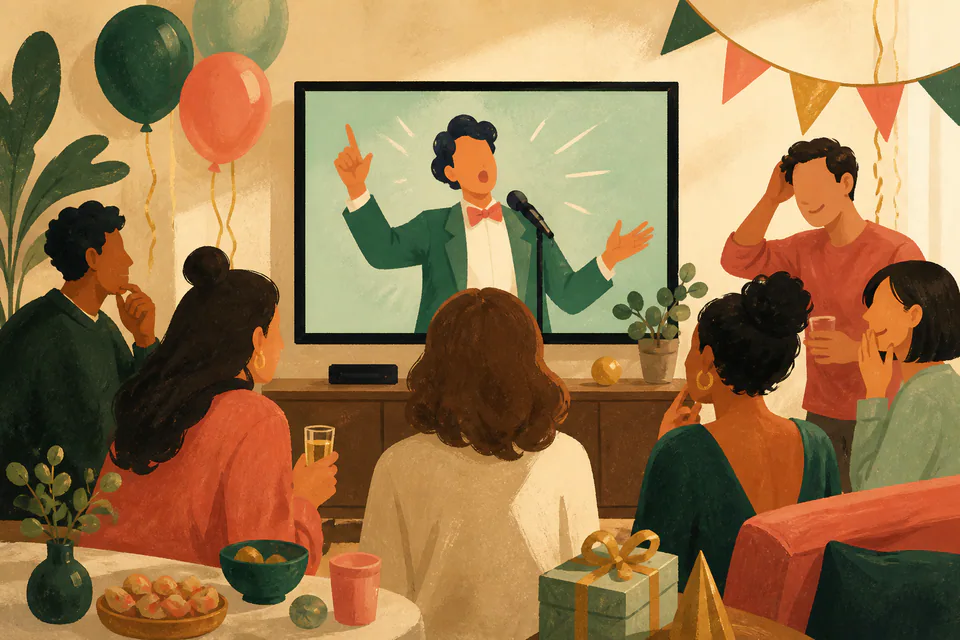
For a private birthday party, someone creates a convincing video of a mutual friend delivering an absurd speech. Everyone, including the subject, will immediately understand that it is fake.
Does obvious fiction eliminate the need for consent?