Roland Frasier is a strategic investor, entrepreneur and renowned deal-maker – and he wants to share his powerful strategies to help you grow your business in any economic climate. Uploaded 27-04-20 In an economic winter, your business has three options: freeze and fail, fumble and maybe survive or fight and grow. You want to fight and grow. You want to make it through and not just survive, but thrive. You want to join the ranks of Apple, Starbucks and other famous companies who used downturns to regroup, reassess and come out even stronger on the other side. As Tony Robbins often says, business is 80% psychology and only 20% skill. You can listen to Tony talk about the psychology of success on his podcast at https://www.tonyrobbins.com/podcasts/episode-11 and start putting those tips into action today. Surround yourself with success. Feed your mind the right fuel. And most of all, shift your mindset and defeat your fear of failure. In this video, Roland’s tips combine both psychology
The furthest most planet in our Solar System, Pluto, averages a distance of 6 billion kilometres from Earth. The Voyager 1 spacecraft launched in 1977 is now 25.9 billion kilometres from Earth, the distance light travels in one day. Voyager 2 is 21.7 billion kilometres from Earth. The voyager craft are the first human-made objects to reach such an extreme distances from Earth.
Berkshire Hathaway, legendary investor Warren Buffett’s holding company, just made a nearly $600M bet on the housing market, all while real estate sentiment (https://www.biggerpockets.com/blog/pulse-q3-2026) hits its lowest levels in over a decade. What do Berkshire and Buffett know about the real estate market that most Americans are completely missing? Between September 17th and October 2nd, Berkshire Hathaway invested nearly $600M in one building company—Lennar. Even with Lennar’s quarterly revenue down 9% as it experiences one of its weakest quarters in over a decade, Berkshire sees what nobody else does: housing will recover, and whoever can build and own it will profit. Berkshire is known for its long-term, conservative, and bottom-line-based investing strategy. So, if the best investors on earth are putting their money into real estate and projecting a long-term recovery on the horizon, should rental property (https://www.biggerpockets.com/guides/how-to-buy-rental-property) inve
In this Jim Rohn Motivation video, discover how one small decision made today can transform the next ten years of your life. Learn how powerful habits, values, and discipline shape your destiny over time—because your future isn’t built in a day, but in daily choices. Key Topics From This Motivational Video: The power of a single decision to change your future Why discipline is more valuable than motivation How small daily habits compound over time The importance of values over emotions Choosing the right influences for long-term success This powerful Jim Rohn speech dives into the decisions that quietly shape your future—the subtle, almost invisible moments that determine whether you drift or direct your life. It’s not the grand events, but the repeated patterns of choice that define your results. Learn how to take ownership, establish your values, and let discipline guide you toward fulfillment, wealth, and personal growth. This Jim Rohn Motivational Video Is Perfect For: Anyone feeli
Hackaday Editors Elliot Williams and Al Williams met to review the week in Hackaday. It was a week for hands, in more ways than one, along with a voice assistant that ditches the cloud, a GPU for twenty cents, glasses that help the visually impaired see with LiDAR, and a virtual mechanical watch that shows you exactly how the real thing ticks. Beyond watch hands, you might like an eighteen-degrees-of-freedom robot hand for under $300 in parts. Or plant your own hands on a spinning wheel to make virtual honey feel sticky and virtual oil feel slippery in VR. For the Can't-Miss Articles, Elliot digs into the truth about hobbyist 3D scanning, photogrammetry versus structured light, and why the meshes you get are rarely the CAD models you wanted. Al, meanwhile, looks at how modern smartphones talk to satellites, bent pipes, flying cell towers, and all. Check out the links below to follow along, and as always, tell us what you think about this episode in the comments (https://hackaday.com/20
SILICON SATAN: THE HIDDEN HIERARCHY OF POWER EXPOSED! Who really controls the controllers? Michael Jaco welcomes back Cregg Lund, author of Silicon Satan, for an explosive conversation exploring what Cregg describes as the Luciferian hierarchy, the secret societies operating behind powerful institutions, and the hidden layers of influence he believes most people never see. Cregg breaks down his proposed levels of control, from political institutions and Silicon Valley power players to billionaire networks, secret societies, and what he calls the ancient Luci bloodlines. But according to Cregg, the biggest mistake is focusing on the visible players rather than the structures he believes operate above them. ⚡ Inside this episode: The Luci hierarchy and Cregg's claims of internal power struggles. The billionaire club, Silicon Valley, and alleged hidden networks of influence. Why Cregg believes dismantling the visible “deep state” would not eliminate the underlying system. Secret societies
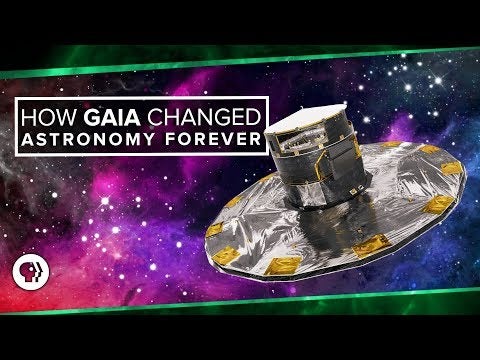
Viewers like you help make PBS (Thank you ) . Support your local PBS Member Station here: https://to.pbs.org/DonateSPACE Uploaded 09-05-18 The great advances in any science tend to come in sudden leaps. April 25th of 2018 marks the beginning of just such a leap for much of astronomy. In the early hours of the morning, the Gaia mission’s second data release dropped. Our understanding of our own galaxy will never be the same again. You can further support us on Patreon at https://www.patreon.com/pbsspacetime Get your own Space Time t-shirt at http://bit.ly/1QlzoBi Tweet at us! @pbsspacetime Facebook: facebook.com/pbsspacetime Email us! pbsspacetime [at] gmail [dot] com Comment on Reddit: http://www.reddit.com/r/pbsspacetime Help translate our videos! https://www.youtube.com/timedtext_cs_panel?tab=2&c=UC7_gcs09iThXybpVgjHZ_7g (https://www.youtube.com/timedtext_cs_panel?c=UC7_gcs09iThXybpVgjHZ_7g&tab=2) Previous Episode: The Star at the End of Time The Gaia satellite was launched in late
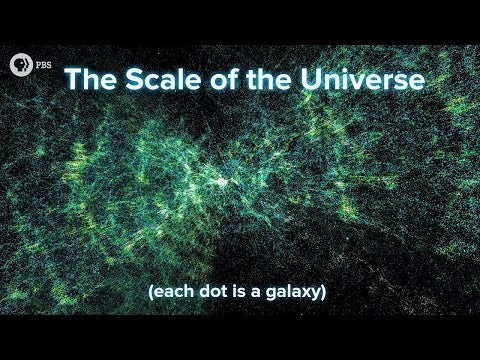
Thank you to Draper and its Hack the Moon initiative for supporting PBS Digital Studios | Learn more at https://wehackthemoon.com. (https://wehackthemoon.com./) Uploaded 25-07-19 PBS Member Stations rely on viewers like you. To support your local station, go to: http://to.pbs.org/DonateSPACE One of the fundamental questions humanity has always asked is how big is our Universe? For much of human history, people believed that Planet Earth was the very center of the entire universe. And Earth is pretty big. But compared the rest of the universe, we are infinitesimally small. The animation in this video the Digital Universe data collection curated by the American Museum of Natural History. The software is used to visualize these datasets is OpenSpace, which is developed through a collaboration between AMNH, Linköping University in Sweden, New York University, and the University of Utah. The software and datasets are open source and are free to download and explore. https://www.openspacepro
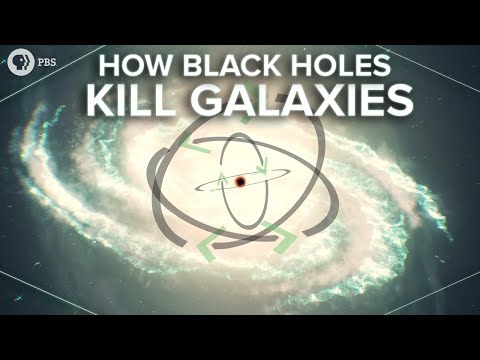
To learn to think like a scientist check out http://Brilliant.org/SpaceTime (http://brilliant.org/SpaceTime) Uploaded 17-06-19 PBS Member Stations rely on viewers like you. To support your local station, go to: http://to.pbs.org/DonateSPACE Check out the new Space Time Merch Store! Support Space Time on Patreon Black holes are really only dangerous if you get too close. Ha, who am I kidding. It turns out they may be responsible for ending star formation across the entire universe. Hosted by Matt O'Dowd Written by Matt O'Dowd Graphics by Leonardo Scholzer Directed by Andrew Kornhaber Produced By: Kornhaber Brown When we first realized that black holes could have masses of millions or even billions of times that of the sun, it came as a bit of a shock. They were discovered as the driving force behind quasars, where matter is heated to extreme incandescence before its plunge into vast black holes. But if that weren’t enough, we soon realized that every single decent-sized galaxy contains
Publicly funded stadiums should provide clear, measurable benefits to local residents.
Share your view, then see how readers voted. No sign-in required. This poll is shared across stories.
Do you agree or disagree?
Common Quandary
A Common Quandary to discuss
Another conversation to explore, separate from this news story.
An AI wrote the perfect condolence message for you. Is it still from the heart?
Your friend is grieving. You want to reach out, but words fail you, so you ask an AI to draft a condolence message. It expresses exactly what you feel. You revise it and send it without mentioning the help.