Deciphering The Vast Scale of the Universe | STELLAR
Listen through the publisher, then discuss the episode here or arrange an in-person Roundtable. Your city determines where to meet.
Roundtables are designed for groups of four, with a shared subject and room for everyone to speak. Come for discussion, with no dating expectation.
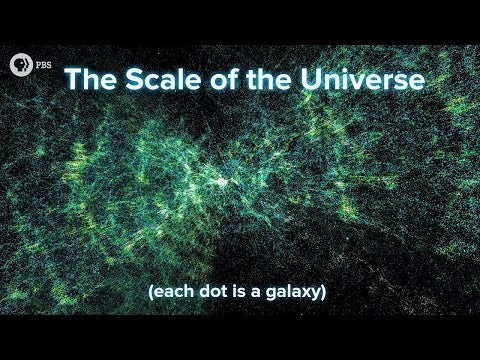
Thank you to Draper and its Hack the Moon initiative for supporting PBS Digital Studios | Learn more at https://wehackthemoon.com. (https://wehackthemoon.com./) Uploaded 25-07-19 PBS Member Stations rely on viewers like you. To support your local station, go to: http://to.pbs.org/DonateSPACE One of the fundamental questions humanity has always asked is how big is our Universe? For much of human history, people believed that Planet Earth was the very center of the entire universe. And Earth is pretty big. But compared the rest of the universe, we are infinitesimally small. The animation in this video the Digital Universe data collection curated by the American Museum of Natural History. The software is used to visualize these datasets is OpenSpace, which is developed through a collaboration between AMNH, Linköping University in Sweden, New York University, and the University of Utah. The software and datasets are open source and are free to download and explore. https://www.openspaceproject.com/ Credit: From the ESO Supernova to the end of the Universe at 00:52 Credit: ESO/L. Calçada/M. Kornmesser/spaceengine.org Credit: Cepheid Variable 4:06 NASA, ESA, M. Kornmesser I know, this video is a bit different from most Space Time videos. It's part of a PBS miniseries called Stellar, done in collaboration with Diana Cowern from @physicsgirl and Joe Hanson from @It'sOkayToBeSmart. Over six episodes we travel to telescopes, go inside space research centers, and chat with amazing scientists. Next up is Joe's episode where he explores where life might be outside our solar system. Check out Joe’s episode here: Check out the other episodes in this series: The Quasar from The Beginning of Time | STELLAR https://www.youtube.com/watch?v=cqCPn… (https://www.youtube.com/watch?v=cqCPn%E2%80%A6) Seeing a Black Hole with a Planet-Sized Telescope | STELLAR https://www.youtube.com/watch?v=gUpKt… (https://www.youtube.com/watch?v=gUpKt%E2%80%A6) I Visited the First Gravitational Wave Detector! LIGO | STELLAR https://www.youtube.com/watch?v=jtp71… (https://www.youtube.com/watch?v=jtp71%E2%80%A6) How We’ll Find the Aliens in Our Solar System! | STELLAR https://www.youtube.com/watch?v=zfqpYDVhXd8&t=2s (https://www.youtube.com/watch?t=2s&v=zfqpYDVhXd8) Stellar is a part of the PBS Summer of Space. There'll be lots of awesome space related content all summer long on PBS. See what's happening at https://www.pbs.org/summer-of-space/ #SummerOfSpacePBS #astrophysics #space Hosted by Matt O’Dowd Written by: Sophia Chen, Matt O’Dowd, Andrew Kornhaber, Eric Brown Directed by: Andrew Kornhaber and Eric Brown Producer: Randa Eid Director of Photography: Eric Brouse Sound: Justin Pope and Brett Van Duesen Production Assistant: Marifisia Bel Editing: Pavel Ezrohi, Tom Levin, Rebbecca Senn Graphics: Murilo Lopes Assistant Editing: Daniel Sircar Produced By: Kornhaber Brown Check out the new Space Time Merch Store! Support Space Time on Patreon
Episode information is provided by the publisher. Listening takes place on the publisher’s service.
Listen at the source ↗