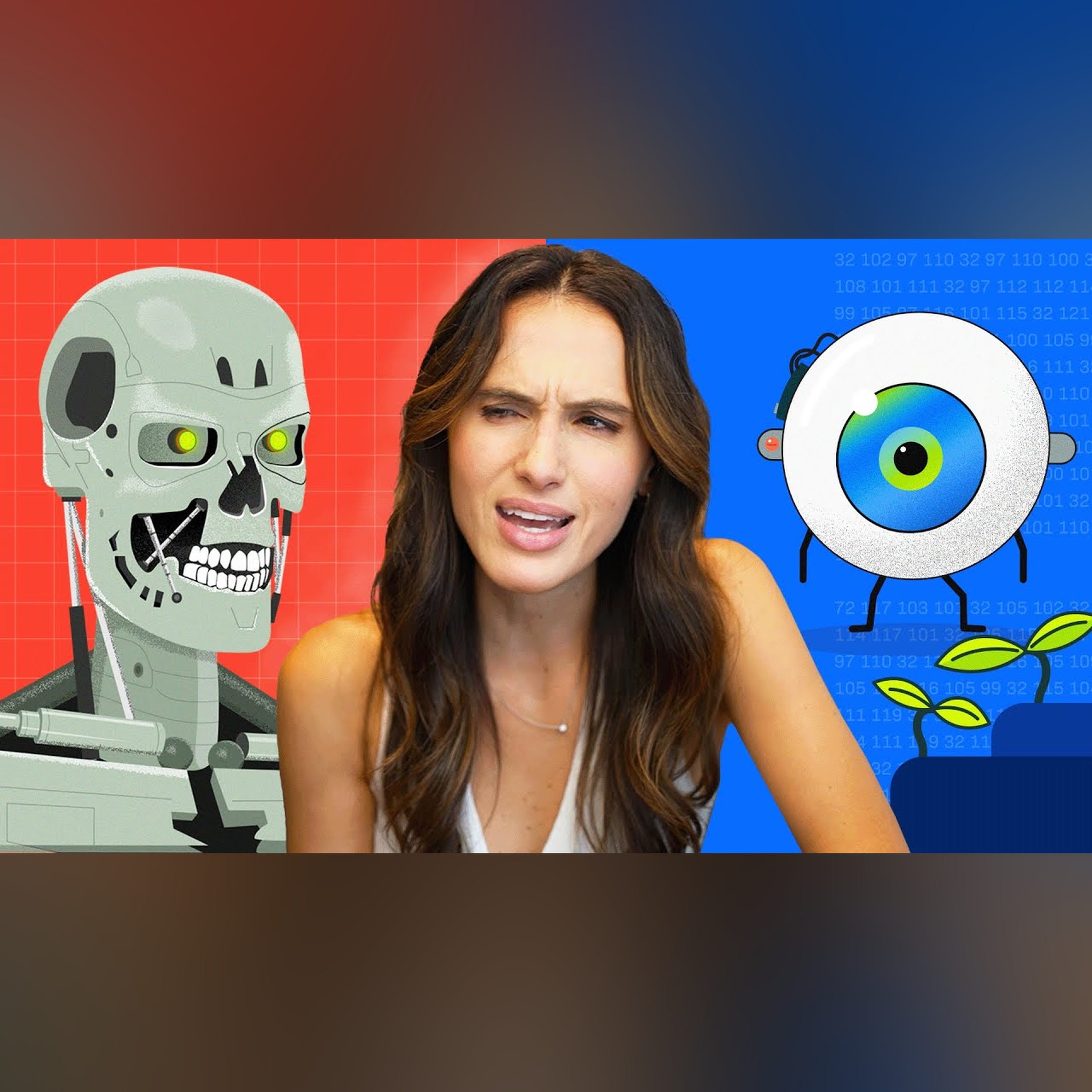
AI is here. Now what? Everyone’s talking about artificial intelligence and machine learning. There are lots of names thrown around - OpenAI’s ChatGPT and DALLE-2, Google’s Bard, Meta’s LLaMa 2, Midjourney, AlphaFold… Right now, we’re in this weird moment where lots of smart people agree we’re on the cusp of a truly world-changing technology. But some seem to be saying it's going to lead to human extinction while others are saying it’s “more profound than fire.” But it all feels so VAGUE. I want to know: How specifically would AI kill me? Or totally transform my life for the better? In this video, that’s what I’m going to try to learn. We dive into what the most extreme bad and good AI futures actually look like, so that you and I can get ready. And more importantly, so we can make sure that we get our real future RIGHT. Chapters: 00:00 Why is AI so confusing? 1:13 What is AI? 2:37 Why is everyone talking about AI now? 5:12 Why is AI dangerous? 6:22 How would AI kill me? 8:08 Should we
AI news from Anthropic's first day of trading, with Gemini Neon in Antigravity, Project Genie, Microsoft's MAI models, AI chips for China and Meta Muse. Anthropic priced its IPO at 83, opened near 111, and topped out above 114 before drifting back into the low 90s. Employees hold an estimated 232 billion dollars in stock, and Ashton Kutcher became a billionaire through his firm's early stake. Google stories included a hands-on account of Gemini Neon in Antigravity reviewing a whole project and then directing Claude Code as its product manager, a live Project Genie build of a South African safari, the Gemini Mac app's computer use, and Gemini for healthcare. Other topics were building an AI operations function from scratch at Verstela, gamified employee onboarding, Microsoft's Labs Canvas and MAI Code 2, House documents showing about 880,000 NVIDIA and AMD chips approved for export to China, and a Reuters report that Meta Muse surfaced private Signal messages through device permissions,
Save 20% with code 9to5daily. New episodes of 9to5Mac Daily are recorded every weekday. Stories discussed in this episode: iOS 27.3 adds Siri AI usage limits, here's what counts toward your limit (https://9to5mac.com/2026/11/18/ios-27-3-adds-siri-ai-usage-limits-heres-what-counts-toward-your-limit/) Apple releases HomeView 27.2.1 update, here's what's new (https://9to5mac.com/2026/11/18/apple-releases-new-homeview-27-2-1-software-update/) Apple announces Black Friday deals on iPhone, iPad, Mac, and more (https://9to5mac.com/2026/11/19/apple-announces-black-friday-deals-on-iphone-ipad-mac-and-more/) Apple's head of camera and Photos software has retired, per report (https://9to5mac.com/2026/11/19/apple-head-of-camera-software-retires/) Listen & Subscribe: Overcast (https://overcast.fm/itunes1331816080/9to5mac-daily) RSS (https://feedpress.me/9to5macdaily) Spotify (https://open.spotify.com/show/3f2JkoxiA3omC8YXpGwobv) TuneIn (https://tunein.com/radio/9to5Mac-Daily-p1089524/) Ad-free vers
In this 360° animation, explore the vibrant world of neon signs and learn the science of what makes them glow. Uploaded 19-09-19 -- When the Hoover Dam was completed, it created a huge source of hydroelectric power and zapped a sleepy desert town to life: Las Vegas, Nevada. With the power supply from the dam, Las Vegas soon exploded with vibrant displays. The source of these dazzling lights was electrified neon gas. In this special 360° animation, explore the colorful world of neon signs as Lippy shares what makes them glow. -- How to view this TED-Ed animated 360° video: If you have access to a Google Cardboard viewer and a smart phone: 1. Open this video in the YouTube app on your phone. 2. Hit pause on the video. 3. Tap the 3 vertical dots on the top right corner of the view window. This will slide up a sub-menu where you will choose the quality setting of your video stream. Choose "2160s." Note that if you are not streaming over Wifi, YouTube will only allow "720s" quality. 4. Tap
Project Synapse: Markets in Freefall, Fragile Infrastructure, and AI's Perfect Storm The hosts banter through the show's intro before focusing on a sense that "things are out of control," citing a WallStreetBets suicide-hotline post amid a market crash and discussing cascading system failures involving Microsoft, the FAA, and a reported NSA internal communications outage. They argue politicians and leadership lack technical competence and clear messaging, increasing panic, while emphasizing that many problems stem from aging, underfunded infrastructure and complex, brittle software (PHP, NGINX, Java), not proven AI attacks—more a "perfect storm" of crises. They debate whether AI should help fix complexity, stressing critical thinking, accountability, and using multiple AIs to verify each other. In a lightning round they cover Anthropic's IPO performance, mixed reactions and token limits with ChatGPT 6.2 (favoring "Sol" over "Astra"), Google's cheaper Neon model and confusing UX, Loblaw
Subtitle: A lot of ladders have a lot of stickers. John shares strong feelings about why Merlin should never, under any circumstances, attempt to get on his roof. This episode of Reconcilable Differences is sponsored by: Scribe (https://scribe.how/diffs): AI-powered workflow documentation. Links and Show Notes: John shares strong feelings about why Merlin should never, under any circumstances, attempt to get on his roof. Follow-up brings updates on inverter microwaves, t-glottalization, plus a brief consideration of clip art tattoos. This week's main topic addresses the titular jingling keys. By which John means connecting with a movie or tv show that seems just out of your reach—right up until it improbably becomes one of your favorites. What is that mix? In this month’s member bonus segment, John and Merlin fret about the future of Letterboxd.com and talk about what can still make social media feel special. You can sign up today (https://www.relay.fm/rd/join) to hear all the member e
Welcome to Pixelated episode 124. This week, Damien, Abner, and Will dive into the announcement of Motorola's flagship return in North America, the Signature 27. Is a $1,600 non-foldable the comeback everyone hoped for, or is this device doomed by rising component costs? Then, with Apple's HomeView smart display set to launch next week, the gang examines Google's lack of a modernized competitor and wonder what they'd want to see from a relaunch in 2027. Enjoy the show? You can listen to our weekly members-only Pixelated Pro bonus episode by signing up for 9to5Google Pro (https://9to5google.com/pro/) for just $5 per month, or about $1 per episode. Thanks to Proton Unlimited for sponsoring the podcast. YouTube Podcasts (https://www.youtube.com/playlist?list=PLcKP282Ii48tKK_KUt1kq1Ist9FkYR6lO) Pocket Casts (https://pca.st/podcast/ac8e6ce0-06b1-0136-c264-7d73a919276a) Spotify (https://open.spotify.com/show/7pMiADiw0KAEW9Tg9UAEnZ?dl_branch=1&si=y8-L9zobTTucmjDVvMJOoQ) Amazon Music (https://
Major project cost overruns should trigger a public review before more money is committed.
Share your view, then see how readers voted. No sign-in required. This poll is shared across stories.
Do you agree or disagree?
Common Quandary
A Common Quandary to discuss
Another conversation to explore, separate from this news story.
The restaurant forgot your expensive entrée. Do you point it out?
After a crowded dinner, you notice the restaurant omitted your most expensive entrée from the bill. Service was slow, the server seemed overwhelmed, and correcting it may create trouble for the person who made the mistake.
Does protecting someone from consequences ever justify benefiting from their error?