Guard against internet "filter bubbles" - Eli Pariser
12 min
Listen through the publisher, then discuss the episode here or arrange an in-person Roundtable. Your city determines where to meet.
Roundtables are designed for groups of four, with a shared subject and room for everyone to speak. Come for discussion, with no dating expectation.
View full lesson: http://ed.ted.com/lessons/beware-online-filter-bubbles-eli-pariser As web companies strive to tailor their services (including news and search results) to our personal tastes, there's a dangerous unintended consequence: We get trapped in a "filter bubble" and don't get exposed to information that could challenge or broaden our worldview. Eli Pariser argues powerfully that this will ultimately prove to be bad for us and bad for democracy. Talk by Eli Pariser.
Episode information is provided by the publisher. Listening takes place on the publisher’s service.
SUPPORT CRYPTO NEWS TODAY Trade cryptocurrency with Kraken (https://kraken.pxf.io/c/6563010/687155/10583) Protect your cryptocurrency with Ledger (https://shop.ledger.com/?r=59fe6e05c254) ️ Protect your online privacy with NordVPN (https://go.nordvpn.net/aff_c?aff_id=143753&offer_id=612&url_id=14830) Follow Crypto News Today on Spotify (https://open.spotify.com/show/4gu4MrqbGVZeNNNbAuvSmR) Visit Crypto News Today for the latest news and analysis (https://cryptonewstoday.io/) Could the artificial intelligence bubble trigger the next major cryptocurrency crash? In today's Daily Crypto Deep Dive, we investigate the increasingly dangerous relationship between artificial intelligence, Wall Street and Bitcoin. With concerns mounting over AI valuations, enormous infrastructure spending, rising borrowing costs and persistent inflation, could the technology sector drag the entire cryptocurrency market down with it? We examine the similarities between today's AI boom and the dot-com bubble, the
Yannik Schrade says privacy is the prerequisite for sovereign artificial intelligence, and that your AI provider is now your competitor. In this conversation with Andy and Rob, he argues that whoever controls the models and the compute will fight the real battle for self-sovereignty, and that those rules have to be enforced with cryptography rather than promises. He describes Arcium as an encrypted supercomputer, not a chain: inference stays encrypted, no single processor can read a prompt, and privacy no longer has to mean a worse product. He also looks ahead to a world where breakout applications only reach the mainstream if they are private by default. Yannik Schrade is co-founder and CEO of Arcium. Live from the financial capital of the world. Timestamps: 00:00 Intro 01:45 Protectors Can Become The Threat 05:13 Your AI Provider Is Your Competitor 07:20 No Single Machine Reads Your Prompt 09:39 The Internet Is Being Rebuilt Encrypted 11:56 An Encrypted Supercomputer Not A Blockchain
Special committees consisting of directors from Tesla and SpaceX are currently negotiating the terms for a massive all-stock megamerger that would combine the two enterprises into a $3.5 trillion corporate giant. Prominent financial institutions like Morgan Stanley, Goldman Sachs, and Evercore have been enlisted to advise the separate committees as they race to finalize an agreement before the end of the year. While the strategic alignment offers tremendous scale, the proposed transaction introduces significant complexities, including heightened execution risks, massive capital requirements, and increased regulatory oversight. Ultimately, the deal will require approval from a majority of Tesla shareholders, leaving independent directors with the heavy responsibility of protecting stakeholder interests against potential legal scrutiny and conflicts.
Brad is once again joined by Ana Reinert, of The Well-Appointed Desk, for our annual gift guide episode. We had a plan to keep all of our picks under $50 this year, did we deliver? This episode of The Pen Addict is sponsored by: Enigma Stationery (https://enigmastationery.com/penaddict): Unique items, top brands and hard-to-find imports. Get $10 off. Guest Starring: Ana Reinert (http://www.relay.fm/people/Anareinert) Links and Show Notes: Support The Pen Addict with a Relay Membership (https://relayfm.memberful.com/checkout?plan=9664) Submit Feedback (https://relay.fm/penaddict/feedback) The Well-Appointed Desk (https://www.wellappointeddesk.com/) The Well-Appointed Desk Shop (https://wellappointeddesk.bigcartel.com/) The Well-Appointed Desk on Patreon (https://patreon.com/wellappointeddesk) uniball One 3-color Multi pen (https://www.jetpens.com/Uni-ball-One-3-Color-Multi-Pens/ct/8329) Pilot Juice Up Classic Glossy 6-color set (https://www.jetpens.com/Pilot-Juice-Up-Gel-Pen-0.4-mm-Clas
Where is the economy is today – is it growing? Flat? Declining? Uploaded 15-10-19 What about YOUR economy – your personal investments, your nest egg? How safe is it, and how likely it is to grow at the rate you want it to? When you think about your current investments, how do you feel? Secure, or are you half-panicked? For many, the recession of 2008 still lingers. Those who suffered are waiting, white-knuckled, holding on to their portfolios and still wondering what to do next. We have, after all, been in one of the longest bull markets in history and bull markets always come to an end at some point. So how do you protect yourself from the possibility of another 2008? And how can you start to take a more proactive, confident approach to your portfolio? When Tony wrote Money Master the Game, he had the unique privilege of sitting down with some of the most successful, masterful investors and financial gurus of all time – including the legendary Ray Dalio. Ray founded the investment man
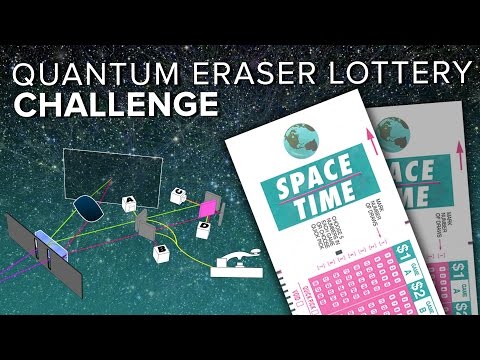
Matt challenges you to use quantum physics to win the lottery. Are you up to the task? Uploaded 17-08-16 Previous Episode on Quantum Eraser https://www.youtube.com/watch?v=8ORLN_KwAgs Get your own Space Time tshirt at http://bit.ly/1QlzoBi Tweet at us! @pbsspacetime Facebook: facebook.com/pbsspacetime Email us! pbsspacetime [at] gmail [dot] com Comment on Reddit: http://www.reddit.com/r/pbsspacetime Support us on Patreon! http://www.patreon.com/pbsspacetime Help translate our videos! http://www.youtube.com/timedtext_cs_panel?tab=2&c=UC7_gcs09iThXybpVgjHZ_7g (http://www.youtube.com/timedtext_cs_panel?c=UC7_gcs09iThXybpVgjHZ_7g&tab=2) The Quantum Eraser experiment seems to show that information can travel backwards in time. On today’s episode of Space Time, we are going to create a time-traveling communication device and use it to cheat on the lottery! Here's Your Challenge question: Why am I going to be sadly disappointed after turning on my invention? I do get a signal – nice work fut
Dig into the slippery slope fallacy, which assumes that one step will lead to a series of events that lead to an extreme— often bad— scenario. Uploaded 19-08-21 -- It’s 1954. Vietnamese nationalists are on the verge of securing an independent Vietnam under communist leader Ho Chi Minh. U.S. President Eisenhower claims that by virtue of the "falling domino principle," communist control of Vietnam would lead to the global spread of authoritarian communist regimes. Can you spot the problem with this argument? Elizabeth Cox explores the slippery slope fallacy. Lesson by Elizabeth Cox, directed by TOGETHER. Support Our Non-Profit Mission ---------------------------------------------- Support us on Patreon: http://bit.ly/TEDEdPatreon Check out our merch: http://bit.ly/TEDEDShop ---------------------------------------------- Connect With Us ---------------------------------------------- Sign up for our newsletter: http://bit.ly/TEDEdNewsletter Find us on Twitter: http://bit.ly/TEDEdTwitter Pe
View full lesson: http://ed.ted.com/lessons/how-do-we-measure-distances-in-space-yuan-sen-ting Uploaded 09-10-14 When we look at the sky, we have a flat, two-dimensional view. So how do astronomers figure the distances of stars and galaxies from Earth? Yuan-Sen Ting shows us how trigonometric parallaxes, standard candles and more help us determine the distance of objects several billion light years away from Earth. Lesson by Yuan-Sen Ting, animation by TED-Ed.
As machines take on more jobs, many find themselves out of work or with raises indefinitely postponed. Is this the end of growth? No, says Erik Brynjolfsson -- it's simply the growing pains of a radically reorganized economy. A riveting case for why big innovations are ahead of us ... if we think of computers as our teammates. Be sure to watch the opposing viewpoint from Robert Gordon. Uploaded 30-08-13 Talk by Erik Brynjolfsson.
Reporting on court cases should protect personal privacy when details add little public value.
Share your view, then see how readers voted. No sign-in required. This poll is shared across stories.
Do you agree or disagree?
Common Quandary
A Common Quandary to discuss
Another conversation to explore, separate from this news story.
Scientists can edit mosquitoes until a deadly disease disappears. Who gets to say yes?
Scientists can potentially release modified mosquitoes whose genes would spread through wild populations and sharply reduce a deadly disease. The ecological effects could cross borders and may be impossible to reverse.
Who may authorize an irreversible change intended to save lives?