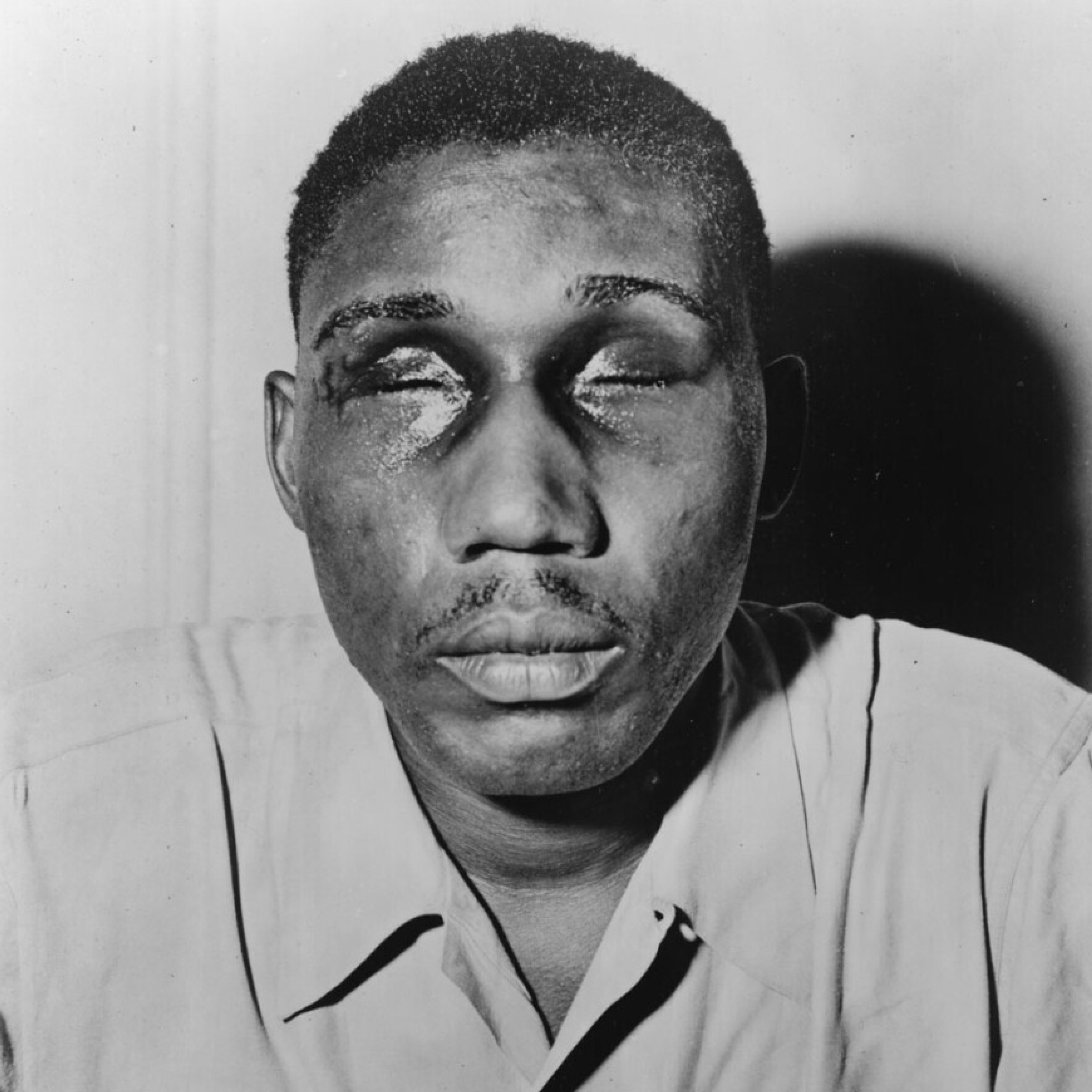
How a Soldier’s Beating Helped Desegregate the Military
51 min
Listen through the publisher, then discuss the episode here or arrange an in-person Roundtable. Your city determines where to meet.
Roundtables are designed for groups of four, with a shared subject and room for everyone to speak. Come for discussion, with no dating expectation.
In 1946, a Black Army veteran was returning from World War II when a white police officer pulled him off a Greyhound bus and beat him blind. The details were fuzzy. No one was sure about the identity of the police officer. The veteran, Isaac Woodard, didn’t even know what town he was in when it happened. Radio host Orson Welles learned about the shocking crime and pledged to find the officer who did it. “We’ll call the policeman ‘Officer X,’” Welles said on his Sunday evening program. “He might be listening to this; I hope so. Officer X, I’m talking to you. Wash your hands. Scrub and scour, you won’t blot out the blood of a blinded war veteran.” This week on Reveal, the podcast Radio Diaries (https://www.radiodiaries.org/) brings us Woodard’s story, from his beating to the outrage that prompted the military’s desegregation. And to understand the experience of a Black servicemember today, we speak with Kyle Bibby, a Marine Corps veteran and co-founder of the Black Veterans Project. Support Reveal’s journalism atRevealnews.org/donatenow (https://checkout.fundjournalism.org/memberform?amount=15&campaign=7015d000001wAmaAAE&installmentPeriod=monthly&org_id=cir) Connect with us onBluesky (https://bsky.app/profile/revealnews.org),Facebook (https://www.facebook.com/ThisIsReveal) andInstagram (https://www.instagram.com/revealnews/)
Episode information is provided by the publisher. Listening takes place on the publisher’s service.
Jensen Huang stepped down as Nvidia CEO on November 12, 2026, after reports about an extramarital relationship with Alice Huang, a former senior executive at Megaspeed. U.S. intelligence reportedly viewed her as an asset working for Beijing. That allegation is not a conviction, and it is not the same thing as proof Nvidia secrets changed hands. Tony Brueski brings in retired FBI Special Agent Robin Dreeke, former leader of the bureau’s Counterintelligence Behavioral Analysis Program, for the question behind the headlines: how does somebody who helped build one of the world’s most important technology companies fail to recognize a possible intelligence threat in his personal life? Huang apologized to his family and Nvidia employees for infidelity. The board announced an outside investigation, while saying it knew of no reason to believe national security or proprietary information was compromised. Reuters subsequently reported that Huang had previously told Nvidia leaders his encounters
November 21, 2026 On November 22, 1963, President John F. Kennedy and First Lady Jacqueline Kennedy were visiting Texas, They hoped to heal a rift in the Democratic Party, as the white supremacists who made up the base of the party’s southern wing loathed the Kennedy administration for its support for Black rights, That base was furious about the administration’s backing of James Meredith, the first Black American to enroll at the University of Mississippi, By going to Dallas, Kennedy hoped to mend some fences in the state Democratic Party, The President's motorcade began with high spirits, Lady Bird Johnson thought, when she heard three shots, that it “must be firecrackers or some sort of celebration,” The Secret Service, knowing what had happened, rushed the motorcade to a hospital, When Vice President Johnson and Lady Bird were told that the President was dead, officials rushed LBJ away, In the confusion - in addition to the murder, it wasn't clear how extensive the plot was against
Hey everybody, Tom Bilyeu here. On today’s episode of Impact Theory, we’re taking on a topic that’s got the whole world holding its breath: the escalating crisis between the United States and Iran. As tensions ratchet up, we’re asking the tough questions—how did we get stuck in this “escalation trap,” and what does it mean for America’s global leverage, our economy, and our very sense of security? The conversation focused on why the traditional idea of “strategy” might be failing policymakers, using powerful analogies—like chess versus roulette—to show how doubling down in conflict can spiral out of control. We’ll break down the risks of tactical “wins” that create even bigger crises, the real leverage Iran holds with control of the Strait of Hormuz, and the mounting pressure on President Trump as political support erodes and legacy hangs in the balance. A key theme that emerged is what happens when military might runs into decentralized opposition, and why high-stakes gambles—like the
MeidasTouch host Ben Meiselas and Professor Justin Wolfers, MeidasTouch’s chief economist and founder of Platypus Economics, break down how Donald Trump’s policies helped drive the stock market plunge and why the sell-off could be the beginning of a much deeper economic crisis. Visit https://meidasplus.com (https://meidasplus.com/) for more! Remember to subscribe to ALL the MeidasTouch Network Podcasts: https://meidasnews.com/podcast Support the MeidasTouch Network: https://patreon.com/meidastouch (https://patreon.com/meidastouchAdd) Add the MeidasTouch Podcast: https://podcasts.apple.com/us/podcast/the-meidastouch-podcast/id1510240831Buy MeidasTouch Merch: https://store.meidastouch.com (https://store.meidastouch.com/) Follow MeidasTouch on Twitter: https://twitter.com/meidastouchFollow MeidasTouch on Facebook: https://facebook.com/meidastouchFollow MeidasTouch on Instagram: https://instagram.com/meidastouchFollow MeidasTouch on TikTok: https://tiktok.com/@meidastouch
This week on The Necessary Conversation, it's Chad, Haley, and Mary Lou. Bob is still recovering but sent in a video message about Trump calling Putin his friend that we watch together. 🇷🇺 Trump held the first-ever three-way talks with Putin and Xi, called it a "12 out of 10," and produced nothing. Then at a press conference he called Putin his friend — and when asked if Putin is a friend to America, the president of the United States said, "I can't speak to America." That same day, Trump's friend Putin launched massive strikes into Ukraine, hit Poland with two missiles — an act of war against a NATO ally — then struck near a Ukrainian restaurant and drone-bombed the first responders, killing a 7-year-old child and a 20-year-old paramedic. We watch Bob's video and ask Mary Lou: is Russia our friend? 🇨🇳 The House Foreign Affairs Committee revealed Trump's Commerce Department approved nearly 880,000 advanced AI chips for Chinese military-linked companies including Alibaba, Tencent, a
Many homeschooling families once kept their kids out of sight during school hours. Today about 6% of households with school-age children homeschool, and they come from varying backgrounds. WORLD’s Lindsay Mast talks with historian Dixie Dillon Lane, author of Skipping School: The History of American Homeschooling and How It Went Mainstream, about how it happened and what factors could still threaten that freedom. ---------------------------- Days before he was arrested by the Romanian secret police, Pastor Richard Wurmbrand read that the Bible included 366 passages to help Christians overcome fear—one for every day of the year, including leap year. This idea inspired Wurmbrand’s faith and helped him stand strong for Christ in the face of opposition, imprisonment, and torture. Whom Shall I Fear? is a 366-day devotional including stories of persecuted Christians that will inspire believers to overcome anxiety, doubt, and fear. More information on this special offer is available at vom.or
When a new healthcare company took over a struggling hospital in Waukegan, Illinois, residents hoped it would finally revitalize the facility. Vista Medical Center East had already been bought and sold four times—but maybe this time would be different. The new owner was American Healthcare Systems, a for-profit company pitching itself as a turnaround specialist for distressed hospitals. Rick Harris, a local pastor and businessman on the hospital’s board, had never heard of it. And his research turned up a troubling example of its work: A year before, AHS took over a struggling hospital in St. Louis. When financial troubles there got worse instead of better, AHS closed it in less than a year. “I’m just thinking to myself, if I’ve got good intentions, if I can’t pay for this hospital, if I owe all of this money…then where am I getting the money to buy Vista?” he said. Soon, AHS was stiffing vendors, not paying doctors, and leaving millions in taxes unpaid. It asked the state of Illinois
More To The Story: This week, Anthropic goes public. Many estimates put the AI company’s valuation at more than $1 trillion, which would make it one of the biggest initial public offerings in history. But Anthropic’s IPO also comes at a time when there are real concerns that the AI boom is a massive bubble—one that could take down the stock market and the economy with it. Science and tech journalist Jacob Ward has been reporting on the AI industry through a critical lens for years, even warning of AI’s red flags months before the launch of ChatGPT. But today, he says one of the things he didn’t fully grasp was the zealotry he now sees from AI’s top leaders. On this week’s More To The Story, Ward talks with host Al Letson about how China is the true wild card in the AI race, what keeps him up at night about the direction of artificial intelligence, and whether Anthropic’s massive spending spree is truly sustainable. Producer: Josh Sanburn | Editor: Kara McGuirk-Allison | Theme music: Fe
Every week, a group of men in their late 60s meets at the Corner Cafe in Elizabethtown, North Carolina. One important reason for these meetups is to discuss what’s going on in their community. Local news has virtually dried up in their rural county, as well as neighboring counties, and some residents say they’re being left in the dark and don’t feel equipped to make informed decisions. “I’m not gonna vote if I can’t get the information,” says Penny Abernathy. Like in much of the country, roughly two-thirds of North Carolina’s counties are considered news deserts. And the lack of local journalism isn’t just making it harder for people to stay informed; it’s exacerbating a crisis of trust in the news media. This week on Reveal, we partner with the podcast Scene on Radio (https://podcasts.apple.com/us/podcast/scene-on-radio/id1036276968) and hosts John Biewen and Chenjerai Kumanyika to understand how American journalism got here and what can be done to repair the cracked foundation of the
Patients should be told clearly when treatment benefits are modest or uncertain.
Share your view, then see how readers voted. No sign-in required. This poll is shared across stories.
Do you agree or disagree?
Common Quandary
A Common Quandary to discuss
Another conversation to explore, separate from this news story.
You paid extra for the aisle seat. Must you trade with a parent?
You reserved and paid extra for an aisle seat on a long flight. A parent asks you to trade for a middle seat so they can sit beside their young child after the airline separated them.
When does another person's predicament become your responsibility?