Listen through the publisher, then discuss the episode here or arrange an in-person Roundtable. Your city determines where to meet.
Roundtables are designed for groups of four, with a shared subject and room for everyone to speak. Come for discussion, with no dating expectation.
PBS Member Stations rely on viewers like you. To support your local station, go to: http://to.pbs.org/DonateSPACE ↓ More info below ↓ Uploaded 24-02-20 Sign Up on Patreon to get access to the Space Time Discord! Sign up for the mailing list to get episode notifications and hear special announcements! Check out the Space Time Merch Store Why is it that we can see these multiple histories play out on the quantum scale, and why do lose sight of them on our macroscopic scale? Many physicists believe that the answer lies in a process known as quantum decoherence. Hosted by Matt O'Dowd Written by Matt O'Dowd Graphics by Leonardo Scholzer, Yago Ballarini, and Pedro Osinski Directed by: Andrew Kornhaber Executive Producers: Eric Brown and Andrew Kornhaber End Credits Music by J.R.S. Schattenberg: https://www.youtube.com/channel/UCRl6-nb4iOnsij-vnpAjp0Q Does conscious observation of a quantum system cause the wavefunction to collapse? The upshot is that more and more physicists think that consciousness - and even measurement - doesn’t directly cause wavefunction collapse. In fact probably there IS no clear Heisenberg cut. The collapse itself may be an illusion, and the alternate histories that the wavefunction represents may continue forever. The question then becomes: why is it that we can see these multiple histories play out on the quantum scale, and why do lose sight of them on our macroscopic scale? Many physicists believe that the answer lies in a process known as quantum decoherence. Thanks to our Patreon Supporters! Big Bang Supporters Alexander Tamas David Barnholdt David Nicklas Fabrice Eap Juan Benet Morgan Hough Quasar Supporters Christina Oegren Mark Heising Vinnie Falco Hypernova Supporter Chuck Zegar Danton Spivey Donal Botkin Edmund Fokschaner Hank S John Hofmann John Pollock John R. Slavik Jordan Young Joseph Salomone Julian Tyacke Justin Ash Mathew Matthew O'Connor Syed Ansar Timothy McCulloch Gamma Ray Burst Supporters A G Adrian Hatch Adrien Molyneux AlecZero Andreas Nautsch Angela Prigge Bradley Jenkins Brandon labonte Brian Blanchard Craig Stonaha Dan Warren Daniel Lyons David Bethala DFaulk Douglas Cantrell Eric Kiebler Frederic Simon Geoffrey Short Graydon Goss Greg Smith John Funai John Robinson Jonathan Nesfeder Josh Thomas Justin Waters Kevin Lee Kevin Warne Kyle Hofer Malte Ubl Michael Conroy Nick Virtue Nick Wright Nickolas Andrew Freeman Patrick Sutton Paul Rose Protius Protius Robert Ilardi Scott Gossett Sean Warniaha Shane Calimlim Sipke Schoorstra Steve Bradshaw Tatiana Vorovchenko Tim Stephani Tonyface Tybie Fitzhugh Yurii Konovaliuk Randall Sylvia #space #quantummechanics #astrophysics
Episode information is provided by the publisher. Listening takes place on the publisher’s service.
Discover how scientists developed atomic clocks, which use the vibrations of atoms to measure and maintain a globally consistent time. Uploaded 19-01-21 -- In 1967, researchers gathered to answer a long-running scientific question: just how long is a second? It might seem obvious at first. A second is the tick of a clock, the swing of a pendulum, the time it takes to count to one. But how precise are those measurements? And what is that length based on? John Kitching digs into how we scientifically define this fundamental unit of time. Lesson by John Kitching, directed by Tjoff Koong. Support Our Non-Profit Mission ---------------------------------------------- Support us on Patreon: http://bit.ly/TEDEdPatreon Check out our merch: http://bit.ly/TEDEDShop ---------------------------------------------- Connect With Us ---------------------------------------------- Sign up for our newsletter: http://bit.ly/TEDEdNewsletter Find us on Twitter: http://bit.ly/TEDEdTwitter Peep us on Instagram
Access the masterclass instantly for free: https://nci.university/learn Uploaded 10-01-26 Your goals don’t fail because you lack discipline — they fail because they were aimed at the wrong system. Optimizing behavior without fixing brain chemistry is like issuing commands to a damaged machine. Until the chemical environment is right, effort just increases friction and burnout. All goals live in the conscious mind — but control does not. Real behavior is governed by the mammalian brain, the ancient systems that decide safety, threat, and energy allocation. Every resolution collapses when those lower systems detect risk, even if you consciously “want” the outcome. Goal-setting ignores this hierarchy — and that’s why it keeps failing. Once you target the parts of the brain actually in charge, change stops feeling like force. Discipline becomes unnecessary when the system itself is aligned. Please note that the content provided in this broadcast is for informational and educational purpose
Read the “Refuse The Easy Life” Action Guide here: [https://jimrohnfans.com/refuse-the-easy-life/](https://jimrohnfans.com/refuse-the-easy-life/) Uploaded 22-02-26 This Action Guide turns the ideas from this video into a simple, repeatable system you can use daily—so you don’t just feel motivated, you actually change what you do. What you’ll get from the Action Guide A clear way to spot the “small deals” comfort keeps offering you A standards check that helps you stop negotiating with yourself A daily structure for choosing what’s necessary over what’s convenient A practical method to separate planned rest (recovery) from comfort (escape) How to use it with this video Watch the video once for the message Rewatch and pause when a line hits you—then write the exact “small compromise” it exposes Use the guide to set a rule for that area (a standard you enforce, not a goal you hope for) Track the next 7 days of choices so effort becomes your default instead of convenience In this video, yo
In this video, Disability Attorney Walter Hnot of the Disability Resolution Law Firm goes over EM 24059 and how it will change your access to social security benefit communications. Americas Most Viewed Disability Attorney Like the content? Review us here: https://g.page/r/CcwyektC7nCPEAg/review . If the link does not work, Google: Disability Resolution, P.A. Welcome to the largest Social Security Disability Tutorial Video Library On Earth. PRIVATE ONE HOUR SESSION PHONE CALL THIS IS HOW YOU CAN GIVE BACK TO HELP GROW THE CAUSE: Option 1: Leave 5 |==================5 STAR REVIEWS==================| Google (Search Disability Resolution Orlando, FL)- https://www.google.com/search?authuse... (https://www.google.com/search?authuse...=) AVVO (Search Walter Hnot) - https://www.avvo.com/attorneys/32817-... BBB (Search Disability Resolution Orlando, FL)- https://www.bbb.org/us/fl/orlando/pro... MARTINDALE (Search Walter Hnot Orlando, FL) - https://www.martindale.com/attorney/w... Option 2: Don
Explore how the Hubble Space Telescope reveals the Universe, from iconic images to major discoveries, and how it complements the James Webb Space Telescope. "ASTROMAN: the Dark Sky Guardian" is a podcast channel that aims to explore popular science in multiple disciplines and research on interdisciplinary approaches, such as sustainability, dark-sky protection, astrophotography, space exploration, astronomy innovation, inclusive science communication, and STEAM Education by integrating science and arts. Exodus Chun-Long Sit, also known as the ASTROMAN, is a transmedia astronomy educator, popular science author, STEAM educator, and science communicator in Hong Kong. He is recently the National Astronomy Education Coordinator (Chair of Hong Kong, China) of the International Astronomical Union and President of Starrix. He was also an International Committee Member of the Dark Sky International, regularly organizing public lectures at the Hong Kong Space Museum and the Hong Kong Science Mu
Conscious parenting doesn't begin with our children, it begins with us. In this heartfelt conversation, Sage Robbins and Mary B. sit down with Tony Robbins to explore what conscious parenting truly looks like: parenting ourselves first, claiming responsibility (not blame), and bringing our most present, connected selves to the table. Uploaded 16-09-26 At its heart, conscious parenting is a shift from a fear-based model to an awareness-based one. Instead of "be careful," we learn to say "be mindful." Instead of reacting, we pause and notice. Because children don't do what we say, they do what we are. Our state becomes their first imprint, and in so many ways, our children become our greatest mirrors and teachers. Watch more videos like this The #1 Secret to Helping ANY Child Self Regulate Their Emotions: https://youtu.be/PwrCX73x9LI Why Your 'Busy' Mind Is Actually Lying to You: https://youtu.be/yq8DFwlEpyg The One Question That Changed My Marriage: “How Am I Being?”: https://youtu.be/3
Viewers like you help make PBS (Thank you ) . Support your local PBS Member Station here: https://to.pbs.org/DonateSPACE Uploaded 26-07-17 Unlock the secrets of Feynman Diagrams. Part 5 in our Quantum Field Theory series. And if you're submitting an answer to our challenge question email your answer by August 2nd to pbsspacetime [AT] gmail.com with the subject line "Feynman Diagram Challenge." You can further support us on Patreon at https://www.patreon.com/pbsspacetime Get your own Space Time tshirt at http://bit.ly/1QlzoBi Tweet at us! @pbsspacetime Facebook: facebook.com/pbsspacetime Email us! pbsspacetime [at] gmail [dot] com Comment on Reddit: http://www.reddit.com/r/pbsspacetime Help translate our videos! https://www.youtube.com/timedtext_cs_... Previous Episode: The Real Star Wars Feynman’s path integral shows us that, to properly calculate the probability of a particle traveling from point A to point B, we need to add up the contributions from all conceivable paths between tho
Sign Up on Patreon to get access to the Space Time Discord! Uploaded 18-08-21 The universe is going to end. But of all the possible ends of the universe vacuum decay would have to be the most thorough - because it could totally rewrite the laws of physics. Today I hope to help you understand exactly how terrified you should be. Check out the Space Time Merch Store Sign up for the mailing list to get episode notifications and hear special announcements! Hosted by Matt O'Dowd Written by Matt O'Dowd Graphics by Leonardo Scholzer, Yago Ballarini, Pedro Osinski, Adriano Leal and Stephanie Faria GFX Visualizations: Ajay Manuel Directed by Andrew Kornhaber Assistant Producer: Setare Gholipour Executive Producers: Eric Brown and Andrew Kornhaber End Credits Music by J.R.S. Schattenberg: https://www.youtube.com/user/MultiDroideka Special thanks to Our Patreon Sponsors Big Bang Supporters Ari Paul Kyle Bulloch Charlie Mrs. Tiffany Poindexter Leo Koguan Sandy Wu Matthew Miller Scott Gray Ahmad Jo
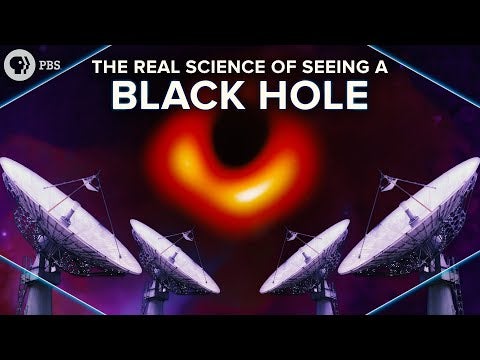
You can learn more about CuriosityStream at https://curiositystream.com/spacetime Uploaded 01-05-19 PBS Member Stations rely on viewers like you. To support your local station, go to: http://to.pbs.org/DonateSPACE How do you take a picture of a black hole and what can we learn from it? Our first ever actual bona fide photo of a black hole, made by the Event Horizon Telescope and revealed to the world in a press conference on April 10th. Since then it’s got plenty of coverage, because … I mean look at it. It’s a freaking black hole. It’s black, it’s holey, it’s everything we hoped it would be. Now that the giddiness has subsided and I personally have stopped spending hours on end staring at a black spot, we can take a breath and actually look at the real science here and discuss exactly how a picture like this could be taken and what we can learn from it. Check out the new Space Time Merch Store! Support Space Time on Patreon Need a Black Hole Refresher #Blackhole #astrophysics #spaceti
Representatives should revise campaign promises when strong new evidence shows a better course.
Share your view, then see how readers voted. No sign-in required. This poll is shared across stories.
Do you agree or disagree?
Common Quandary
A Common Quandary to discuss
Another conversation to explore, separate from this news story.
A private joke from years ago goes public. How long should it follow the person who wrote it?
Someone shares a screenshot of a tasteless joke made years ago in a private friends' chat. The person who wrote it says they were performing for a small audience, have changed, and never agreed to have the message made public.
How private should speech remain when it reveals something troubling?