Listen through the publisher, then discuss the episode here or arrange an in-person Roundtable. Your city determines where to meet.
Roundtables are designed for groups of four, with a shared subject and room for everyone to speak. Come for discussion, with no dating expectation.
PBS Member Stations rely on viewers like you. To support your local station, go to: http://to.pbs.org/DonateSPACE ↓ More info below ↓ Uploaded 30-09-19 Sign Up on Patreon to get access to the Space Time Discord! Check out the Space Time Merch Store The universe is big, but it’s peanuts compared to the eternally inflating multiverse. But just how many universes are there? What are they like? And most importantly, what can they tell us about … aliens? Challenge Answer Winners Steven Mertens David DeLaney Chris Lotery Eneko Fabien Sangouard Ian Bonnell *Please email your selection from the Space Time Merch Store along with your address to [email protected] with the subject line “Challenge Question Winner” Hosted by Matt O'Dowd Written by Matt O'Dowd Graphics by Leonardo Scholzer Directed by: Andrew Kornhaber Executive Producers: Eric Brown and Andrew Kornhaber End Credits Music by J.R.S. Schattenberg: https://www.youtube.com/channel/UCRl6-nb4iOnsij-vnpAjp0Q Imagine it: the observable part of our universe is 93 billion light years across, and that’s just a small fraction of the stuff created in our Big Bang. But in the eternal inflation picture, ours is just one among uncountable bubble universes. Bubbles that are continuously appearing and growing within a vastly larger spacetime that itself expands at an exponentially accelerating rate. A greater inflationary spacetime whose expansion never ends. We looked at the bizarre idea of eternal inflation in recent episodes – but we stopped short of exploring the full implications of this proposition. Those implications are, frankly, completely nuts. Some may also be true. Big Bang Supporters: Alexander Tamas Anton Lifshits David Barnholdt David Boyer David Nicklas Fabrice Eap Juan Benet Justin Lloyd Matt Miller Morgan Hough Quasar Supporters: Mark Heising Mark Rosenthal Vinnie Falco Hypernova Supporters: Chuck Zegar Danton Spivey Donal Botkin Edmund Fokschaner Hank S Joe Pearce John Hofmann John R. Slavik Jordan Young Joseph Salomone Matthew Matthew O'Connor Syed Ansar Gamma Ray Burst Supporters: A.G. Adrian Molyneux Alec Zero Andreas Nautsch Bradley Jenkins Brandon Labonte Brian Dan Warren Daniel Lyons David Behtala DFaulk Dustan Jones Geoffrey Short Greg Smith James Flowers James Quintero John Funai John Michael Kerr John Pollock John Robinson Jonathan Nesfeder Joseph Dillman Josh Thomas Kevin Lee Kevin Warne Kyle Hofer Malte Ubl Mark Vasile Nick Virtue Nick Wright Paul Rose Scott Gossett Sean Warniaha Steve Bradshaw Tim Stephani Tonyface Yurii Konovaliuk
Episode information is provided by the publisher. Listening takes place on the publisher’s service.
Dive into the Greek myth of Helios and Phaethon, where the Sun God allows his mortal son to drive his chariot for a day. Uploaded 18-01-22 -- Every morning, Helios unleashed his golden chariot, and set out across the sky. As the Sun God transformed dawn into day, he thought of his son, Phaethon, below. To prove to Phaethon that he was truly his father, Helios decided to grant him anything he wanted. Unfortunately, what Phaethon wanted was to drive Helios’ chariot for a day. Iseult Gillespie shares the tragic myth of the charioteer. Lesson by Iseult Gillespie, directed by Raghav Arumugam and Jagriti Khirwar. Support Our Non-Profit Mission ---------------------------------------------- Support us on Patreon: http://bit.ly/TEDEdPatreon Check out our merch: http://bit.ly/TEDEDShop ---------------------------------------------- Connect With Us ---------------------------------------------- Sign up for our newsletter: http://bit.ly/TEDEdNewsletter Find us on Twitter: http://bit.ly/TEDEdTwitt
To check the transcript: https://www.buzzsprout.com/2379282 Imagine someone who has lived abroad for many years. One evening, they're talking to a friend about their hometown. They mention the streets they used to walk down, the familiar voices, and the little things they never thought they'd miss. Their friend asks: “Why do you get so emotional whenever you talk about your hometown? Do you want to move back?” They reply: “It's not that simple. It goes deeper than that. I miss a version of my life that doesn't exist there anymore.” Hello everyone, and welcome to Daily English. Today's expression is “It goes deeper than that.” We use this expression when something is more complicated, meaningful, or emotionally significant than it first appears. In other words, there's something beneath the surface that people might not immediately recognize. In our opening example, the person isn't necessarily longing to return to their hometown. What they miss might be their childhood, the people they
Obsessions, Addictions, and Compulsions | The Dangers of Your Smartphone Addiction | Tony Robbins Podcast Uploaded 30-05-19 Did you know that the average American checks email within 6 seconds of arriving at work? Or that 75% of adults say they spend the entire day within an arm’s reach of their phones? Whether we want to admit it or not, the smartphone has become a critical extension of our lives. And it’s easy to understand why. Smartphone technology allows us a number of communication options including voice calls, text messages, video chat and instant messenger. We have immediate access to the information and are constantly connected to the web. And with the advancement of mobile technology, we can do our banking, shop online, check movie times, check our heart rates, edit photos, publish blog posts – anytime, anywhere. But what is this convenience really costing us? In this episode of the Tony Robbins Podcast, we’re talking with renowned social psychologist, Adam Alter. Adam is an
In Brought to You By: How Corporations Warped the Truth, Conned the Public, and Broke Democracy (https://bookshop.org/a/12343/9781639736331), Amy Westervelt exposes the plot hidden within the familiar story of science denial. Over the last century, Big Industry has built a vast apparatus of think tanks, lobbyists, sponsored university labs, and obliging news networks to con the public and fool decision-makers, poisoning the informational ecosystem and warping the nature of truth along the way. With her signature wit and incisiveness, Westervelt introduces the masterminds of corporate misinformation: Herb Schmertz, the public relations pioneer who made Mobil “the thinking man's oil company;” Richard Edelman, the PR guy who helped the dairy industry vilify oat milk; David Petraeus, the disgraced spy chief using counter-insurgency tactics to discredit climate science; and many more. She shows how these company men have worked to usher in an era of unprecedented corporate control. Only by
Your car is a computer on wheels, and someone across the country could hack its brakes. Check out the full episode: https://lewishowes.com/legacy/marc-goodman/ Marc Goodman, author of Future Crimes and a teacher at Singularity University, told Lewis that cybersecurity is now everyone's problem, because there has never been a computer system that couldn't be hacked. A Samsung TV can listen to everything you say in your bedroom. Tens of thousands of conference room video systems have been hacked, so a spy no longer needs to hide a bug under the table. Then Marc told the story of Cassidy Wolf, Miss Teen America, who opened an email that said “I've seen you naked.” A classmate had bought spyware online and was secretly running her webcam. She went to the FBI, and he went to prison for years. A Post-it Note over your webcam does the job. Marc: “just 'cause you don't see the light doesn't mean the camera's not on. Hosted by Simplecast, an AdsWizz company.
I know it sounds like an exaggeration. It sounds like the kind of thing a man says to sound wise. But I have tested it against the lives of people who succeeded and people who struggled, and the pattern is so consistent it stopped surprising me a long time ago. Uploaded 23-08-26 The ones who built something lasting almost all had a grip on their mornings. They owned the first hour. They did not let the day happen to them. They happened to the day. And the ones who felt forever behind had lost their mornings without ever noticing they had lost them. A morning does not announce its importance. It slips by so quietly that most people never stop to ask what happened to it. And what slips away with it is the one stretch of the day when you had the clearest access to yourself. Here is the truth: whatever you give your freshest attention to, you have declared to be most important. Most people, without ever deciding to, have crowned their interruptions. This seminar unpacks the single mechanic
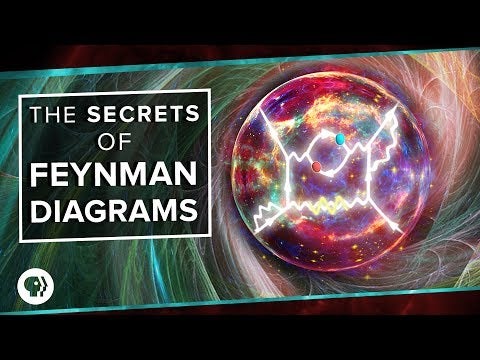
Viewers like you help make PBS (Thank you ) . Support your local PBS Member Station here: https://to.pbs.org/DonateSPACE Uploaded 26-07-17 Unlock the secrets of Feynman Diagrams. Part 5 in our Quantum Field Theory series. And if you're submitting an answer to our challenge question email your answer by August 2nd to pbsspacetime [AT] gmail.com with the subject line "Feynman Diagram Challenge." You can further support us on Patreon at https://www.patreon.com/pbsspacetime Get your own Space Time tshirt at http://bit.ly/1QlzoBi Tweet at us! @pbsspacetime Facebook: facebook.com/pbsspacetime Email us! pbsspacetime [at] gmail [dot] com Comment on Reddit: http://www.reddit.com/r/pbsspacetime Help translate our videos! https://www.youtube.com/timedtext_cs_... Previous Episode: The Real Star Wars Feynman’s path integral shows us that, to properly calculate the probability of a particle traveling from point A to point B, we need to add up the contributions from all conceivable paths between tho
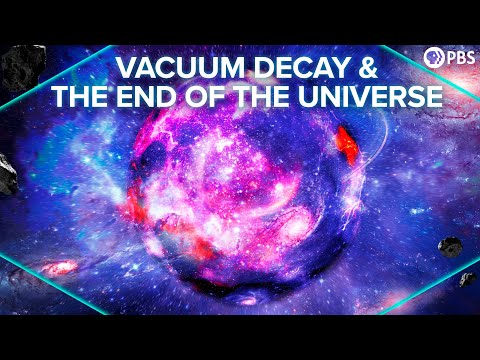
Sign Up on Patreon to get access to the Space Time Discord! Uploaded 18-08-21 The universe is going to end. But of all the possible ends of the universe vacuum decay would have to be the most thorough - because it could totally rewrite the laws of physics. Today I hope to help you understand exactly how terrified you should be. Check out the Space Time Merch Store Sign up for the mailing list to get episode notifications and hear special announcements! Hosted by Matt O'Dowd Written by Matt O'Dowd Graphics by Leonardo Scholzer, Yago Ballarini, Pedro Osinski, Adriano Leal and Stephanie Faria GFX Visualizations: Ajay Manuel Directed by Andrew Kornhaber Assistant Producer: Setare Gholipour Executive Producers: Eric Brown and Andrew Kornhaber End Credits Music by J.R.S. Schattenberg: https://www.youtube.com/user/MultiDroideka Special thanks to Our Patreon Sponsors Big Bang Supporters Ari Paul Kyle Bulloch Charlie Mrs. Tiffany Poindexter Leo Koguan Sandy Wu Matthew Miller Scott Gray Ahmad Jo
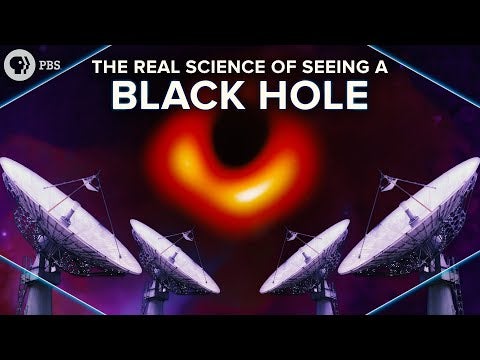
You can learn more about CuriosityStream at https://curiositystream.com/spacetime Uploaded 01-05-19 PBS Member Stations rely on viewers like you. To support your local station, go to: http://to.pbs.org/DonateSPACE How do you take a picture of a black hole and what can we learn from it? Our first ever actual bona fide photo of a black hole, made by the Event Horizon Telescope and revealed to the world in a press conference on April 10th. Since then it’s got plenty of coverage, because … I mean look at it. It’s a freaking black hole. It’s black, it’s holey, it’s everything we hoped it would be. Now that the giddiness has subsided and I personally have stopped spending hours on end staring at a black spot, we can take a breath and actually look at the real science here and discuss exactly how a picture like this could be taken and what we can learn from it. Check out the new Space Time Merch Store! Support Space Time on Patreon Need a Black Hole Refresher #Blackhole #astrophysics #spaceti
Independent oversight bodies need real investigatory powers, not only advisory roles.
Share your view, then see how readers voted. No sign-in required. This poll is shared across stories.
Do you agree or disagree?
Common Quandary
A Common Quandary to discuss
Another conversation to explore, separate from this news story.
Someone you love asks, “Do you think I’ll be okay?” What if you do not?
A relative with a poor prognosis asks whether you think they will recover. They seem to need reassurance, but you believe the odds are very low and do not want to spend the remaining time pretending.
Can preserving hope justify saying more than you believe?