Listen through the publisher, then discuss the episode here or arrange an in-person Roundtable. Your city determines where to meet.
Roundtables are designed for groups of four, with a shared subject and room for everyone to speak. Come for discussion, with no dating expectation.
What if the things we do to motivate our teenagers are doing the opposite? Most of us have done it. A tenner for a good exam result. An hour on the Xbox once the homework is done. A new phone if the grades come back right. It works, in the moment. But Dr Özgür Bolat thinks we are paying a much higher price than we realise. Özgür is an educational scientist with a master's from Harvard, a PhD from Cambridge and a visiting research post at MIT Sloan. He has advised Google, YouTube Kids and Unilever on child development. His book, The Reward Trap, draws on seven decades of research to show why gold stars, treats, praise and privileges so often backfire, and what to do instead. His interest is personal. He was the textbook high achiever: 56th out of a million students in Turkey's national exam, a perfect GPA at Harvard, a Cambridge doctorate. Then he came home, with everything going right, and felt anxious. He realised his happiness depended on outside approval. He had to keep succeeding to feel OK. And when he asked himself why, the answer led back to how he was parented. For a full explanation of the points made in the podcast click here (https://teenagersuntangled.substack.com/p/why-using-rewards-to-motivate-teens?r=1fywpq) Dr Özgür Bolat (https://ozgurbolat.co.uk/) -The Reward Trap There's no shame in reaching out for support. When you look after yourself your entire family benefits. My email [email protected] Instagram (https://www.instagram.com/teenagersuntangled/) Facebook (https://m.facebook.com/teenagersuntangled/)
Episode information is provided by the publisher. Listening takes place on the publisher’s service.
Giouli thought alcohol was the one thing that let her stop being perfect. Hear how a 30-day break she expected to end in January led her to write the first quit lit book in Greece and help change how her country talks about drinking. What happens when a question you ask yourself one January refuses to go away? For Giouli, alcohol started as freedom from perfectionism at university. It followed her through a demanding events career and into motherhood, when wine came home every night and blackouts began to scare her. Rules and moderation only left her feeling guilty. Then, holding a glass of red wine on her balcony, she asked herself who she was without it. That question led her to write two books, become a coach, and help shift the drinking culture in Greece. Why alcohol felt like freedom from perfectionism, not a way to numb The common belief about drinking at home that kept her from questioning alcohol What moderation rules did to her guilt and her sense of control The balcony moment
Viewers like you help make PBS (Thank you ) . Support your local PBS Member Station here: https://to.pbs.org/DonateSPACE Uploaded 18-04-18 To find out more, visit: https://brilliant.org/SpaceTime Now that gravitational waves are definitely a thing, it’s time to think about some of the crazy things we can figure out with them. In some cases we’re going to need a gravitational wave observatory - in fact, we've already built one. You can further support us on Patreon at https://www.patreon.com/pbsspacetime Get your own Space Time t-shirt at http://bit.ly/1QlzoBi Tweet at us! @pbsspacetime Facebook: facebook.com/pbsspacetime Email us! pbsspacetime [at] gmail [dot] com Comment on Reddit: http://www.reddit.com/r/pbsspacetime Help translate our videos! https://www.youtube.com/timedtext_cs_panel?tab=2&c=UC7_gcs09iThXybpVgjHZ_7g (https://www.youtube.com/timedtext_cs_panel?c=UC7_gcs09iThXybpVgjHZ_7g&tab=2) Previous Episode: The Physics of Life (ft. It's Okay to be Smart and PBS Eons!) https://w
A kiss can be wonderful. It can create an instant connection, spark romance, or make you feel closer to someone. But a kiss can also have the opposite effect — and sometimes ruin everything. So what makes kissing so powerful, and why can one kiss make such a difference? There's some fascinating science behind it. https://www.scientificamerican.com/article/why-we-kiss/ We spend an enormous amount of time worrying about what's going to change. What's next? What's coming? How do we prepare? But what if we're paying attention to the wrong things? Some of the most important forces shaping our lives never change, and understanding them may be far more valuable than trying to predict the future — something humans are notoriously bad at. Morgan Housel, partner at The Collaborative Fund and author of Same as Ever: A Guide to What Never Changes (https://amzn.to/3SwWn6u) (https://amzn.to/3SwWn6u)), joins me to explain why the things that stay the same may be the most important things to understan
How do you get your kids interested in learning without making it feel like homework? In today's episode, we're revisiting some of Ryan's favorite conversations with Kenny Curtis, host of Greeking Out (https://podcasts.apple.com/us/podcast/greeking-out-from-national-geographic-kids/id1483233279) and History Snacks (https://podcasts.apple.com/us/podcast/history-snacks/id1874130976), about how to encourage your kids' interests, nurture their natural curiosity, take those interests beyond a screen, and turn their curiosity into real-world experiences. Check out the full episodes with Kenny Curtis (https://podcasts.apple.com/us/podcast/greeking-outs-kenny-curtis-on-how-ancient-myths-teach/id1430315931?i=1000682597107)! | Apple Podcasts (https://podcasts.apple.com/us/podcast/greeking-outs-kenny-curtis-on-how-ancient-myths-teach/id1430315931?i=1000682597107), Spotify (https://open.spotify.com/episode/2CZPpfwjiwEsvb84EZyyz5), YouTube (https://www.youtube.com/watch?v=qAu5_O-KZNg) Pick up a cop
Support Stoicism Philosophy on Ko-fi Do you enjoy our content? Help us keep sharing Stoic wisdom by supporting us on Ko-fi. Click here to support us (https://ko-fi.com/stoicpodcast) Thank you for being a key part of Stoicism Philosophy. Your generosity keeps Stoic philosophy alive! HOW TO GET WHAT YOU WANT does not begin with wanting more, but with learning to master your mind, your impulses, and your actions. In this video, you will discover 8 Stoic secrets for pursuing your goals with discipline, calm, and clarity, without depending on luck or letting yourself be carried away by anxiety. Stoicism teaches that true power lies in controlling what depends on you: your decisions, your character, your focus, and your response to obstacles. Through principles inspired by the wisdom of Marcus Aurelius, Seneca, and Epictetus, you will learn how to turn desire into action, strengthen your self-control, maintain inner peace, and keep moving forward even when circumstances are not perfect. If y
Master the skills that change lives — enroll in your free human behavior course today: https://nci.university/learn Uploaded 14-03-26 During the first ninety seconds of any interaction, a window opens in the human brain that most people never notice. A specific sequence of neurological events unfolds — predictable, exploitable, and almost never taught outside of military and intelligence training. Very few people alive understand the full mechanics of what happens inside that window. Only operators, interrogators, and behavioral scientists with the right access have ever had this mapped out for them. Someone made sure it stayed that way. Every interaction you've ever had — every negotiation, every first impression, every moment you walked into a room — was governed by this sequence. You were either running it or it was being run on you. Most people spend their entire lives on the receiving end without ever knowing it. Language is the delivery system. But language isn't where it starts.
What if you could ask questions that got your teens talking, build critical thinking and connection? We spend a lot of time trying to optimise our teenagers: their grades, their screen time, their behaviour. It’s easy to forget to be interested in who they actually are. This week on Teenagers Untangled I spoke to Andy Nadler, dad of two teenage boys and founder of Food for Thought. One silly question at dinner changed the way his family talks to each other, and it changed how well he knows his sons. It started with worry. Andy’s older son brought home an English essay where the paragraphs didn’t connect. His younger son made bold claims about music, and when Andy pushed back, he dug in rather than rethinking. Andy works in software and asks questions for a living. He’d assumed his kids would pick up the habit. They hadn’t. So he brought one question to dinner: “If animals could talk, which would give the best advice, and which would be the biggest complainers?” First came the side-eye,
In this Wonder Room, Katharine Radice and I go back over my interview with Paul D Sweeney, author of University, Maybe? (https://universitymaybe.com/) Your responses to that episode were excellent, thank you. Fatima wished she’d heard it before her daughter’s Year 13. Alison still remembers her dad asking why she wanted to go. She says that question matters just as much today as it did then, maybe more. I loved the point made by Katharine Radice (https://open.substack.com/users/411749337-katharine-radice), who works at Cambridge University in a pastoral role Don’t oversell the importance of loving the course. “Students who don’t enjoy every module often decide they’ve failed.” The rhythm of the day (how much structure, city or campus) may matter more to their happiness than the subject. Do check the nitty-gritty, though: economics at one university can be far more maths-heavy than at another. Flexible courses are worth looking for too. Some other reflections: Check your own assumptions
Every autumn, families start the university conversation with the same question: which one? Paul Sweeney thinks most of us skip the question that should come first: should my child go at all, and if so, why? Paul dropped out of an engineering degree he hated and ran away to a job in an airline’s lost baggage department. He later became chief strategy officer at Unite, the UK’s largest listed student accommodation provider, and now advises universities on strategy and AI. His new book, University, Maybe?, draws on all of that background and his experience of going through this decision twice as a parent. We talked about what you’re really paying for, what universities would rather you didn’t ask, and why the alternatives aren’t consolation prizes. Click here for Paul Sweney'’s (https://universitymaybe.com/) website Click here to get my personal thoughts, the top tips from the episode (https://teenagersuntangled.substack.com/p/before-asking-which-university-ask?r=1fywpq×tamp=288.4) and j
Health advice should account for people's income, time, and practical circumstances.
Share your view, then see how readers voted. No sign-in required. This poll is shared across stories.
Do you agree or disagree?
Common Quandary
A Common Quandary to discuss
Another conversation to explore, separate from this news story.
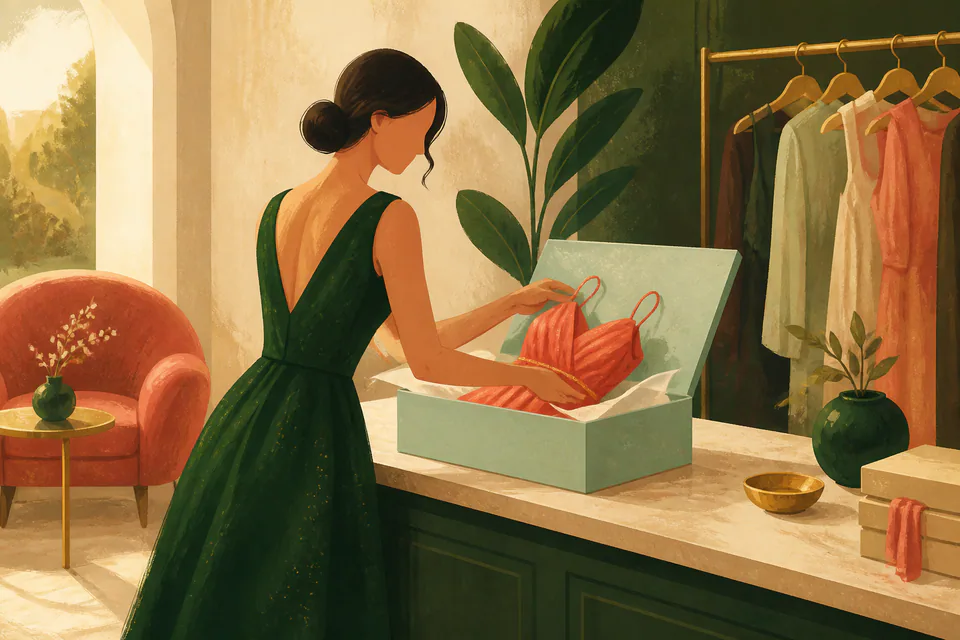
You wear an expensive outfit once and return it spotless. Clever or dishonest?
You buy an expensive outfit for a single event, keep it spotless, and return it the next day. The store's generous policy allows returns without asking whether an item was worn.
Does exploiting a policy differ from breaking a rule?