English-language podcasts

PBS Space Time

Using Stars to See Gravitational Waves

17 min

Listen through the publisher, then discuss the episode here or arrange an in-person Roundtable. Your city determines where to meet.

Roundtables are designed for groups of four, with a shared subject and room for everyone to speak. Come for discussion, with no dating expectation.

Viewers like you help make PBS (Thank you ) . Support your local PBS Member Station here: https://to.pbs.org/DonateSPACE Uploaded 18-04-18 To find out more, visit: https://brilliant.org/SpaceTime Now that gravitational waves are definitely a thing, it’s time to think about some of the crazy things we can figure out with them. In some cases we’re going to need a gravitational wave observatory - in fact, we've already built one. You can further support us on Patreon at https://www.patreon.com/pbsspacetime Get your own Space Time t­-shirt at http://bit.ly/1QlzoBi Tweet at us! @pbsspacetime Facebook: facebook.com/pbsspacetime Email us! pbsspacetime [at] gmail [dot] com Comment on Reddit: http://www.reddit.com/r/pbsspacetime Help translate our videos! https://www.youtube.com/timedtext_cs_panel?tab=2&c=UC7_gcs09iThXybpVgjHZ_7g (https://www.youtube.com/timedtext_cs_panel?c=UC7_gcs09iThXybpVgjHZ_7g&tab=2) Previous Episode: The Physics of Life (ft. It's Okay to be Smart and PBS Eons!) https://www.youtube.com/watch?v=GcfLZSL7YGw&t=25s (https://www.youtube.com/watch?t=25s&v=GcfLZSL7YGw) We are at the cusp of a golden age of gravitational wave astronomy. We’ve already talked about the Laser Interferometer Gravitational Wave Observatory–LIGO, and the first discovery of gravitational waves here. Those videos came out almost two years ago. A lot has happened since then. First, an update on LIGO. In its two and a half years of operation, LIGO has observed five certain black hole–black hole mergers. These events have been consistently surprising. Reinterpreting Low Frequency LIGO/Virgo Events as Magnified Stellar-Mass Black Holes at Cosmological Distances Broadhurst, Diego and Smoot (2018) On Stellar-Mass Black Hole Mergers in AGN Disks Detectable with LIGO McKernan et al. 2018 Stars as Resonant Absorbers of Gravitational Waves McKernan, Ford, Kocsis and Haiman Hosted by Matt O'Dowd Written by Drew Rosen and Matt O'Dowd Produced by Rusty Ward Graphics by Grayson Blackmon Assistant Editing and Sound Design by Mike Petrow and Linda Huang Made by Kornhaber Brown (www.kornhaberbrown.com) Special thanks to our Patreon Big Bang, Quasar and Hypernova Supporters: Big Bang CoolAsCats David Nicklas Faisal Saud Anton Lifshits Joey Redner Fabrice Eap Quasar Tambe Barsbay Mayank M. Mehrota Mars Yentur Mark Rosenthal Dean Fuqua Roman Pinchuk ColeslawPurdie Hypernova Edmund Fokschaner Matthew O’Connor Eugene Lawson Barry Hatfield Martha Hunt Joseph Salomone Chuck Zegar Jordan Young Ratfeast John Hofmann Craig Peterson Thanks to our Patreon Gamma Ray Burst Supporters: James Hughes Fabian Olesen Kris Fernet Jane Meyers James Flowers Greg Allen TJMadison Denys Ivanov Nick Virtue Alexey Eromenko Nicholas Rose Scott Gossett Mark Vasile Patrick Murray Sultan Alkhulaifi Alex Seto Michal-Peanut Karmi Erik Stein Kevin Warne JJ Bagnell J Rejc Avi Goldfinger John Pettit Florian Stinglmayr Benoit Pagé-Guitard Nathan Leniz Brandon Labonte David Crane Greg Weiss Brandon Cook Daniel Lyons

Episode information is provided by the publisher. Listening takes place on the publisher’s service.

Listen at the source ↗

Featured places to meet in Palo Alto, CA

Explore these places and arrange a conversation through ThinkMatch.

City guide for Palo Alto, CA

More from PBS Space Time

PBS Space Time

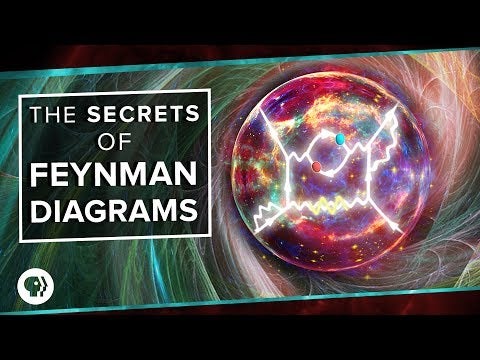
The Secrets of Feynman Diagrams

19 min

Viewers like you help make PBS (Thank you ) . Support your local PBS Member Station here: https://to.pbs.org/DonateSPACE Uploaded 26-07-17 Unlock the secrets of Feynman Diagrams. Part 5 in our Quantum Field Theory series. And if you're submitting an answer to our challenge question email your answer by August 2nd to pbsspacetime [AT] gmail.com with the subject line "Feynman Diagram Challenge." You can further support us on Patreon at https://www.patreon.com/pbsspacetime Get your own Space Time t­shirt at http://bit.ly/1QlzoBi Tweet at us! @pbsspacetime Facebook: facebook.com/pbsspacetime Email us! pbsspacetime [at] gmail [dot] com Comment on Reddit: http://www.reddit.com/r/pbsspacetime Help translate our videos! https://www.youtube.com/timedtext_cs_... Previous Episode: The Real Star Wars Feynman’s path integral shows us that, to properly calculate the probability of a particle traveling from point A to point B, we need to add up the contributions from all conceivable paths between tho

Discuss this episode

PBS Space Time

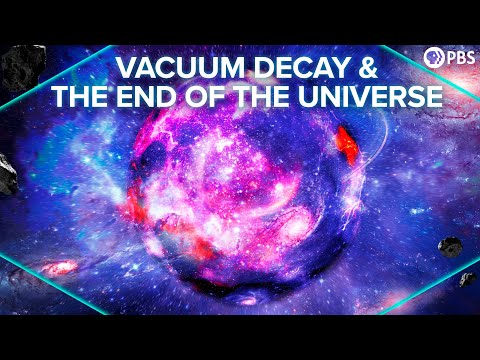
How Vacuum Decay Would Destroy The Universe

17 min

Sign Up on Patreon to get access to the Space Time Discord! Uploaded 18-08-21 The universe is going to end. But of all the possible ends of the universe vacuum decay would have to be the most thorough - because it could totally rewrite the laws of physics. Today I hope to help you understand exactly how terrified you should be. Check out the Space Time Merch Store Sign up for the mailing list to get episode notifications and hear special announcements! Hosted by Matt O'Dowd Written by Matt O'Dowd Graphics by Leonardo Scholzer, Yago Ballarini, Pedro Osinski, Adriano Leal and Stephanie Faria GFX Visualizations: Ajay Manuel Directed by Andrew Kornhaber Assistant Producer: Setare Gholipour Executive Producers: Eric Brown and Andrew Kornhaber End Credits Music by J.R.S. Schattenberg: https://www.youtube.com/user/MultiDroideka Special thanks to Our Patreon Sponsors Big Bang Supporters Ari Paul Kyle Bulloch Charlie Mrs. Tiffany Poindexter Leo Koguan Sandy Wu Matthew Miller Scott Gray Ahmad Jo

Discuss this episode

PBS Space Time

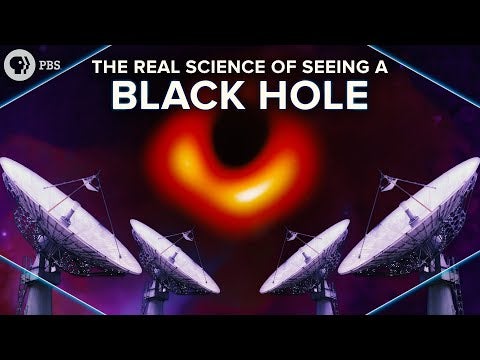
The Real Science of the EHT Black Hole

16 min

You can learn more about CuriosityStream at https://curiositystream.com/spacetime Uploaded 01-05-19 PBS Member Stations rely on viewers like you. To support your local station, go to: http://to.pbs.org/DonateSPACE How do you take a picture of a black hole and what can we learn from it? Our first ever actual bona fide photo of a black hole, made by the Event Horizon Telescope and revealed to the world in a press conference on April 10th. Since then it’s got plenty of coverage, because … I mean look at it. It’s a freaking black hole. It’s black, it’s holey, it’s everything we hoped it would be. Now that the giddiness has subsided and I personally have stopped spending hours on end staring at a black spot, we can take a breath and actually look at the real science here and discuss exactly how a picture like this could be taken and what we can learn from it. Check out the new Space Time Merch Store! Support Space Time on Patreon Need a Black Hole Refresher #Blackhole #astrophysics #spaceti

Discuss this episode

Community Poll

Publicly funded stadiums should provide clear, measurable benefits to local residents.

Share your view, then see how readers voted. No sign-in required. This poll is shared across stories.

Do you agree or disagree?

Choose one answer

Common Quandary

A Common Quandary to discuss

Another conversation to explore, separate from this news story.

Your father is becoming a dangerous driver. Would you report him behind his back?

Your father values the independence his car gives him. He has not caused an accident, but his reactions have noticeably slowed and several recent drives frightened you. He refuses an assessment.

When may care override another adult's autonomy?

Explore this quandary