How to speak monkey: The language of cotton-top tamarins - Anne Savage
8 min
Listen through the publisher, then discuss the episode here or arrange an in-person Roundtable. Your city determines where to meet.
Roundtables are designed for groups of four, with a shared subject and room for everyone to speak. Come for discussion, with no dating expectation.
View full lesson: http://ed.ted.com/lessons/do-you-speak-monkey-the-language-of-cotton-top-tamarins-anne-savage Uploaded 26-06-14 The cotton-top tamarin is a very vocal monkey -- the species communicates using a sophisticated language of 38 distinct and grammatically structured calls! Anne Savage teaches a few of these chirps and whistles, taking us through a day in the life of Shakira the tamarin (using sounds pulled from the wild) as Shakira signals to her family, talks to her food and warns against potential predators. Lesson by Anne Savage, animation by Avi Ofer.
Episode information is provided by the publisher. Listening takes place on the publisher’s service.
This is an edited lesson from NCI Grad School. Check out Grad School here: https://nci.university/nci-4 Uploaded 26-06-25 Scholarships AVAILABLE now. Want to command attention the moment you walk in—without saying a word? In this video, Chase Hughes reveals the exact behavioral psychology, body language, and frame control techniques used by elite operators, interrogators, and top-level influencers. Learn how to walk into any room and instantly radiate authority, presence, and control—before you even speak. Free behavior skills training: https://nci.university/masterclass Chase’s books on Amazon: https://www.amazon.com/stores/Chase-Hughes/author/B06VW1H89K?ref=sr_ntt_srch_lnk_1&qid=1750928422&sr=8-1&isDramIntegrated=true&shoppingPortalEnabled=true (https://www.amazon.com/stores/Chase-Hughes/author/B06VW1H89K?isDramIntegrated=true&qid=1750928422&ref=sr_ntt_srch_lnk_1&shoppingPortalEnabled=true&sr=8-1) ⸻ Keywords: frame control, nonverbal dominance, how to own the room, influence and pers
You've gotten very good at pretending you don't feel it. Uploaded 21-08-26 Maybe it's a conversation with someone you love. Someone you work for. A partner, a parent, a friend who's been quietly taking more than they give. Or the hardest one of all — a conversation with yourself, the one where you finally admit something you've refused to say out loud for years. You know exactly which one I'm talking about. You felt it the moment I said the word. A name came up, or a face, and your stomach did something small and unpleasant, and you pushed it back down where it's been living. That flinch is the most honest thing that's happened to you all day. Here is the truth: the life you say you want — the freedom, the peace, the relationship, the income, the respect — there's a very good chance it's on the other side of one conversation you keep refusing to have. Not ten. One. This seminar unpacks the single mechanic behind a stuck life: the necessary conversation you keep treating like a locked d
Happy Sunday! Welcome to Heal Squad’s The Sunday Set Up. Life lessons to help you start the week. How much of success comes down to simply showing up? This week, we talk keeping an open mind, taking chances, and recognizing the doors that open along the way. From Olympic athletes appearing on national television alongside Mercedes Moné to performers who keep showing up week after week hoping for their big break, we explore why success isn't always about talent or luck. Sometimes it's about making connections, putting in the effort, and being willing to try without knowing what we'll get in return. We talk knowing when to stop investing time in people who aren't willing to help themselves, and why even experiences that don't work out can teach us something valuable. The takeaway: don't wait for the perfect moment or expect someone else to make things happen. Be willing to take a chance, walk through the doors that open, and remember that half of life is just showing up. Plus, a little b
Microplastics in my Heart Letter: https://staycuriousmetabolism.substack.com/p/microplastics-in-my-heart-its-worse?r=40ekz2 Stanford Fiber RCT, Letter https://staycuriousmetabolism.substack.com/p/fiber-is-good-for-you-is-lazy-science?r=40ekz2 Microbiome Reset, Letter https://staycuriousmetabolism.substack.com/p/how-im-rebuilding-my-microbiomeafter?r=40ekz2 Description: Microplastics are everywhere—in our food, water, and inside our bodies—and avoiding them completely is nearly impossible. In this conversation, I sit down with Dr. Matthew Dunn PhD, a molecular biologist working at the intersection of biotechnology and human health, to unpack what the science actually says about microplastics and how they may be linked to cardiovascular disease, reproductive health issues, and gut inflammation We break down the landmark human data, the animal and cellular studies that help explain possible mechanisms, and dissect the state of the data. We also explore a potential inside-out solution: usi
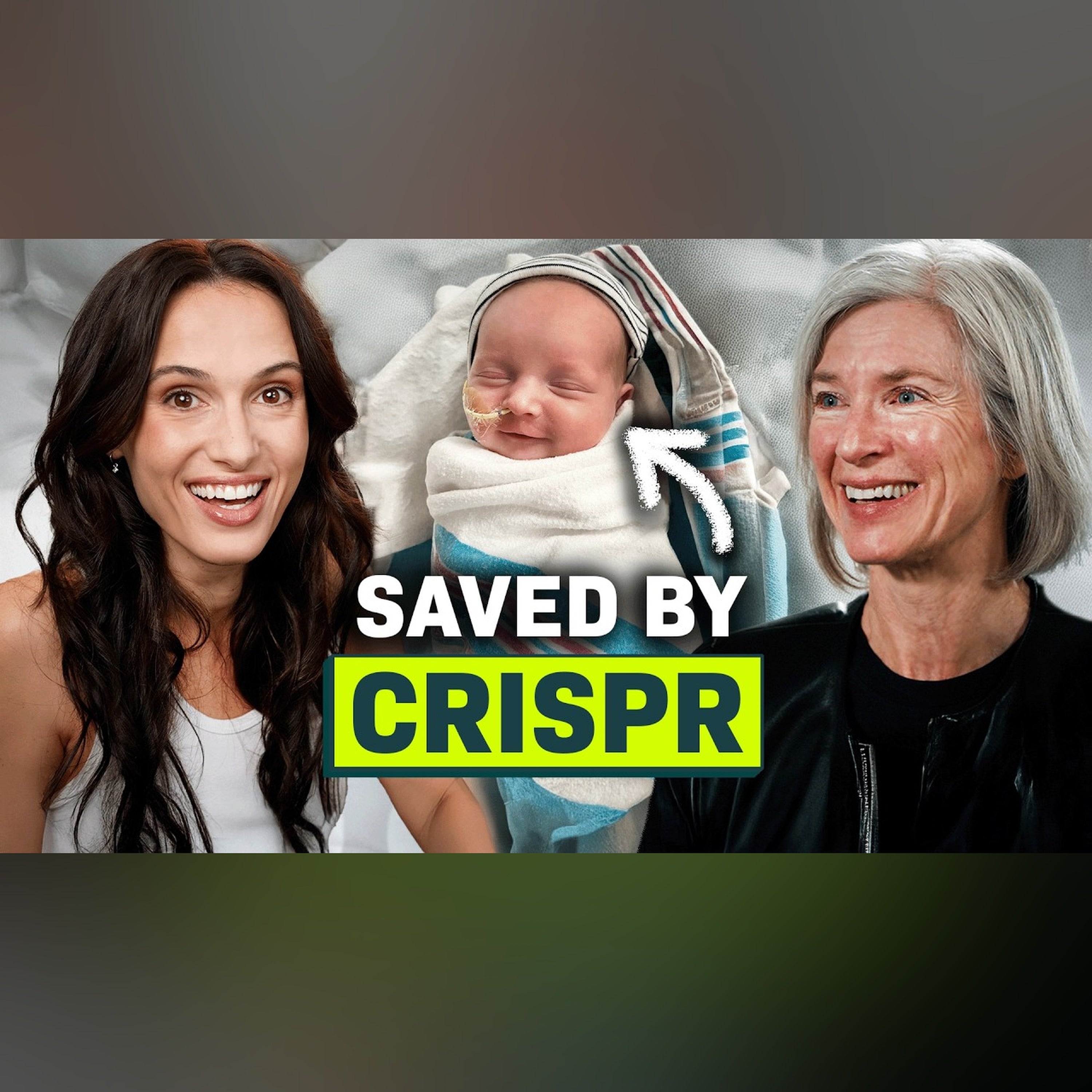
Human DNA editing is finally here. Check out the new WHOOP here! https://join.whoop.com/cleo There is a microscopic technology that now gives us the power to edit our own genes while we’re alive. To cure certain diseases, possibly prevent others, or boost what our bodies can do… or maybe, one day give our kids abilities no one has ever had before… effectively putting evolution into our hands. This is not some sci-fi future! We’re already using this technology in real medical treatments in plants to grow new crops and in animals to create new species! Just yesterday, news broke that a baby’s life was saved using personalized gene editing that fixed one tiny error in its DNA. This is truly “huge if true.” Deciding how we use this new superpower may be the biggest challenge we have ever faced - and the biggest opportunity to reduce human suffering. This tool is called CRISPR. Dr. Jennifer Doudna won the Nobel Prize for discovering it. So, in this third episode of Huge Conversations, Dr. D
View full lesson: http://ed.ted.com/lessons/surviving-a-nuclear-attack-irwin-redlener The face of nuclear terror has changed since the Cold War, but disaster-medicine expert Irwin Redlener reminds us the threat is still real. He looks at some of history's farcical countermeasures and offers practical advice on how to survive an attack. Talk by Irwin Redlener.
Explore what makes polio so dangerous, what is causing the 21st century resurgence of cases, and how we can eradicate the disease. -- In 1952, polio was everywhere: killing or paralyzing roughly half a million people annually. Yet just 10 years later, paralytic polio cases in the US dropped by 96% and we were on track to get rid of polio for good. But in recent years, the virus started striking back. So, what’s behind these recent spikes? Explore the dangers of poliovirus and the possibility of eradicating this deadly disease. Directed by Anton Bogaty. This video made possible in collaboration with Gates Ventures Learn more about how TED-Ed partnerships work: https://bit.ly/TEDEdPartner A special thanks to Ananda Bandyopadhyay, Amber Zeddies, and Kathleen O'Reilly who provided information and insights for the development of this video. Support Our Non-Profit Mission ---------------------------------------------- Support us on Patreon: http://bit.ly/TEDEdPatreon Check out our merch: htt
Todd Humphreys forecasts the near-future of geolocation when millimeter-accurate GPS "dots" will enable you to find pin-point locations, index-search your physical possessions ... or to track people without their knowledge. And the response to the sinister side of this technology may have unintended consequences of its own. (Filmed at TEDxAustin.) Uploaded 26-06-13 Talk by Todd Humphreys.
Extra learning support should avoid publicly labeling students as failures.
Share your view, then see how readers voted. No sign-in required. This poll is shared across stories.
Do you agree or disagree?
Common Quandary
A Common Quandary to discuss
Another conversation to explore, separate from this news story.
Your anonymous gift could inspire millions more if you reveal your name. Do you?
A donor wants to make a transformative gift without recognition. The charity believes announcing the gift and the donor's identity would encourage matching contributions and help far more people.
Can the opportunity to create more good outweigh a preference for privacy?