English-language podcasts

TED-Ed

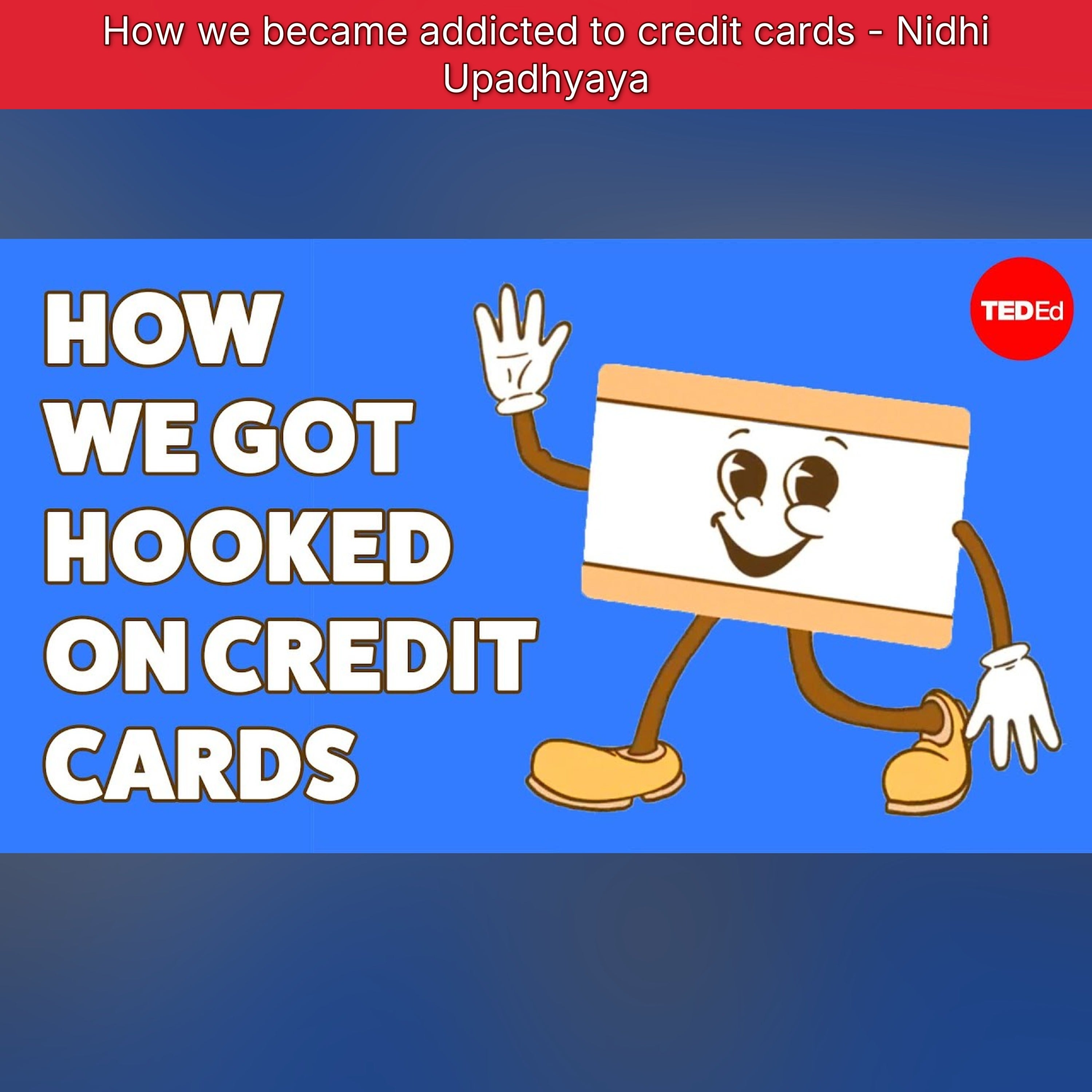
How we became addicted to credit cards - Nidhi Upadhyaya
7 min

Listen through the publisher, then discuss the episode here or arrange an in-person Roundtable. Your city determines where to meet.

Roundtables are designed for groups of four, with a shared subject and room for everyone to speak. Come for discussion, with no dating expectation.

Dig into the history of credit cards in the United States, and how they have evolved since the 1950s into the industry we know today. -- Today, credit cards are a $500 billion-a-year industry. Banks consider these lines of credit when deciding whether or not to approve loans, incentivizing customers to maintain multiple credit cards. So, how did this lending system originate? And how did they get to be so popular? Nidhi Upadhyaya digs into the history of credit cards in the United States. Lesson by Nidhi Upadhyaya, directed by Jeff Le Bars, JetPropulsion.space. Support Our Non-Profit Mission ---------------------------------------------- Support us on Patreon: http://bit.ly/TEDEdPatreon Check out our merch: http://bit.ly/TEDEDShop ---------------------------------------------- Connect With Us ---------------------------------------------- Sign up for our newsletter: http://bit.ly/TEDEdNewsletter Find us on Twitter: http://bit.ly/TEDEdTwitter Peep us on Instagram: http://bit.ly/TEDEdInstagram ---------------------------------------------- Keep Learning ---------------------------------------------- View full lesson: https://ed.ted.com/lessons/a-brief-history-of-credit-cards-nidhi-upadhyaya Dig deeper with additional resources: https://ed.ted.com/lessons/a-brief-history-of-credit-cards-nidhi-upadhyaya/digdeeper Animator's website: https://jetpropulsion.space (https://jetpropulsion.space/) Music: https://www.campstudio.co (https://www.campstudio.co/) ---------------------------------------------- Thank you so much to our patrons for your support! Without you this video would not be possible! Khalifa Alhulail, Martin Stephen, Jose Henrique Leopoldo e Silva, Mandeep Singh, Abhijit Kiran Valluri, Morgan Williams, Devin Harris, Pavel Zalevskiy, Karen Goepen-Wee, Filip Dabrowski, Barbara Smalley, Megan Douglas, Tim Leistikow, Ka-Hei Law, Hiroshi Uchiyama, Mark Morris, Misaki Sato, EdoKun, SookKwan Loong, Bev Millar, Lex Azevedo, Michael Aquilina, Jason A Saslow, Yansong Li, Cristóbal Moenne, Dawn Jordan, Prasanth Mathialagan, Samuel Doerle, David Rosario, Dominik Kugelmann - they-them, Siamak Hajizadeh, Ryohky Araya, Mayank Kaul, Christophe Dessalles, Heather Slater, Sandra Tersluisen, Zhexi Shan, Bárbara Nazaré, Andrea Feliz, Victor E Karhel, Sydney Evans, Latora, Noel Situ, emily lam, Sid, Niccolò Frassetto, Mana, I'm here because of Knowledge Fight Facebook group., Linda Freedman, and Edgardo Cuellar.

Episode information is provided by the publisher. Listening takes place on the publisher’s service.

Listen at the source ↗

Featured places to meet in Palo Alto, CA

Explore these places and arrange a conversation through ThinkMatch.

City guide for Palo Alto, CA

More from TED-Ed

TED-Ed

Withstanding a nuclear attack - Irwin Redlener

33 min

View full lesson: http://ed.ted.com/lessons/surviving-a-nuclear-attack-irwin-redlener The face of nuclear terror has changed since the Cold War, but disaster-medicine expert Irwin Redlener reminds us the threat is still real. He looks at some of history's farcical countermeasures and offers practical advice on how to survive an attack. Talk by Irwin Redlener.

Discuss this episode

TED-Ed

The true reason polio poses such a threat

10 min

Explore what makes polio so dangerous, what is causing the 21st century resurgence of cases, and how we can eradicate the disease. -- In 1952, polio was everywhere: killing or paralyzing roughly half a million people annually. Yet just 10 years later, paralytic polio cases in the US dropped by 96% and we were on track to get rid of polio for good. But in recent years, the virus started striking back. So, what’s behind these recent spikes? Explore the dangers of poliovirus and the possibility of eradicating this deadly disease. Directed by Anton Bogaty. This video made possible in collaboration with Gates Ventures Learn more about how TED-Ed partnerships work: https://bit.ly/TEDEdPartner A special thanks to Ananda Bandyopadhyay, Amber Zeddies, and Kathleen O'Reilly who provided information and insights for the development of this video. Support Our Non-Profit Mission ---------------------------------------------- Support us on Patreon: http://bit.ly/TEDEdPatreon Check out our merch: htt

Discuss this episode

TED-Ed

How to fool a GPS - Todd Humphreys

21 min

Todd Humphreys forecasts the near-future of geolocation when millimeter-accurate GPS "dots" will enable you to find pin-point locations, index-search your physical possessions ... or to track people without their knowledge. And the response to the sinister side of this technology may have unintended consequences of its own. (Filmed at TEDxAustin.) Uploaded 26-06-13 Talk by Todd Humphreys.

Discuss this episode

Community Poll

Reinterpreting familiar stories for new audiences is usually worthwhile.

Share your view, then see how readers voted. No sign-in required. This poll is shared across stories.

Do you agree or disagree?

Choose one answer

Common Quandary

A Common Quandary to discuss

Another conversation to explore, separate from this news story.

Someone holds a grocery line spot while their partner fills the cart. Is that cutting?

A shopper with one item stands ahead of you in a long checkout line. Just before reaching the register, their partner arrives with a cart packed to the top and joins them. They insist they were shopping together all along.

Can one person reserve a place in line for an unknown amount of work?

Explore this quandary