How Your Immune System Recognises Invaders | Boring Science For Sleep
393 min
Listen through the publisher, then discuss the episode here or arrange an in-person Roundtable. Your city determines where to meet.
Roundtables are designed for groups of four, with a shared subject and room for everyone to speak. Come for discussion, with no dating expectation.
Fall asleep to this quiet science story. A Boring Science For Sleep episode about How Your Immune System Recognises Invaders. How Your Immune System Recognises Invaders Settle in for a quiet exploration of How Your Immune System Recognises Invaders. This episode follows A Fruit Fly In Strasbourg; Mice, Cell Lines And Dallas; How Sensors Read Molecules; Telling Self From Stranger; Lymph Nodes, Memory And Restraint. Listen closely or let the details drift past. Chapters 00:00:00 How Your Immune System Recognises Invaders 01:42:27 Why Nuclear Fusion Releases So Much Energy 04:09:03 Why Entropy Makes Heat Flow From Hot to Cold If you enjoy this quiet science bedtime pace, you might also like Psalms for Sleep on Spotify — same quiet rhythm, different night. Search Spotify for Psalms for Sleep.
Episode information is provided by the publisher. Listening takes place on the publisher’s service.
In this calm and sleepy facts episode, we journey far beyond our own solar system to explore the thousands of worlds orbiting distant stars, places we have only recently learned to find and are only just beginning to understand. We start with the basics of what an exoplanet is and how astronomers detect them, from the gentle dimming of a star as a planet passes in front of it to the tiny gravitational wobble a hidden world imprints on its sun. We visit the extraordinary harvest of the Kepler space telescope, which revealed that planets are not rare exceptions but the rule, scattered across nearly every star in the Milky Way. Along the way we encounter strange and extreme worlds, gas giants so close to their stars that they complete an orbit in mere days, tidally locked planets with one face locked in permanent daylight and the other in endless night, and rogue planets drifting alone through interstellar space with no star to call home. We explore the habitable zone, the narrow region a
For a written breakdown, early access to content like this, and extra nuances, see the associated StayCurious Metabolism newsletter: https://open.substack.com/pub/staycuriousmetabolism/p/stop-chasing-8-hours-of-sleep?r=40ekz2&utm_campaign=post&utm_medium=web&showWelcomeOnShare=true (https://open.substack.com/pub/staycuriousmetabolism/p/stop-chasing-8-hours-of-sleep?r=40ekz2&showWelcomeOnShare=true) Pinealon Letter: https://staycuriousmetabolism.substack.com/p/why-im-trying-this-peptide-for-sleep?r=40ekz2 No Sleep Letter: https://staycuriousmetabolism.substack.com/p/what-if-you-didnt-need-to-sleep-this?r=40ekz2 Deep Sleep Masterclass: https://staycuriousmetabolism.substack.com/p/how-to-help-your-brain-clean-itself?r=40ekz2 I review several gamma entrainment devices in the Deep Sleep letter, along with the evidence supporting this tool. The only device I have personal experience with is Gamma Light Therapy, which was developed based on some of the early Nature research and is also one of
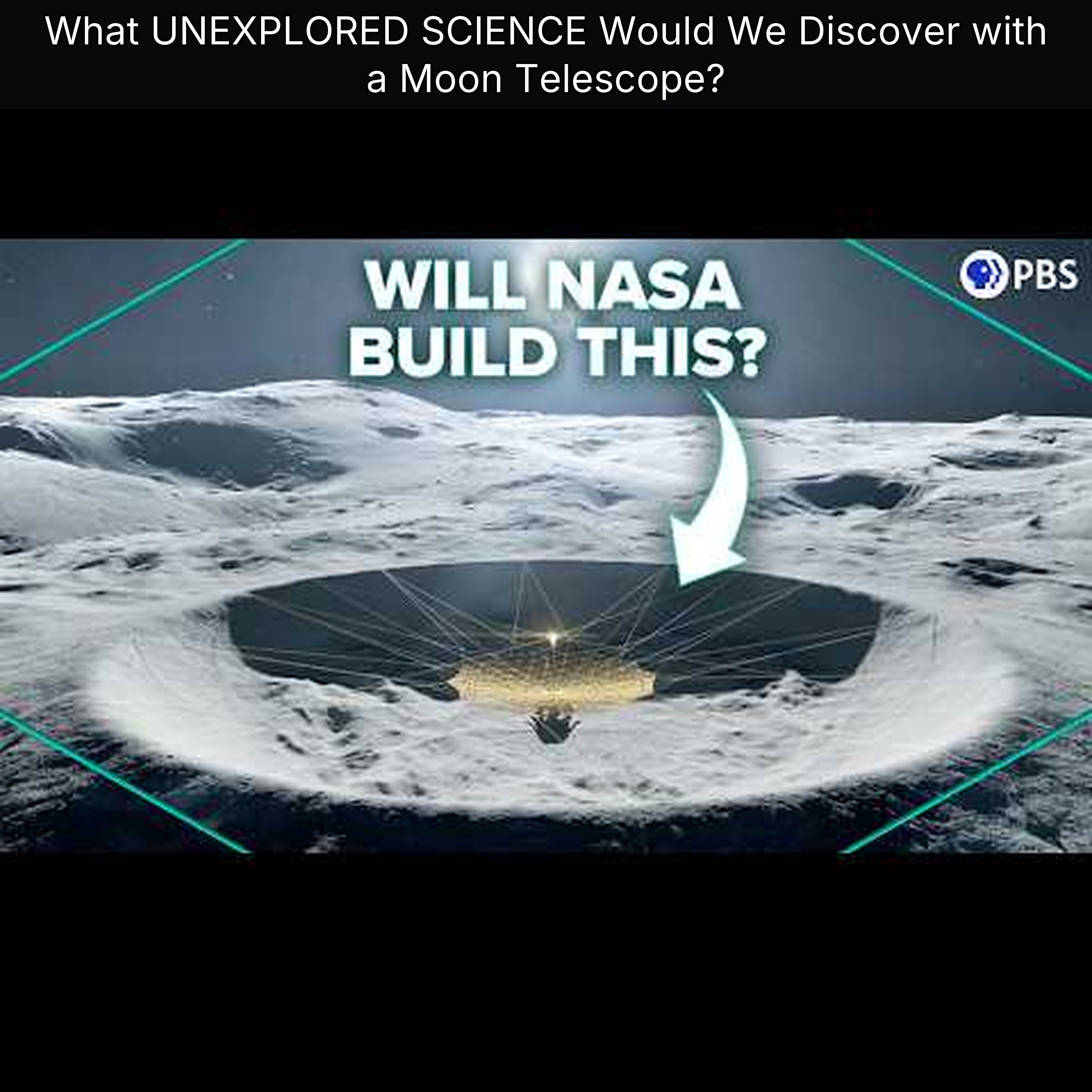
PBS Member Stations rely on viewers like you. To support your local station, go to:http://to.pbs.org/DonateSPACE Sign Up on Patreon to get access to the Space Time Discord! In order to see the faint light from objects in deepest space, astronomers go to the darkest places on the planet. In order to listen to their quite radio signals, they head as far from any radio-noisy humans as possible. But there’s nowhere on the earth, or even orbiting the Earth, that’s far enough to hear to the faint radio hum from the time before stars. In fact, we may need to build a giant radio telescope in the quietest place in the solar system—the far side of the moon. Check out the Space Time Merch Store Sign up for the mailing list to get episode notifications and hear special announcements! Search the Entire Space Time Library Here: https://search.pbsspacetime.com/ Hosted by Matt O'Dowd Written by Matt Caplan & Matt O'Dowd Post Production by Leonardo Scholzer, Yago Ballarini, Adriano Leal & Stephanie Far
Are AI referees ruining sports? Or making them better? If you’re watching the 2023 US Open, you’re seeing automated referee calls. After years of controversy about human accuracy, tennis has used a system called Hawkeye to not only check human calls… but now to replace human referees. And this robot ref revolution isn’t just happening in tennis. It’s taking over the sports world. Soccer, basketball, baseball, they are all using machines to improve the calls being made on the field. The World Cup in particular has invested in these tools, from VAR (video assistant referee) to semi-automated offside and goal-line technology. The stakes are high. The difference between a right or wrong call can be a championship, or millions of dollars in prizes, endorsements, ticket sales. For the most part, fans like tech that makes calls more objective. HOWEVER… there is a big chunk of sports fans who would strongly disagree, who think that robot refs are ruining the game. Thing is, this tech isn’t goi
A kiss can be wonderful. It can create an instant connection, spark romance, or make you feel closer to someone. But a kiss can also have the opposite effect — and sometimes ruin everything. So what makes kissing so powerful, and why can one kiss make such a difference? There's some fascinating science behind it. https://www.scientificamerican.com/article/why-we-kiss/ We spend an enormous amount of time worrying about what's going to change. What's next? What's coming? How do we prepare? But what if we're paying attention to the wrong things? Some of the most important forces shaping our lives never change, and understanding them may be far more valuable than trying to predict the future — something humans are notoriously bad at. Morgan Housel, partner at The Collaborative Fund and author of Same as Ever: A Guide to What Never Changes (https://amzn.to/3SwWn6u) (https://amzn.to/3SwWn6u)), joins me to explain why the things that stay the same may be the most important things to understan
In Brought to You By: How Corporations Warped the Truth, Conned the Public, and Broke Democracy (https://bookshop.org/a/12343/9781639736331), Amy Westervelt exposes the plot hidden within the familiar story of science denial. Over the last century, Big Industry has built a vast apparatus of think tanks, lobbyists, sponsored university labs, and obliging news networks to con the public and fool decision-makers, poisoning the informational ecosystem and warping the nature of truth along the way. With her signature wit and incisiveness, Westervelt introduces the masterminds of corporate misinformation: Herb Schmertz, the public relations pioneer who made Mobil “the thinking man's oil company;” Richard Edelman, the PR guy who helped the dairy industry vilify oat milk; David Petraeus, the disgraced spy chief using counter-insurgency tactics to discredit climate science; and many more. She shows how these company men have worked to usher in an era of unprecedented corporate control. Only by
Fall asleep to this quiet science story. A Boring Science For Sleep episode about How Mechanical Clocks Turn Gears Into Time. How Mechanical Clocks Turn Gears Into Time Settle in for a quiet exploration of How Mechanical Clocks Turn Gears Into Time. This episode follows A Bell Without a Face; Iron, Brass, Gut and Oak; Counting Teeth Into Hours; The Swing and the Sea; Towers, Tanks and Long Clocks. Listen closely or let the details drift past. Chapters 00:00:00 How Mechanical Clocks Turn Gears Into Time 01:30:53 Graphite Pencils and the Clay Inside the Core 04:02:09 Wood Screws and the Cutting of Spiral Threads If you enjoy this quiet science bedtime pace, you might also like Psalms for Sleep (https://open.spotify.com/show/7zd2RN8SMTCheFA2ifYK0m) on Spotify — same quiet rhythm, different night.
Fall asleep to this quiet science story. A Boring Science For Sleep episode about How Concrete Turns From Wet Paste Into Solid Stone. How Concrete Turns From Wet Paste Into Solid Stone Settle in for a quiet exploration of How Concrete Turns From Wet Paste Into Solid Stone. This episode follows Heat Inside Hoover Dam; Cement, Stone And Water; How The Paste Joins Up; Keeping The Water In; Knowing When It's Ready. Listen closely or let the details drift past. Chapters 00:00:00 How Concrete Turns From Wet Paste Into Solid Stone 01:23:01 Gramophone Records and the Pressing of Grooves 03:55:53 Woven Wire Sieves and the Sizing of the Mesh If you enjoy this quiet science bedtime pace, you might also like True Crime for Sleep (https://open.spotify.com/show/05dzYD65s7sflbCdBiKBty) on Spotify — same quiet rhythm, different night.
Fall asleep to this quiet science story. A Boring Science For Sleep episode about Why the Periodic Table Has Repeating Patterns. Why the Periodic Table Has Repeating Patterns Settle in for a quiet exploration of Why the Periodic Table Has Repeating Patterns. This episode follows A chart on canvas; Families, octaves and gaps; Electrons and their rooms; Wrong weights, new gases; The rows that kept growing. Listen closely or let the details drift past. Chapters 00:00:00 Why the Periodic Table Has Repeating Patterns 01:31:53 Why Neutron Stars Pack So Much Into So Little 04:00:42 Tennis Balls and the Stitching of Felt Covers If you enjoy this quiet science bedtime pace, you might also like Psalms for Sleep (https://open.spotify.com/show/7zd2RN8SMTCheFA2ifYK0m) on Spotify — same quiet rhythm, different night.
Reliable software matters more than releasing new features quickly.
Share your view, then see how readers voted. No sign-in required. This poll is shared across stories.
Do you agree or disagree?
Common Quandary
A Common Quandary to discuss
Another conversation to explore, separate from this news story.
You are training the software that may replace your team. Do you warn them?
A manager is asked to help test software that could eliminate several jobs on their team. Leadership insists the project is uncertain and confidential, while employees are making major financial decisions.
When does loyalty to colleagues override professional confidentiality?