If AI Can Do the Math, What Do the Mathematicians Do?
92 min
Listen through the publisher, then discuss the episode here or arrange an in-person Roundtable. Your city determines where to meet.
Roundtables are designed for groups of four, with a shared subject and room for everyone to speak. Come for discussion, with no dating expectation.
What’s it like to watch AI solve a problem you’ve spent years on? Researcher Ittai Abraham spent about two years working on a set of math problems. Years later, he gave one of them to an AI model. In about an hour, it made progress where he’d gotten stuck. Stanford cryptographer Dan Boneh takes that experience a step further. Suppose an AI settles P vs. NP, one of the biggest open questions in computer science. A computer can check every step, but the proof runs to a billion pages. What would we actually understand? This episode brings together researchers — Abraham, Boneh, Scott Duke Kominers, and Justin Thaler — to talk about where math goes from here, now that AI is so good at solving hard problems. Also: why a model can produce a correct proof and still skip key steps, how you develop a feel for which problems are worth pursuing, and what they’d tell a student deciding whether to spend the next five years on a math PhD. This episode is for anyone wondering what happens to human knowledge if AI can prove things we may never understand. Resources: Mentioned in the episode OpenAI math drop Fermat’s Last Tango William Thurston, “On proof and progress in mathematics” Lean, the open-source proof assistant Kirwin Hampshire, “The Dark Night of Mathematics” Terence Tao’s sketch of the proof about Landau–Siegel zeros discussed by Scott Steven Strogatz, “A Mathematician Reads the AI Future” Math paper with a fantastic “Disclosure of AI usage” Follow the speakers Ittai Abraham — https://x.com/ittaia · https://www.linkedin.com/in/ittaia Dan Boneh — https://x.com/danboneh · https://www.linkedin.com/in/dan-boneh-8b599020 Scott Duke Kominers — https://x.com/skominers·https://www.linkedin.com/in/scott-kominers Justin Thaler — https://x.com/SuccinctJT · https://people.cs.georgetown.edu/jthaler/ Robert Hackett — https://x.com/rhackett · https://www.linkedin.com/in/rhhackett More from a16z Frontier Read the newsletter — https://a16zfrontier.substack.com/ Stay Updated: Find a16z on YouTube: YouTube (https://www.youtube.com/@a16z) Find a16z on X (https://x.com/a16z) Find a16z onLinkedIn (https://www.linkedin.com/company/a16z) Follow our host: https://twitter.com/eriktorenberg For more details please see a16z.com/disclosures. Hosted by Simplecast, an AdsWizz company.
Episode information is provided by the publisher. Listening takes place on the publisher’s service.
A conversation happens somewhere you're not in the room. A decision gets made about you, without you. And when it's over, you find out you were expendable. Replaceable. And it stings, because you told yourself you were valuable. You worked hard. You showed up. Uploaded 19-07-26 But hard work and showing up, it turns out, are not the same thing as being irreplaceable. Most people spend their whole lives perfecting the art of being adequate, and then wonder why they get treated as adequate. Here is the truth: the marketplace does not respond to how you feel about your value. It responds to your value. And your value is something you can build. This seminar walks through the specific things you must understand about becoming the kind of person the world reorganizes itself around — the person others fight to keep. CHAPTERS 0:00 Intro — The decision made without you 1:57 The confession most people won't make out loud 3:47 Presence is not production 5:26 Why the reward always follows the val
Five auctions scheduled. Five auctions conducted. No withdrawals. No cancellations. No last-minute sales prior. That alone tells me the market is behaving better than it was through May, June and July. Prices are not rising — yet. But in many markets, I believe they have already corrected more than the official data suggests. The data will eventually catch up. It always does. The key question is whether we are close to the bottom. With job losses and restructures still working their way through the economy, unemployment may be weaker than the headline number indicates. That is one reason I believe the RBA will be very cautious from here. The best agents don’t wait for a headline to tell them what is happening. They watch buyers, vendors, stock levels and auction rooms in real time. And if you want to be sharper, more accountable and better prepared for whatever 2027 brings, Red Belt Coaching (https://coach.tompanos.com.au/red-belt-wait-list) is now locking in members!
Claudia, Slopcore, and Humanoid Robots: AI Culture, Open Source Art, and the Coming Acceleration The hosts discuss viral AI-generated music videos featuring the open-source character Claudia and related acts like Astro Blue, including the song "Wait Till You See It," and explain how claudia.gallery shares models, tools, and costs ($95–$400) so anyone can create. They describe "slopcore" as AI-made music openly from an AI perspective, often with optimistic messages about the future, automation, and income distribution, while debating authenticity in art and parallels to past tech backlash (electric guitar, Milli Vanilli). The conversation shifts to humanoid robots, highlighting XPeng's Iron robot interacting onstage and claims of autonomous Q&A, projected production of one robot every 2.5 minutes by early 2027, and expected EV-level pricing. They connect robots to elder care and healthcare access, then broaden to AI acceleration, citing AI progress in mathematics (including discussion o
A.I. for Falling Asleep Faster: Quieting a Busy Mind at Bedtime, a practical, beginner-friendly look at how artificial intelligence can help you quiet a busy mind at bedtime. Falling Asleep Faster? Press play on Episode 434 of A.I. for Beginners and learn exactly how artificial intelligence, especially ChatGPT, alongside Sleep Cycle and Calm, can help you quiet a busy mind at bedtime. WHAT YOU WILL LEARN IN THIS EPISODE - Why falling asleep faster is so hard to handle alone, and what is actually going on underneath it - A specific way to use Sleep Cycle to work through it, step by step - An example prompt you can copy word for word: "Help me do a quick worry dump right now so I can let these thoughts go until tomorrow" - A second practical technique, with another ready-to-use prompt: "Give me a slow, calming breathing pattern I can follow as I try to fall asleep" WHO THIS EPISODE IS FOR - Anyone currently working on falling asleep faster - Anyone curious about using ChatGPT or Sleep Cy
What if your worst day could actually become the turning point of your life? In this video, Tony Robbins shares powerful insights on how to transform pain into fuel, turning setbacks into purpose and unstoppable growth. Uploaded 14-09-25 Watch more videos like this Priming - The Daily Habit Tony Robbins Uses: https://www.youtube.com/watch?v=faTGTgid8Uc Do THIS to Break Through ANY Challenge You're Facing: https://youtu.be/ssgHDCsACTw Why Most People Never Feel Truly Happy (And How to Change It): https://youtu.be/bHG0370m8XM Join "The Edge" - Tony Robbin's FREE weekly newsletter: https://tonyr.co/3YJ0m2L Try Tony AI for just $1: https://tonyr.co/4cr742A Follow Tony Robbins: Facebook: https://www.facebook.com/TonyRobbins Instagram: https://instagram.com/tonyrobbins/ TikTok: https://www.tiktok.com/@tonyrobbins Twitter: https://twitter.com/tonyrobbins LinkedIn: https://www.linkedin.com/in/officialtonyrobbins Website: https://www.tonyrobbins.com/ Tony Robbins is a #1 New York Times best-sel
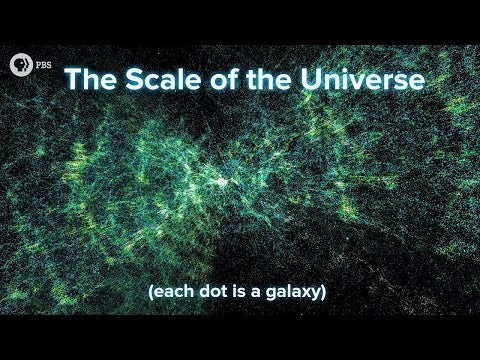
Thank you to Draper and its Hack the Moon initiative for supporting PBS Digital Studios | Learn more at https://wehackthemoon.com. (https://wehackthemoon.com./) Uploaded 25-07-19 PBS Member Stations rely on viewers like you. To support your local station, go to: http://to.pbs.org/DonateSPACE One of the fundamental questions humanity has always asked is how big is our Universe? For much of human history, people believed that Planet Earth was the very center of the entire universe. And Earth is pretty big. But compared the rest of the universe, we are infinitesimally small. The animation in this video the Digital Universe data collection curated by the American Museum of Natural History. The software is used to visualize these datasets is OpenSpace, which is developed through a collaboration between AMNH, Linköping University in Sweden, New York University, and the University of Utah. The software and datasets are open source and are free to download and explore. https://www.openspacepro
How do you build a network product when it only works if everyone around you is already using it? Originally recorded in 2024, Tinder founder Sean Rad explains how the company went from a few hundred users to the world’s #1 dating app. Sean joins a16z General Partner Andrew Chen to unpack Tinder’s early product decisions, why the team avoided mass marketing in favor of building density on college campuses, and how the swipe experience grew out of designing specifically for mobile. They also discuss why product-market fit has to come before marketing, how Tinder learned from failed features, and why listening to users mattered more than competitors or the press. Resources: Learn more about Speedrun:https://a16z.com/games/speedrun/ Find Sean on Twitter:https://x.com/seanrad Find Andrew on Twitter:https://x.com/andrewchen Stay Updated: Find a16z on YouTube: YouTube (https://www.youtube.com/@a16z) Find a16z on X (https://x.com/a16z) Find a16z onLinkedIn (https://www.linkedin.com/company/a1
What if one of healthcare’s most powerful interventions isn’t a drug, but food? Originally recorded in 2020, this conversation looks at how nutrition could help prevent and manage chronic disease while lowering healthcare costs. Julie Yoo speaks with Dr. Andrea Feinberg and Plated co-founder Josh Hix about food insecurity, medically tailored meals, reimbursement, and why access and convenience can matter as much as knowing what’s healthy. They also discuss how online grocery shopping and delivery could reshape people’s food environments, and what it would take to make nutritious food a more integrated part of healthcare. Resources: Follow Dr. Andrea Feinberg on LinkedIn:https://www.linkedin.com/in/andrea-feinberg-md-9584a8b7 Follow Josh Hix on X:https://x.com/joshhix Follow Julie Yoo on X:https://x.com/julesyoo Stay Updated: Find a16z on YouTube: YouTube (https://www.youtube.com/@a16z) Find a16z on X (https://x.com/a16z) Find a16z onLinkedIn (https://www.linkedin.com/company/a16z) Foll
Can you turn the lessons you learn from experience into a repeatable system for making better decisions? Ray Dalio argues that writing down the principles behind your decisions, testing them against history, and eventually turning them into algorithms can help. In this archive conversation, Ray joins a16z’s Alex Rampell and Sonal Chokshi to discuss decision-making under uncertainty, learning from mistakes, and why understanding cause and effect matters more than blindly trusting a black-box model. They also get into radical open-mindedness, judging people on process rather than outcomes, building teams around complementary strengths, and why knowing what you don’t know may be more valuable than what you do. Resources: Follow Ray Dalio on X:https://x.com/RayDalioX Blog (https://blog.x.com/en/insights/finance-tweets-of-the-month--april-2017) Follow Alex Rampell on X:https://x.com/arampellAndreessen Horowitz (https://a16z.com/author/alex-rampell/) Follow Sonal Chokshi on X:https://x.com/s
Research announcements should give uncertainty as much attention as promising findings.
Share your view, then see how readers voted. No sign-in required. This poll is shared across stories.
Do you agree or disagree?
Common Quandary
A Common Quandary to discuss
Another conversation to explore, separate from this news story.
You have outgrown a lonely friend. Do you keep inviting them anyway?
An old friend keeps asking to join your newer social circle. They have done nothing wrong, but you no longer enjoy spending time together and suspect they have few other close relationships.
Can compassion require maintaining a friendship you no longer choose?