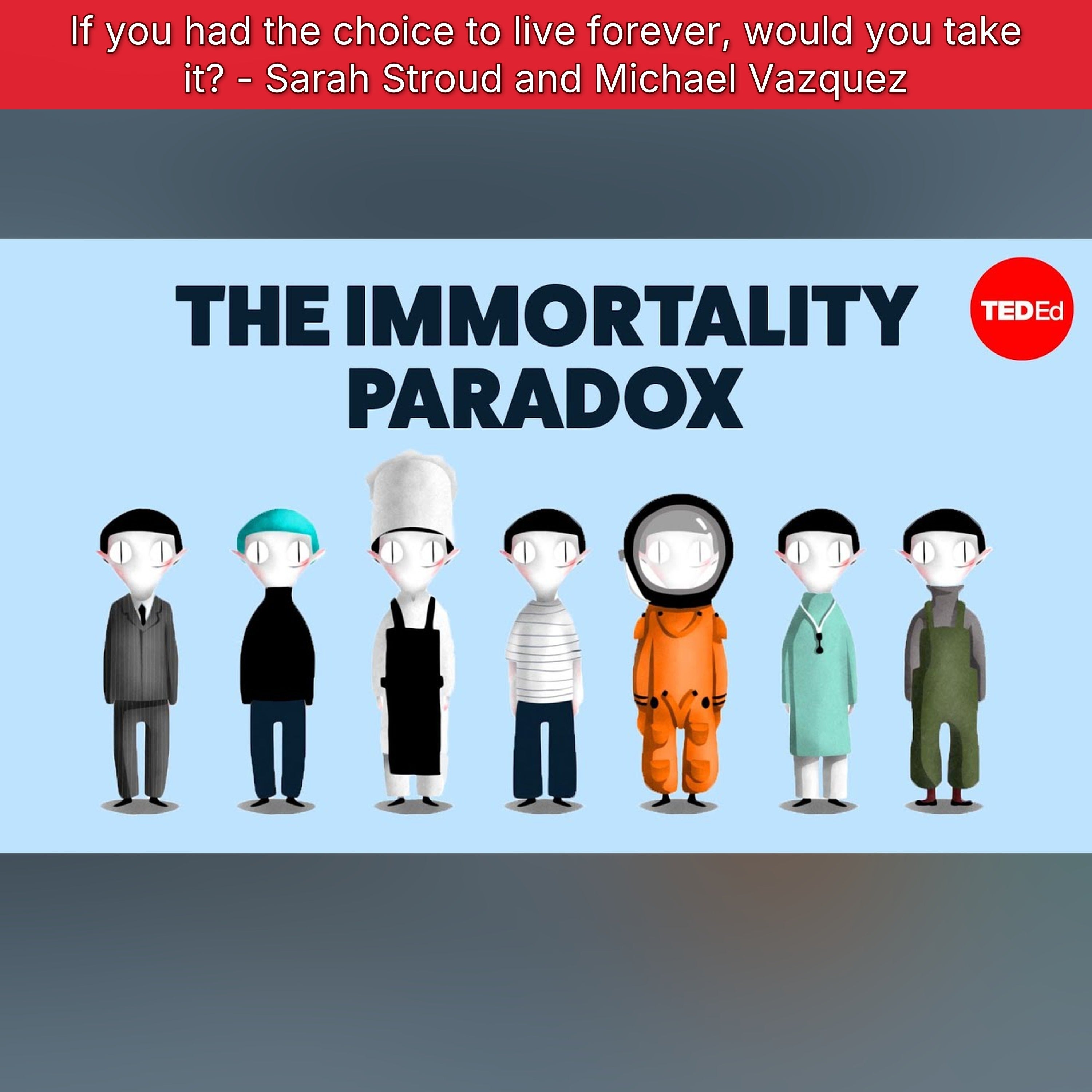
If you had the choice to live forever, would you take it? - Sarah Stroud and Michael Vazquez
Listen through the publisher, then discuss the episode here or arrange an in-person Roundtable. Your city determines where to meet.
Roundtables are designed for groups of four, with a shared subject and room for everyone to speak. Come for discussion, with no dating expectation.
Explore different philosophers’ ideas on immortality and dig into their theories about the positives and negatives of eternal life. -- While cleaning out your uncle’s attic you find a chest with a sparkling potion. The attached tag declares drinking this liquid will make you immortal. Your body will be frozen at its current age, and these effects would be final and irreversible. The instructions are clear — the only question is, do you drink the potion? Sarah Stroud and Michael Vazquez explore this philosophical debate. Lesson by Sarah Stroud and Michael Vazquez, directed by Skirmanta Jakaitė. This video was produced in collaboration with the Parr Center for Ethics, housed within the renowned Philosophy Department at the University of North Carolina at Chapel Hill. The Parr Center is committed to integrating abstract work in ethical theory with the informed discussion of practical ethical issues, and prides itself on the development of innovative and inclusive approaches to moral and civic education. Learn more about how TED-Ed partnerships work: https://bit.ly/TEDEdPartner Support Our Non-Profit Mission ---------------------------------------------- Support us on Patreon: http://bit.ly/TEDEdPatreon Check out our merch: http://bit.ly/TEDEDShop ---------------------------------------------- Connect With Us ---------------------------------------------- Sign up for our newsletter: http://bit.ly/TEDEdNewsletter Find us on Twitter: http://bit.ly/TEDEdTwitter Peep us on Instagram: http://bit.ly/TEDEdInstagram ---------------------------------------------- Keep Learning ---------------------------------------------- View full lesson: https://ed.ted.com/lessons/if-you-had-the-chance-to-be-immortal-would-you-take-it-sarah-stroud-and-michael-vazquez Dig deeper with additional resources: https://ed.ted.com/lessons/if-you-had-the-chance-to-be-immortal-would-you-take-it-sarah-stroud-and-michael-vazquez/digdeeper ---------------------------------------------- Thank you so much to our patrons for your support! Without you this video would not be possible! Matthew Neal, Denis Chon, Julian Oberhofer, Monte Carroll, Eddy, Jay M, Constantino Victor Delgado, Andrea Galvagni, Andrew Tweddle, Laurel-Ann Rice, Fernando A. Endo, Helen Lee, pam morgan, sarim haq, Gerardo Castro, Michel-Ange Hortegat, Enes Kirimi, Amaury BISIAUX, ND, Samyogita Hardikar, Vanessa Graulich, Vandana Gunwani, Abdulmohsin Almadi, AJ Lyon, Geoffrey Bultitude, Mi Mi, Thomas Rothert, Brian Elieson, Oge O, Weronika Falkowska, Nevin Spoljaric, Sid Chanpuriya, Anoop Varghese, David Yastremski, Noah Webb, Roberto Chena, Oliver Koo, Luke Pisano, Andrea Gordon, Aleksandar Donev, Nicole Klau Ibarra, Jesse Lira, Ezekiel Raui, Petr Vacek, Dennis, Olivia Fu, Kari Teffeau, Cindy Lai, Rajath Durgada Manjunath, and Dan Nguyen.
Episode information is provided by the publisher. Listening takes place on the publisher’s service.
Listen at the source ↗