Listen through the publisher, then discuss the episode here or arrange an in-person Roundtable. Your city determines where to meet.
Roundtables are designed for groups of four, with a shared subject and room for everyone to speak. Come for discussion, with no dating expectation.
Merriam-Webster's Word of the Day for November 13, 2026 is: impertinent • \im-PER-tuh-nunt\ • adjective Impertinent is a formal word describing someone or something that is rude and showing a lack of respect. // The band stopped doing interviews after years of journalists asking invasive and impertinent questions. See the entry > (https://www.merriam-webster.com/dictionary/impertinent) Examples: “On Friday night, I discovered that the plans I had for Saturday morning were not going to work out, so I decided to go fishing instead. It was too late to hitch up with a fishing buddy, and it would be impertinent to ask permission to fish on someone’s private property at such a late hour, so I decided to go by myself to the public section of the Soque River.” — Bill Hager, The White County (Georgia) News, 7 July 2026 Did you know? A pertinent statement or remark is one that pertains—that is, is relevant—to the subject at hand. It stands to reason, therefore, that impertinent could be used to describe things that are irrelevant. Indeed, “not pertinent” is the word’s oldest meaning, dating to the 15th century. A pertinent question: how did a word meaning “irrelevant” come to also describe someone as rude (now the more common sense of impertinent)? The answer comes down to the particular quality of rudeness on display. Burping loudly while your teacher is giving a lecture, for example, would be rude, but unlikely to be called impertinent. Raising your hand mid-lecture to ask where your teacher purchased such a ridiculous sweater, however, would be impertinent, i.e. such a question is rude because it in no way pertains to the matter at hand in a classroom.
Episode information is provided by the publisher. Listening takes place on the publisher’s service.
The gate doesn't have a lock. It doesn't have a key. There's nobody standing on the other side waiting to wave you through. Uploaded 09-09-26 The gate was open the whole time. You just couldn't see it, because you were staring at the ground, waiting for your feet to feel light. You've been standing there for years, warming up for a race you never run. Here is the truth: readiness is not a feeling you receive. It is a decision you make. The people who built the things you wish you'd built didn't feel more ready than you do — they just stopped waiting to feel it. This seminar unpacks the single mechanic behind why you never feel ready — and why willingness, not readiness, is what actually builds a life. CHAPTERS 0:00 Intro — The gate was open the whole time 2:04 The classroom lie: prepare, then perform 4:24 Fear wearing the mask of wisdom 6:36 Readiness is a quality you bring, not a state you arrive at 8:24 The glass never fills — skill comes from use 11:36 The cruel arithmetic of the wa
To check the transcript: https://www.buzzsprout.com/2379282 Imagine someone who has lived abroad for many years. One evening, they're talking to a friend about their hometown. They mention the streets they used to walk down, the familiar voices, and the little things they never thought they'd miss. Their friend asks: “Why do you get so emotional whenever you talk about your hometown? Do you want to move back?” They reply: “It's not that simple. It goes deeper than that. I miss a version of my life that doesn't exist there anymore.” Hello everyone, and welcome to Daily English. Today's expression is “It goes deeper than that.” We use this expression when something is more complicated, meaningful, or emotionally significant than it first appears. In other words, there's something beneath the surface that people might not immediately recognize. In our opening example, the person isn't necessarily longing to return to their hometown. What they miss might be their childhood, the people they
Until a little under two weeks ago, Silicon Valley Bank was the sixteenth largest bank in the United States, the favoured choice of tech startups due to the tailored services it provided. But by 10th March 2023, American authorities were taking control of SVB following its collapse. It had assets of over $200bn, making for the second biggest bank failure in US history. There were a number of factors behind the collapse, and it’s causing concern as it’s common for one bank collapse to be followed by another, due to what’s called financial contagion. Indeed, just a few days later it was the turn of New York-based Signature Bank to collapse. And over in Europe, Switzerland’s second largest bank Crédit Suisse had to take out a $54bn to stay afloat, before then being bought out by the country’s largest bank UBS, in a bid to halt the crisis. Why did Silicon Valley Bank collapse? How do stock market crashes happen? In under 3 minutes, we answer your questions! To listen to the last episodes,
Get the 200+ Page Optimal Living Daily Workbook (PDF) - Free. Want to turn today's episode into an actionable plan? Episode 4232: Chris Guillebeau shares a candid, funny account of his lack of qualifications, from a short-lived dishwashing job to failing his way through statistics and shrink-wrapping pallets. He argues that formal credentials matter far less than people think, and that anyone who builds a good life without them should treat that work with gratitude and diligence. It is an encouraging take on personal development for anyone who has ever felt like an imposter. Read along with the original article(s) here: https://chrisguillebeau.com/qualifications/ Quotes to ponder: "First, forget about what you're actually qualified to do. It's irrelevant and no one cares." "Fourth, when you do find something that works for you, you should be very grateful, every day." "Regardless of your actual qualifications, there's one thing that no one can give you and no one can take away: the wil
A.I. for Building Self-esteem: Seeing Yourself More Clearly and Kindly, a practical, beginner-friendly look at how artificial intelligence can help you see yourself a little more clearly and kindly. Building Self-esteem? Press play on Episode 427 of A.I. for Beginners and learn exactly how artificial intelligence, especially ChatGPT, alongside a journaling app, can help you see yourself a little more clearly and kindly. WHAT YOU WILL LEARN IN THIS EPISODE - Why building self-esteem is so hard to handle alone, and what is actually going on underneath it - A specific way to use a journaling app to work through it, step by step - An example prompt you can copy word for word: "Help me notice when I'm judging myself far harsher than I'd judge a friend" - A second practical technique, with another ready-to-use prompt: "Help me write down three qualities I actually like about myself, beyond achievements" WHO THIS EPISODE IS FOR - Anyone currently working on building self-esteem - Anyone curio
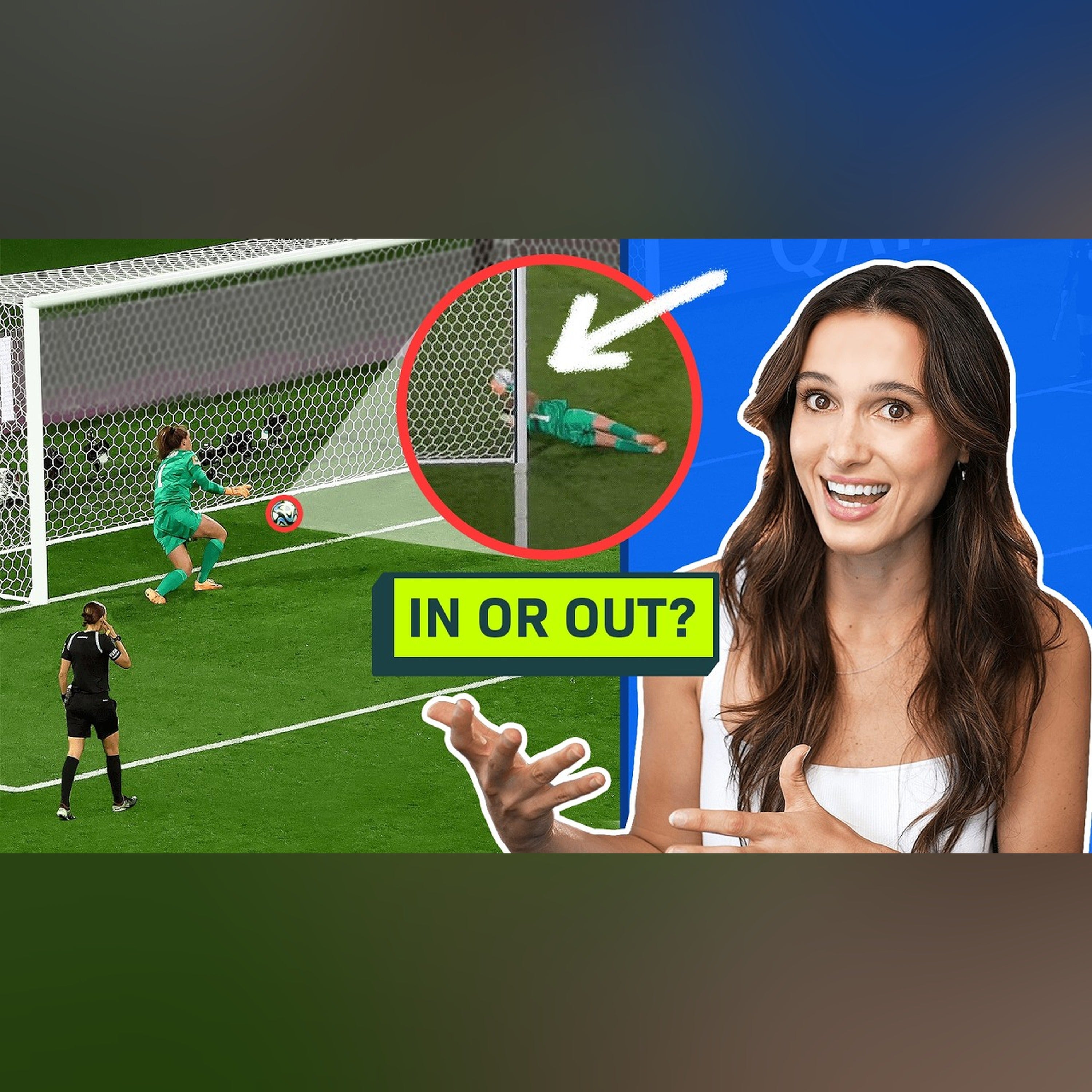
Are AI referees ruining sports? Or making them better? If you’re watching the 2023 US Open, you’re seeing automated referee calls. After years of controversy about human accuracy, tennis has used a system called Hawkeye to not only check human calls… but now to replace human referees. And this robot ref revolution isn’t just happening in tennis. It’s taking over the sports world. Soccer, basketball, baseball, they are all using machines to improve the calls being made on the field. The World Cup in particular has invested in these tools, from VAR (video assistant referee) to semi-automated offside and goal-line technology. The stakes are high. The difference between a right or wrong call can be a championship, or millions of dollars in prizes, endorsements, ticket sales. For the most part, fans like tech that makes calls more objective. HOWEVER… there is a big chunk of sports fans who would strongly disagree, who think that robot refs are ruining the game. Thing is, this tech isn’t goi
Merriam-Webster's Word of the Day for November 21, 2026 is: meet-cute • \MEET-kyoot\ • noun Meet-cute refers to a cute, charming, or amusing first encounter between romantic partners. A meet-cute can be such an encounter as shown in a movie or television show, or one that happens in real life. // Their meet-cute felt as if it came straight out of a romantic comedy. See the entry > (https://www.merriam-webster.com/dictionary/meet-cute) Examples: “Two women, Dylan and Melanie, cross paths on an artificial beach in a near-apocalyptic meet-cute: one has emerged from the underwater pod in which she was raised, the other works at a luxury resort as a bartender… and may also be a robot.” — Natalie Zutter, Literary Hub, 2 Jan. 2026 Did you know? Isn’t it cute how two words can be introduced to each other and become an inseparable pair soon after? Well, that’s exactly what happened when meet and cute got together in the early 1950s. The duo was spotted in The New York Times Book Review in 1952
Merriam-Webster's Word of the Day for November 20, 2026 is: ruthless • \ROOTH-lus\ • adjective Ruthless means "having no pity." It describes people, behaviors, circumstances, etc. regarded as cruel or merciless. // Wolves and other large carnivores are often portrayed (and feared) as ruthless predators even as they play vital roles in their ecosystems. See the entry > (https://www.merriam-webster.com/dictionary/ruthless) Examples: "One of Shakespeare's most powerful and enduring tragedies, 'Macbeth' remains an urgent and gripping story. Ambition and prophecy collide as a fateful prediction drives Macbeth into a ruthless pursuit of power, destroying everything in his path." — The Daily Gazette (Schenectady, New York), 25 Sept. 2026 Did you know? Ruthless can be defined as "without ruth" or "having no ruth." So what, then, is ruth? The noun ruth (https://www.merriam-webster.com/dictionary/ruth), which is now considerably less common than ruthless, means "compassion for the misery of anot
Merriam-Webster's Word of the Day for November 19, 2026 is: upbraid • \up-BRAYD\ • verb To upbraid someone is to speak to them in an angry or critical way in response to something they have done wrong—in other words, to scold them. // The teacher upbraided the class after discovering the chalkboard erasers had been clapped all over the walls. See the entry > (https://www.merriam-webster.com/dictionary/upbraid) Examples: “An industrious ant spends all summer gathering food for the cold months, while a lazy grasshopper dances and sings. Once winter hits, the grasshopper is cold and hungry, and goes begging for food from the ant, who refuses to share any of its bounty, upbraiding the grasshopper for failing to plan.” — David A. Graham, The Atlantic, 17 Apr. 2026 Did you know? First things first: do not confuse upbraid with topknot lest you be upbraided for it. Topknot is a noun referring to a hairstyle, while upbraid is a verb (and an ancient one at that) meaning “to criticize or scold se
Correcting clear officiating errors is worth some interruption to a game's flow.
Share your view, then see how readers voted. No sign-in required. This poll is shared across stories.
Do you agree or disagree?
Common Quandary
A Common Quandary to discuss
Another conversation to explore, separate from this news story.
Your carry-on fits only if you sit on it. Do you try the airport sizer?
Your suitcase is slightly larger than the airline allows, although it has fit overhead on previous flights. Checking it costs extra and risks missing a connection. Other passengers have equally questionable bags and staff are checking inconsistently.
Does uneven enforcement weaken a traveler's duty to follow the rule?