English-language podcasts

CrashCourse

Introduction to Biology: Crash Course Biology #1

20 min

Listen through the publisher, then discuss the episode here or arrange an in-person Roundtable. Your city determines where to meet.

Roundtables are designed for groups of four, with a shared subject and room for everyone to speak. Come for discussion, with no dating expectation.

Biology is the study of life—a four-letter word that connects you to 4 billion years worth of family tree. The word “life” can be tricky to define, but a shared set of characteristics helps biologists identify living things. In this episode of Crash Course Biology, you’ll learn how all of life is connected, and why studying biology can help us better understand ourselves and our relationship to all living things. Chapters: Welcome to Crash Course Biology! 00:00 Life's Characteristics 2:14 Is a Virus Alive? 6:18 Life Beyond Earth 8:52 Biology and You 10:03 All Life is Connected 10:44 Review & Credits 11:59 Sources: https://docs.google.com/document/d/1GLDtAXE6ekg4Chk2qN3TYbNt0pJbyaHqTqRd6QY8pd4/edit?usp=sharing This series was produced in collaboration with HHMI BioInteractive, committed to empowering educators and inspiring students with engaging, accessible, and quality classroom resources. Visit https://BioInteractive.org/CrashCourse (https://biointeractive.org/CrashCourse) for more information. Check out a free collection of kahoots based on this video here: https://create.kahoot.it/course/ccc14ccd-b511-4c6a-bd54-30965b18e530 Are you an educator looking for what NGSS Standards are covered in this episode? Check out our Educator Standards Database for Biology here: https://www.thecrashcourse.com/biologystandards Check out our Biology playlist here: https://www.youtube.com/playlist?list=PL8dPuuaLjXtPW_ofbxdHNciuLoTRLPMgB Watch this series in Spanish on our Crash Course en Español channel here: https://www.youtube.com/playlist?list=PLkcbA0DkuFjWQZzjwF6w_gUrE_5_d3vd3 Crash Course Biology is hosted by Dr. Samuel Ramsey. Learn more about him here: https://www.drsammy.online/ *** Crash Course is on Patreon! Thanks to the following patrons for their generous monthly contributions that help keep Crash Course free for everyone forever: Katie, Tori Thomas, DL Singfield, Ken Davidian, Stephen Akuffo, Toni Miles, Steve Segreto, Kyle & Katherine Callahan, Laurel Stevens, Burt Humburg, Allyson Martin, Aziz Y, Perry Joyce, Scott Harrison, Mark & Susan Billian, Alan Bridgeman, Rachel Creager, Breanna Bosso, Matt Curls, Jennifer Killen, Jon Allen, Sarah & Nathan Catchings, team dorsey, Trevin Beattie, Eric Koslow, Jennifer Dineen, Indija-ka Siriwardena, Jason Rostoker, Siobhán, Ken Penttinen, Nathan Taylor, Les Aker, William McGraw, ClareG, Rizwan Kassim, Constance Urist, Alex Hackman, Pineapples of Solidarity, Katie Dean, Stephen McCandless, Wai Jack Sin, Ian Dundore, Justin, Mark, Caleb Weeks. __ Want to find Crash Course elsewhere on the internet? Facebook - http://www.facebook.com/YouTubeCrashCourse Twitter - http://www.twitter.com/TheCrashCourse Instagram - https://www.instagram.com/thecrashcourse/ CC Kids: http://www.youtube.com/crashcoursekids

Episode information is provided by the publisher. Listening takes place on the publisher’s service.

Listen at the source ↗

Featured places to meet in Palo Alto, CA

Explore these places and arrange a conversation through ThinkMatch.

City guide for Palo Alto, CA

More from CrashCourse

CrashCourse

Dark Energy, Cosmology part 2: Crash Course Astronomy #43

18 min

The majority of the universe is made up of a currently mysterious entity that pervades space: dark energy. We don’t know exactly what it is, but we do know that dark energy accelerates the expansion of space. We think this means the Universe will expand forever, even as our view of it shrinks while space expands faster all the time. Check out the Crash Course Astronomy solar system poster here: http://store.dftba.com/products/crashcourse-astronomy-poster If you want to learn more about the creation and death of the universe, watch Crash Course Big History here: https://youtube.com/playlist?list=PL8dPuuaLjXtMczXZUmjb3mZSU1Roxnrey -- Chapters: Introduction: The Expanding Universe 00:00 The Expansion of Space is Accelerating 2:17 What is Dark Energy? 4:19 Will the Universe Expand Forever? The Geometry of the Universe 5:20 The Cosmic Horizon of the Observable Universe 6:50 Review 10:20 -- GEOMETRY OF THE UNIVERSE RESOURCES Geometry: Expanding faster than light: General expansion: -- PBS Di

Discuss this episode

CrashCourse

Diazonium Salts and Nucleophilic Aromatic Substitution: Crash Course Organic Chemistry #47

20 min

Have you ever wondered where cured meats like salami or pepperoni get their bright red color? Of course its from organic chemistry! A chemical called nitric acid gives them that bright color, while also increasing their shelf. It's also involved in some other interesting reactions. In this episode of Crash Course Organic Chemistry we'll see how nitrous acid reacts with primary amines to form diazonium salts, we'll learn about alkyldiazonium salts and aryldiazonium salts, and see what conditions are necessary for nucleophilic aromatic substitutions. Series Sources: Brown, W. H., Iverson, B. L., Ansyln, E. V., Foote, C., Organic Chemistry; 8th ed.; Cengage Learning, Boston, 2018. Bruice, P. Y., Organic Chemistry, 7th ed.; Pearson Education, Inc., United States, 2014. Clayden, J., Greeves, N., Warren., S., Organic Chemistry, 2nd ed.; Oxford University Press, New York, 2012. Jones Jr., M.; Fleming, S. A., Organic Chemistry, 5th ed.; W. W. Norton & Company, New York, 2014. Klein., D., Organ

Discuss this episode

CrashCourse

Alkene Addition Reactions: Crash Course Organic Chemistry #16

19 min

Like a trendy dance, a fighting combo, or a secret handshake, organic reactions can be broken down into simpler steps. In this episode of Crash Course Organic Chemistry, we’ll specifically be looking at alkene addition reactions, and with each new reaction ask ourselves three questions to help us puzzle through the mechanism and understand what’s going on. Episode Sources: Le Couteur, P, Burreson, J. Napoleon’s Buttons: 17 molecules that changed history., Penguin, New York, 2004, Chapter 1. Whipps, H., “How the Spice Trade Changed the World,” https://www.livescience.com/7495-spice-trade-changed-world.html Last accessed, 3/28/2020. Henriques, Martha, “How spices changed the ancient world,” http://www.bbc.com/future/bespoke/made-on-earth/the-flavours-that-shaped-the-world/ Last accessed, 3/28/2020. Hashimoto, K., Yaoi, T., Koshiba, H., Yoshida, T., Maoka, T., Fujiwara, Y., Yaamoto, Y, Mori, K., “Photochemical Isomerization of Piperine, a Pungent Constituent of Pepper”, Food Sci. Technol.

Discuss this episode

Community Poll

Documentaries should disclose editing choices that substantially affect how events are understood.

Share your view, then see how readers voted. No sign-in required. This poll is shared across stories.

Do you agree or disagree?

Choose one answer

Common Quandary

A Common Quandary to discuss

Another conversation to explore, separate from this news story.

The restaurant gives free birthday cake. Is moving your birthday by a week close enough?

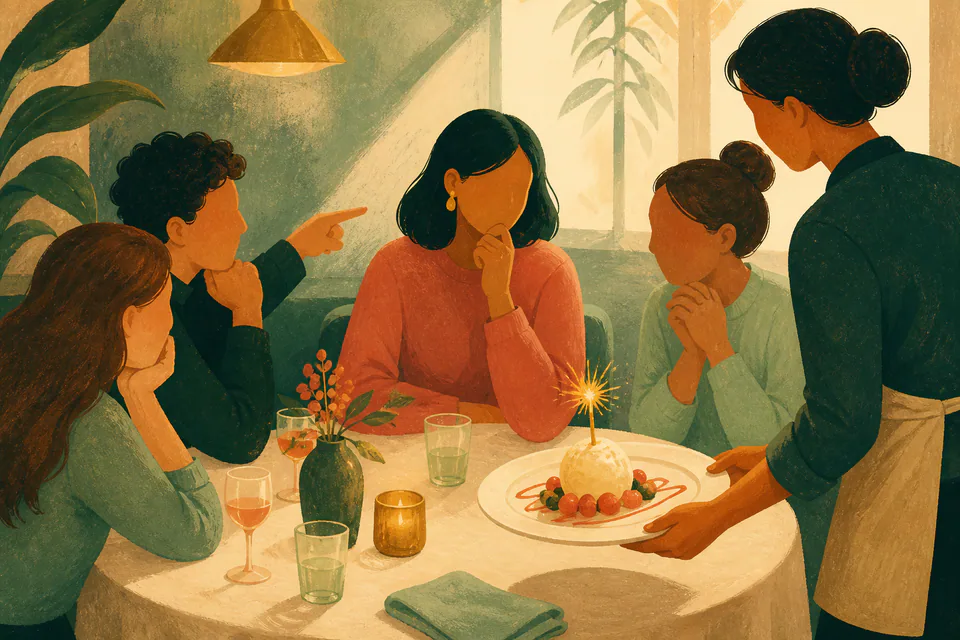
A restaurant offers a spectacular free dessert on birthdays. Your birthday was last week, but nobody took you out then. When the server asks whether anyone is celebrating, your friends point at you and wait for your answer.

How much flexibility can a harmless celebration tolerate before it becomes a lie?

Explore this quandary