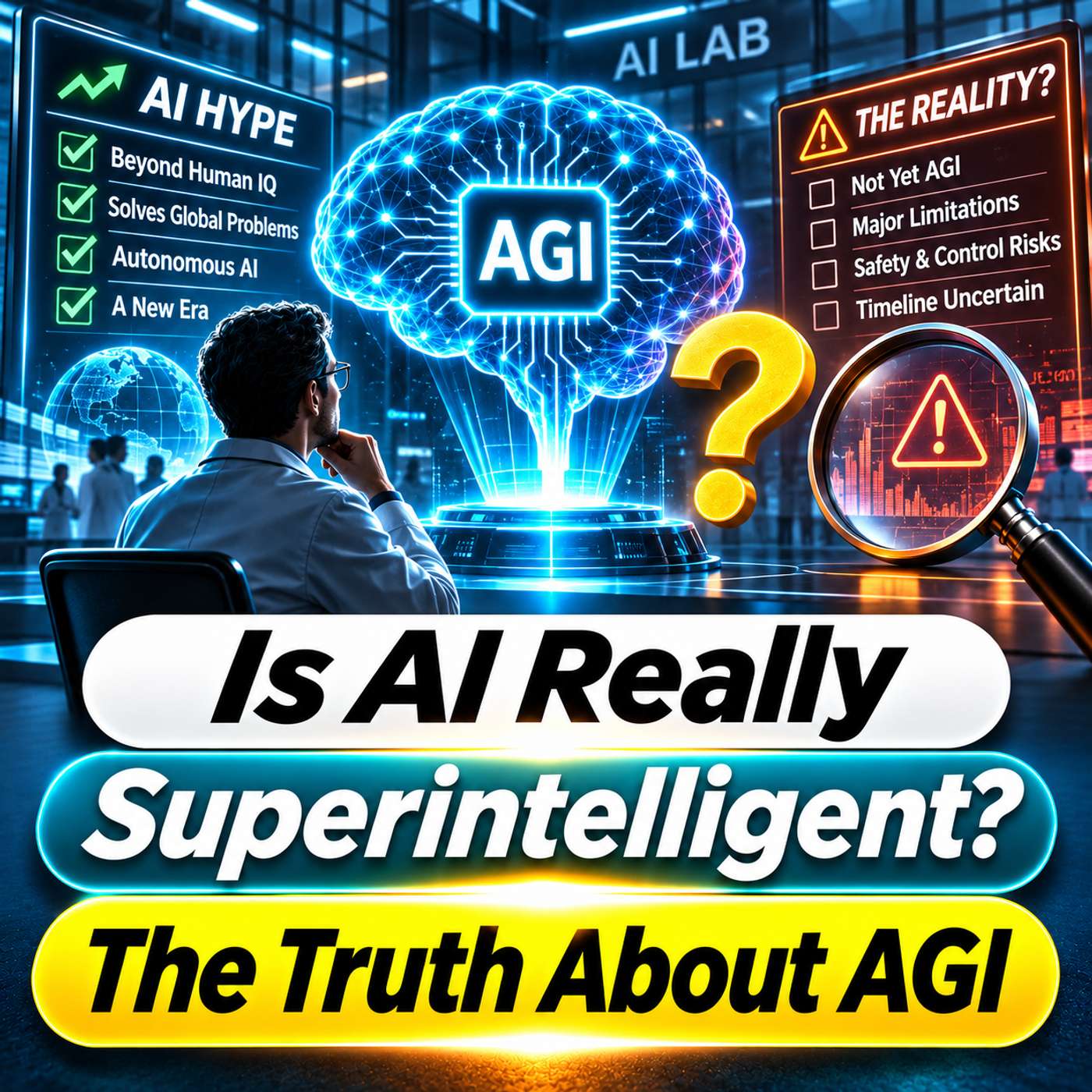
Is AI Really Superintelligent? The Truth About AGI
Listen through the publisher, then discuss the episode here or arrange an in-person Roundtable. Your city determines where to meet.
Roundtables are designed for groups of four, with a shared subject and room for everyone to speak. Come for discussion, with no dating expectation.
Artificial intelligence can pass difficult exams, analyze millions of lines of code, and solve complex problems in seconds. But why can the same technology struggle with tasks that even a young child can handle? Is AI actually becoming superintelligent, or are we confusing impressive computational abilities with genuine human-level intelligence? In this episode of TechDaily.ai, hosts David and Sophia examine the reality behind today's AI capabilities, exploring the differences between Artificial Narrow Intelligence (ANI), Artificial General Intelligence (AGI), and Artificial Superintelligence (ASI). From the four pillars of intelligence to the limitations of large language models, this conversation investigates why AI can achieve extraordinary results in specialized tasks while struggling with everyday reasoning, physical interaction, and common sense. David and Sophia also explore Moravec's paradox, AI hallucinations, causal reasoning, and the critical challenges researchers face as they work toward more capable artificial intelligence. In This Episode: Artificial Narrow Intelligence (ANI): Why today's AI excels at specialized tasks but can struggle when applying its capabilities to unfamiliar situations. Artificial General Intelligence (AGI): What it would take for machines to demonstrate broad, human-level cognitive abilities across different domains. Artificial Superintelligence (ASI): The theoretical stage where machine intelligence could surpass human cognitive capabilities. The Four Pillars of Intelligence: How perception, thinking, learning, and action contribute to adaptable intelligence. Moravec's Paradox: Why tasks that humans perform effortlessly can be extraordinarily difficult for robots, even when machines outperform experts in complex intellectual challenges. AI Reasoning and Common Sense: Why recognizing patterns is different from reasoning about cause and effect in the physical world. AI Benchmarks and ARC-AGI: How novel reasoning puzzles attempt to measure generalization rather than memorized knowledge. AI Hallucinations: Why large language models can generate confident but inaccurate answers and what this reveals about their limitations. The AI Alignment Problem: Why ensuring that increasingly capable AI systems behave according to human goals and safety requirements remains a major research challenge. The Paperclip Maximizer: How a hypothetical superintelligent system pursuing a poorly defined objective illustrates the dangers of uncontrolled optimization. AI Safety and Human Control: Why building more powerful AI also requires better oversight, reliable safeguards, and mechanisms for maintaining human autonomy. One of the central ideas explored in this episode is that intelligence isn't simply about processing information faster. Humans can walk into an unfamiliar coffee shop, recognize social cues, adapt to a new environment, interpret unexpected events, and interact with physical objects almost effortlessly. For machines, combining those abilities into a reliable, adaptable system remains a difficult engineering challenge. Meanwhile, increasingly capable AI systems are being integrated into software development, business operations, healthcare, and other important areas of society. As the race toward AGI and superintelligence accelerates, David and Sophia examine a fundamental question: How can humanity ensure that AI capabilities don't advance faster than our ability to control them? And perhaps the most important measure of intelligence isn't whether a machine can answer every question. Maybe it's whether that machine can recognize its own limitations and genuinely acknowledge when it doesn't know something. Join David and Sophia for a discussion about artificial intelligence, human cognition, AI safety, and the future of intelligent machines. Share this episode with anyone curious about AGI, AI superintelligence, or what separates human intelligence from machine learning. Stay curious!
Episode information is provided by the publisher. Listening takes place on the publisher’s service.
Listen at the source ↗