Kurt Geiger CEO: Neil Clifford – Invisible Jobs, Hiring For Attitude, & Being The One Person
62 min
Listen through the publisher, then discuss the episode here or arrange an in-person Roundtable. Your city determines where to meet.
Roundtables are designed for groups of four, with a shared subject and room for everyone to speak. Come for discussion, with no dating expectation.
The Gstaad Guy sits down with Neil Clifford, CEO of Kurt Geiger, and a man who left school in 1983 with a report saying it was a shame he did not try harder, to explore why the best jobs have become invisible to the people who would be best at them. With a career built from a hardware shop counter in Portsmouth to the top of a global footwear and accessories business, Neil reflects on curiosity as a superpower, the difference between the skills you can teach and the attitude you cannot, and the one person who gives somebody their break. The conversation dives into the jobs that are never advertised, how badly retail sells itself as a career, and the case for hiring on attitude and adding the skills afterwards. Neil makes the case for apprenticeships, for employers who walk into the job centre themselves, and for the art teacher who lends a fourteen year old a camera and changes the whole shape of a life. A direct look at access, attitude and the quiet work of opening doors. Filmed at The Twenty Two (London), Gingko Suite. (00:00) Intro ️ (01:48) Surviving The Pandemic (03:07) Retail Undersells Itself ️ (03:42) Six Months Of Wednesdays ️ (05:17) These Jobs Are Invisible ☕ (05:59) Be The One Person ☝️ (06:58) Two Million And A School (09:28) How Do You Try Harder? (10:26) Twelve Percent Unemployment (11:39) Delivering Paraffin (13:19) Debenhams, Portsmouth, 1985 (14:04) The Etch A Sketch ️ (15:19) Nine Thousand And My Own Keys (18:01) The FT In The Window (20:16) Retail Is Art And Science (22:05) Two Years And A Kombi ⏳ (24:49) Sixty Million, Losing Two (26:06) Who Kurt Geiger Was (29:17) Betting On A Handbag (30:12) Everyone Needs An American 🇺🇸 (32:13) A Firework Display (33:24) Saved By America 🇺🇸 (36:31) Why London ️🇬🇧 (41:45) If Your Company Hasn’t Got It (45:14) Skin Grows Over My Ears (46:50) My Alarm Is 4:47 ⏰ (51:38) Attitude Over Skills (54:04) À La Poubelle vs. Fantastique ️ (57:23) Curiosity Over Nostalgia (1:00:25) I Think Best Moving (1:02:49) Hairy Angels
Episode information is provided by the publisher. Listening takes place on the publisher’s service.
There are two kinds of people sitting in this room tonight. They look the same. They talk almost the same. They want almost the same things out of life. But one of them is going to have a very different life than the other. Uploaded 16-10-26 And the gap between them has nothing to do with talent, nothing to do with luck, nothing to do with where they started. It has to do with what they do every single day. The small things. The things nobody claps for. The things nobody sees. One of them is a dreamer. He can describe the business he's going to build, the body he's going to have, the house he'll live in. And five years from now, he'll describe the very same life, in the very same words, still not having it. The other is a doer. He may stumble over his words, but he's been quietly building the thing while the dreamer talked about it. Here is the truth: a dream without a habit attached to it is just a wish. The habit is the bridge, and most people never build it, so they stand on one sid
Imagine if every big change in our lives came with a whole community stepping up beside us… In this episode, I sit down with Dr Arne Rubinstein, former GP and emergency doctor, founder of the Rites of Passage Institute, and a man who's spent more than 30 years walking young people across the threshold into adulthood. Arne's work began around a fire at his very first men's gathering, listening to a hundred men wrestle with the same handful of wounds. Then in the Emergency Dpt, he kept meeting teenagers who'd pushed it one step too far... kids trying to become adults with nobody there to hold them. He came to believe every young person will go through a rite of passage either way. The question is whether we leave them to create their own, or gather around and help. We talk about why our culture is so good at turning away from the big moments - from first periods to menopause to death - and what opens up when we turn towards them. We explore: Separation, transformation and integration, an
What will you do when the going gets tough? How will you react to economic winter, changes in the market and other events beyond your control? Will you shrink back in fear and adopt an attitude of scarcity – or will you power forward and learn how to take advantage of the moment? Uploaded 28-04-20 In this video, Ryan Deiss, CEO of Digital Marketer, best-selling author and expert investor, shares what you can do to not only continue to grow your business, but to grow as a human being as well. There are ways to make the most of hard times as a business leader, marketer, parent and friend. It’s all about turning your obstacles into opportunities. How can you do that? You must shift your focus. Instead of focusing on the negative, find the possibilities. You can head to https://www.tonyrobbins.com/career-business/where-focus-goes-energy-flows to learn how to get focused in this new environment. Tough economic times put most people in a mindset of scarcity and fear. They pull back. Business
Happy Sunday! Welcome to Heal Squad’s The Sunday Set Up. Life lessons to help you start the week. How much of success comes down to simply showing up? This week, we talk keeping an open mind, taking chances, and recognizing the doors that open along the way. From Olympic athletes appearing on national television alongside Mercedes Moné to performers who keep showing up week after week hoping for their big break, we explore why success isn't always about talent or luck. Sometimes it's about making connections, putting in the effort, and being willing to try without knowing what we'll get in return. We talk knowing when to stop investing time in people who aren't willing to help themselves, and why even experiences that don't work out can teach us something valuable. The takeaway: don't wait for the perfect moment or expect someone else to make things happen. Be willing to take a chance, walk through the doors that open, and remember that half of life is just showing up. Plus, a little b
We’re about to time travel into the future Sam Altman is building… I interviewed Sam Altman, the CEO of OpenAI, the company behind ChatGPT. They’re trying to build a “superintelligence” that could far exceed humans in almost every field – and they just released their most powerful tool yet, GPT-5. A few years ago, that would’ve sounded like science fiction! Not anymore. In fact, they’re not alone. We’re in the middle of the most high stakes global race any of us have ever seen. Hundreds of billions of dollars and an unbelievable amount of human work… It’s a profound moment. Most people never see a huge technological shift like this in their lives and it’s happening all around us right now. So in this conversation, I’m going to try to time travel into the future with Sam Altman, to see what he’s trying to build… so you and I can really understand what’s coming. Welcome to HUGE* Conversations. Chapters: 0:00 What future are we headed for? 2:06 What can GPT-5 do that GPT-4 can’t? 6:57 Wha
Join NCI University today to master human behavior and influence: Uploaded 05-11-21 This is a dive to discover the possibilities, not the case itself. Sirhan Sirhan, in full Sirhan Bishara Sirhan, (born March 19, 1944, Jerusalem), Palestinian-born Jordanian citizen who was convicted (1969) of fatally shooting U.S. Sen. Robert F. Kennedy on June 5, 1968. He received the death penalty, but the sentence was later commuted to life. Sirhan, a Christian Palestinian, was born in Jerusalem. In 1948 Jordan took control of East Jerusalem and what is now the West Bank, and the following year it granted citizenship to people living in those areas. It is believed that this is how Sirhan became a Jordanian citizen. In the 1950s, he and his family moved to the United States and eventually settled in Pasadena, California. There he attended Pasadena City College and later held odd jobs, notably working at a horse stable and later at a health food store. During this time, Sirhan became vocal in his oppo
The Gstaad Guy sits down with Robert Kyncl, CEO of Warner Music Group, and the executive who helped turn YouTube from a defendant into a business, to explore what it takes to be heard in a world where everybody can publish. With a career built from a talent agency mailroom in Los Angeles through Netflix when it still shipped DVDs and YouTube when it was still losing money and fighting lawsuits, Robert reflects on growing up behind the Iron Curtain, on managing the unknown as a skill rather than a condition, and on why a legacy company should be run like a startup by removing layers rather than adding them. The conversation dives into the difference between emotional software and functional software, why interactivity is the thing recorded music has never had, and the rise of local language charts in markets that English once simply supplied. Robert makes the case for executives who know the detail the way a founder does, for the quick no as the second best decision available to a compa
The Gstaad Guy sits down with Carolina Bucci, founder and jewellery designer, and the fourth generation of a Florentine family that has been making jewellery since 1885, to explore what happens when someone refuses to accept the rules they inherit. With a career built between the workshops of Florence and the shop floors of New York and London, Carolina reflects on designing for herself first, treating no as the opening of a negotiation rather than the end of one, and the difference between a piece that is precious and a piece that is meaningful. The conversation dives into the Florentine finish that makes gold look as though it is covered in diamonds, the four collaborations that reimagined one of the most recognisable watches in the world, and why the best things are the ones you never take off. Carolina makes the case for jewellery that leaves the safe, for scratches worth keeping, and for the kind of personalisation nobody else is meant to see. A warm and exacting look at inheritan
The Gstaad Guy sits down with Ben Gorham, founder and former creative director of BYREDO, who spent his first eighteen years intending to play professional basketball and the next twenty building a fragrance house that only looked sudden from the outside, to explore what patience is worth when nobody is keeping time. With a career built on turning memory into something invisible, Ben reflects on making things for himself long before he knew who would want them, the absurdity of selling scent by gender, and why the people who change the world so often get described the same way. The conversation dives into the moment he first smelt his own work on a stranger, what maximum ambition costs at home, and why spotting a gap in the market no longer works. Ben shares the business plan that lost him the room, the diaries that became one of his bestsellers, and the two questions he asks about any boy his daughter mentions. A grounded look at memory, patience, and building something designed to ou
Predictable working hours are more important than maximum scheduling flexibility.
Share your view, then see how readers voted. No sign-in required. This poll is shared across stories.
Do you agree or disagree?
Common Quandary
A Common Quandary to discuss
Another conversation to explore, separate from this news story.
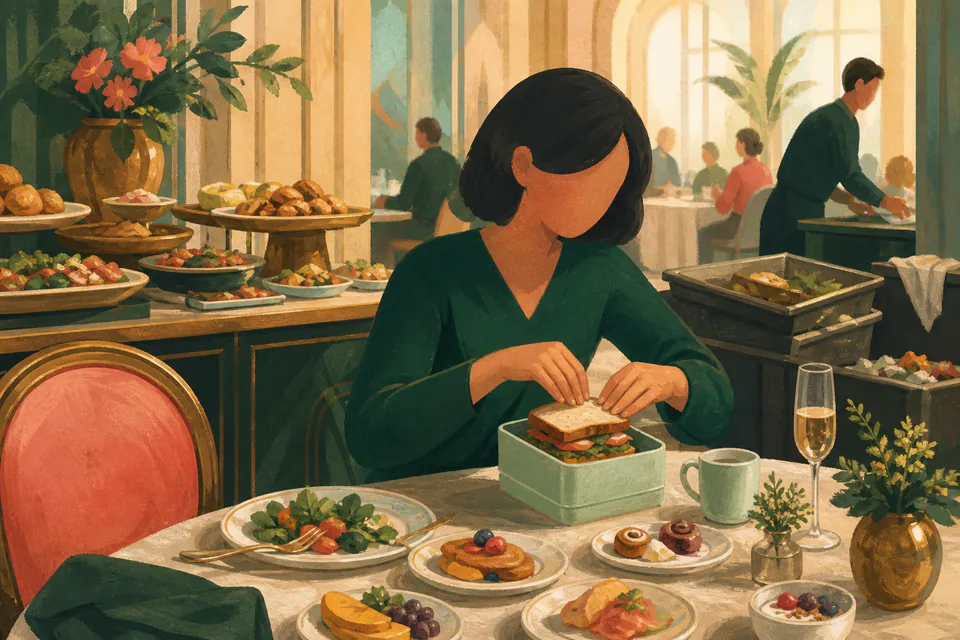
The buffet is unlimited while you are inside. Can one sandwich leave in your pocket?
An expensive hotel brunch advertises unlimited food but forbids takeout. You are full, yet quietly assembling a sandwich for later would cost the hotel almost nothing. Several trays will likely be discarded after service.
Does preventing waste justify ignoring the boundary of a bargain?