Larry Wilmore, Bernie Mac Show Creator: We Won Every Award. Fox Fired Me Anyway.
70 min
Listen through the publisher, then discuss the episode here or arrange an in-person Roundtable. Your city determines where to meet.
Roundtables are designed for groups of four, with a shared subject and room for everyone to speak. Come for discussion, with no dating expectation.
Larry sits down with Daniel Lubetzky to talk about being locked out of auditioning for In Living Color and writing his way onto the staff instead, the one idea inside every scene of The Bernie Mac Show ("Children are terrorists"), and why getting fired from the show he created crushed him — while losing The Nightly Show on Comedy Central felt like relief. He breaks down the difference between a showrunner and an executive producer, why jokes are "truth concentrate," how he knows if a writer has a voice in two pages, and how he gave Quinta Brunson an early break. Plus: selling books door to door, the night he bombed so badly his glasses fogged up, telling David Copperfield "Nope," working on The Office when everyone thought it would flop, and playing Make Me Laugh with his brother as kids. Also: the Marx Brothers, a backstage drink with Bill Clinton, the White House Correspondents' Dinner, why joy drives him more than laughs, and the Mexican Inquisition. Become a Builder: https://buildersmovement.org/ Music: Amos Cochran https://www.editscoremusic.com/ Production: Straybird Studios https://www.straybird.studio/ Post Production: Jennell Lewis & Scott Convery Social Media Production: https://www.edits-etc.com/ Build or Break Team: Executive Producer & Host: Daniel Lubetzky Executive Producer: Kristin Schneider Head of Programming & Production: Joel Rubin Marketing & Communications: Sarah Black Associate Producer & Social Media: Taylor Larned Booking & Scheduling: Kayla Rose Network Relations: Julianna Cohen
Episode information is provided by the publisher. Listening takes place on the publisher’s service.
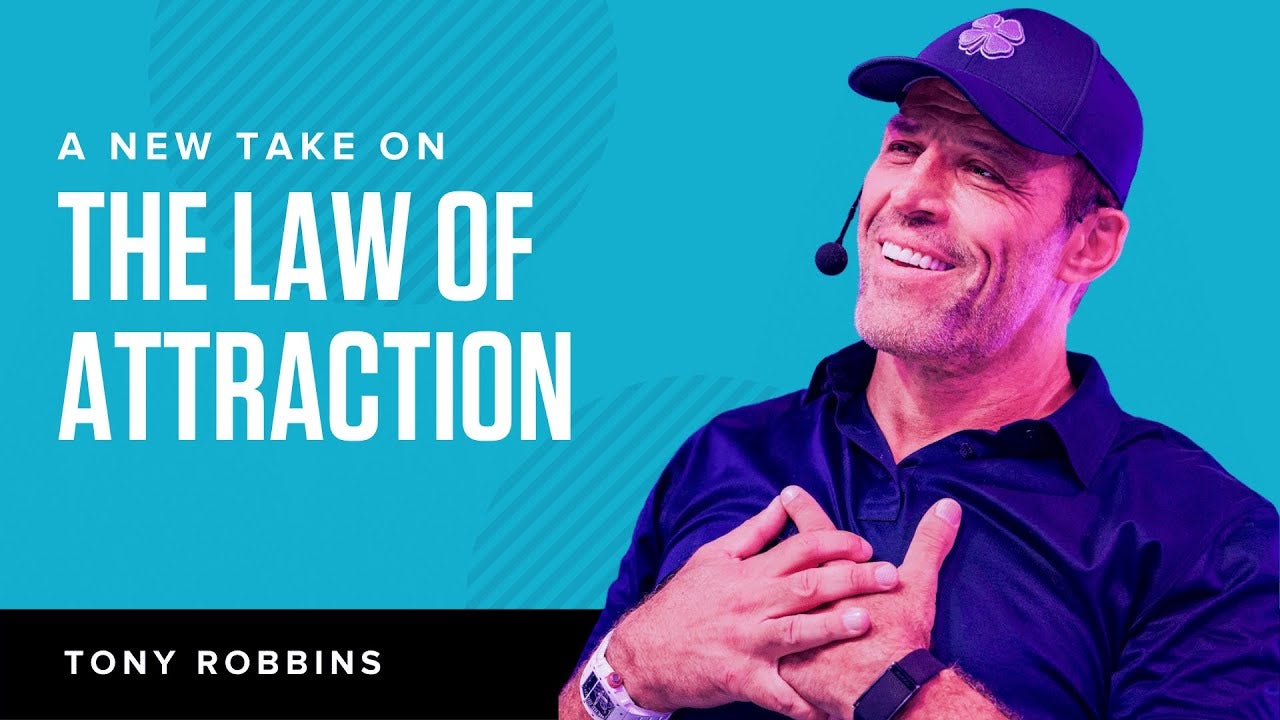
We've all heard of the law of attraction – but in this video, Tony Robbins gives a new take on it... one that you might not have heard before. Uploaded 28-07-21 What if instead of it being all about getting the things that you want, it was about becoming the person who would have those things? What does that mean? It means if you want a passionate and loving relationship, you become a passionate and loving person. If you want to grow your business beyond your wildest dreams, you become a person who focuses on growth and learning. If you want to live a long and vital life, you become a person who does that right now, today. So what's it really about? It's about raising your standards. It's about creating the energy in your body, in your mind and in your surroundings that propels you toward the life that you want. This video was originally taken from Tony Robbins' Unleash the Power Within Event. Unleash the Power Within is the signature event designed by entrepreneur, best-selling author
The same complaint takes another hour of your week. You may have every reason to be upset. What change would you want that time and attention to help create? In this episode of The Level Up Podcast, Paul Alex breaks down how to turn recurring frustration into a direction you can begin working toward. Paul makes room for unfair situations and appropriate ways to address them. A necessary conversation, request for help, or formal concern may deserve action. Repeating the same argument in your head can still leave your own future waiting. Name the change beneath the complaint, whether it involves time, a role, or a boundary. Then look for movement that does not require someone else to apologize or agree. The step can matter while you are still upset; you do not have to resolve every feeling before acting. In this episode, you’ll learn: • How to notice when replaying a complaint has stopped providing useful information. • Why naming the desired change gives frustration a practical directio
Gianni Agnelli is the head of the family that controls Fiat, and the vast business empire beyond the carmaker that helped shape modern Italy. Charming, charismatic and powerful, he's regarded by many as Italy’s unofficial king, and his family de facto royalty. When he dies the country is plunged into mourning and fear for its economic future. But Gianni’s death also triggers an inheritance dispute that will shake his family to its core. Inheritance tells the story of the family dramas that shape some of the world's biggest businesses. Search for Inheritance wherever you get your BBC podcasts. Host: Sofia Bettiza Series Producer: Simon Tulett Producer: Bob Howard Fact-checkers: Adriana Urbano and Randa Darwish Music: Thomas Ross Fitzsimons Mixing and sound design: Richard Hannaford Series Editor: Matt Willis With special thanks to Jennifer Clark, Michele Masneri, Rachel Sanderson, Andrea Colli and Octavia Woodward. Senior Commissioning Producer: Sarah Green Commissioning Editor: Jon Man
For nearly a year, a group of friends regularly explored the abandoned buildings of Taunton State Hospital in Massachusetts. They'd been through nearly every part of the property, but one basement remained a mystery, sealed behind a chained and padlocked door. Eventually, curiosity got the better of them. Armed with bolt cutters and flashlights, six friends made their way into the dark basement. At the far end, they discovered disturbing markings and what appeared to be bloodstains. Then one of them claimed something had touched her—and things quickly became terrifying. A piercing screech, flashlights suddenly going dark, and a frightening encounter with shadowy figures sent the group scrambling for the exit. They had spent months exploring the hospital without experiencing anything like it. Had they finally encountered something paranormal, or was there a reason that basement had been locked away? #RealGhostStoriesOnline #TauntonStateHospital #HauntedAsylum #AbandonedHospital #ShadowF
In 1966, Australian novelist Elizabeth Harrower was on the brink of literary fame. Her fourth novel, The Watch Tower, was hailed as one of the year's best Australian books, alongside a novel by her friend Patrick White. White went on to win the Nobel Prize for Literature, but Harrower stopped writing altogether. For the next four decades, she disappeared from the literary world. Now, a new biography aims to unravel the mystery of one of Australia's most elusive writers. Guest: Susan Wyndham, author of Elizabeth Harrower: The Woman in the Watch Tower winner of the Mark and Evette Moran Nib Literary Award.
What if your AI agent could find the people you should know before you even start looking? Cosign is building a professional network around reputation and trusted recommendations, and now agents can use that network too. MTS host Sophia Dew sits down with a16z’s David Booth and Cosign’s Bella Nazzari to discuss what they’ve learned since launching Cosign, why traditional profiles often miss the operators doing the most important work, and how the Cosign Awards are surfacing talent through the people willing to vouch for them. They also explore an emerging behavior: people connecting their agents to Cosign to continuously find relevant people, lists, and opportunities, and what professional networking could look like when both humans and their agents participate. Resources: Follow David Booth: https://x.com/davidbooth Follow Bella Nazzari: https://x.com/nazzari Follow Sophia Dew: https://x.com/sophiadew Learn more about Cosign:https://cosign.co/ Connect your agent to Cosign:https://cosi
Lawrence Bender produced Pulp Fiction, Reservoir Dogs, Kill Bill, Inglourious Basterds, Good Will Hunting and An Inconvenient Truth. Here's what a producer actually does — and why the job is equal parts magic and business. Lawrence sits down with Daniel Lubetzky (founder of KIND) to break down the job most people never understand — Daniel included: developing the script, casting, raising the money, protecting the director, and treating every movie like a new company. In his words, producing is "one foot in the world of the creative… and one foot in the world of the practical." It starts somewhere unexpected: before any of it, he was a ballet dancer. Then a career-ending injury, a $400 car he called the BGT, and the lowest grip job on a TV set. The stories: A $100,000 horror movie shot in a bankrupt grocery store stocked with dented boxes. Meeting Quentin Tarantino at a 4th of July party. The answering machine message from Harvey Keitel that changed Reservoir Dogs. A 222-page Kill Bill
Nikki Haley on the Iranian plot that targeted her, the real reason she left Trump's cabinet, and whether she'll ever run for president again. The former UN ambassador and two-term South Carolina governor sits down with Daniel Lubetzky to talk John Bolton and the National Security Council meetings that stopped happening, the Russia sanctions reversal that ended with "With all due respect, I don't get confused," what she'd do differently on Iran, why China is an adversary for life, and bringing down the Confederate flag after the Mother Emanuel shooting. Plus: the Little Miss Bamberg pageant that disqualified her, the man who jumped on her car in New Hampshire, getting locked out of the governor's mansion in her robe, and the Mexican Inquisition. 00:00 Meet Nikki Haley 01:13 Little Miss Bamberg Pageant: Disqualified at Five Years Old 05:49 How She Negotiates: China, North Korea, Putin & Xi 08:41 Truth-Telling Over Popularity: Earning Respect at the UN 10:27 Learning on the Job: From Gove
Museums should actively seek histories missing from their existing collections.
Share your view, then see how readers voted. No sign-in required. This poll is shared across stories.
Do you agree or disagree?
Common Quandary
A Common Quandary to discuss
Another conversation to explore, separate from this news story.
A pricey AI tutor can turn B students into A students. Should schools let them use it?
An effective AI tutor adapts to each student and dramatically improves performance, but its subscription is expensive. A public school cannot provide it to everyone and worries that allowing its use will deepen existing inequality.
Should access be limited when a beneficial tool cannot yet be shared fairly?