LeBlanc v. Privacy and Civil Liberties Oversight Board — D.C. Cir. (Nov 17, 2026)
36 min
Listen through the publisher, then discuss the episode here or arrange an in-person Roundtable. Your city determines where to meet.
Roundtables are designed for groups of four, with a shared subject and room for everyone to speak. Come for discussion, with no dating expectation.
The D.C. Circuit considers whether the President could remove members of a federal privacy watchdog without showing cause. The Privacy and Civil Liberties Oversight Board reviews counterterrorism programs and advises Congress and the executive branch about their effects on privacy and civil liberties. Two members refused White House requests to resign and were told that their positions had been terminated in January 2025. They sued, and a federal judge held the removals unlawful and ordered officials other than the President to treat them as still serving. The government appealed. The case turns on a 2007 rewrite of the Board’s statute. Congress made it a separate independent agency and deleted language saying members served at the President’s pleasure, but did not add an express for-cause removal clause. The government’s lawyer will argue that this silence leaves the President free to remove members, and that the Board’s advisory role is still an executive function. The former members’ lawyer will argue that the statutory changes and watchdog mission make protection from arbitrary removal clear, without particular magic words. Even if the removals were unlawful, the lawyers dispute whether an ordinary injunction is available, or whether the members must satisfy the stricter test for mandamus—a special order compelling an official to act. Listen for the difference between the power to fire, the independence Congress designed, and the court’s power to provide a practical remedy. LeBlanc v. Privacy and Civil Liberties Oversight Board (No. 25-5197) — U.S. Court of Appeals for the District of Columbia Circuit, argued November 17, 2026. Sources: Official D.C. Circuit oral argument: Official recording listing: District court memorandum opinion (Doc24, May21,2025):
Episode information is provided by the publisher. Listening takes place on the publisher’s service.
For review: 1. Iraq has reached a compromise with the powerful Iran-backed militia Kataeb Hezbollah, three senior security officials said, after Prime Minister Ali al-Zaidi readied security forces to move against the group. Reflecting the gravity of the situation, Iraqi Shiite political sources said Esmail Qaani, commander of Iran’s elite Revolutionary Guards’ Quds Force, arrived in Baghdad late on Monday to help defuse tensions with Kataeb Hezbollah, Tehran’s most powerful militia ally in Iraq. 2. Lebanese President Joseph Aoun launched a lengthy rebuke of Iran in an Independence Day address, arguing that the Islamic Republic does not have the right to interfere in Lebanon’s internal affairs, as it long has via support for its local terror proxy, Hezbollah. 3. Yemen’s Houthis launched strikes on the Saudi capital Riyadh on Saturday, after vowing reprisals for a “special operation” by the Saudi-led coalition fighting them. The coalition later said it had “intercepted and destroyed” thr
Rebuilding the government after Trump and DOGE will take more than rehiring the people they fired last year. The Supreme Court enabled the administration’s assault on services and protections millions of Americans rely upon, and it could still block the rebuilding, too. On this week’s Amicus, Dahlia Lithwick talks with Cornell law professor and former Biden administration official K. Sabeel Rahman about his new book, Remaking the State: A New Blueprint for American Democracy (https://www.amazon.com/dp/1967190208?tag=slatmaga-20&th=1), about why restoring the old machinery of the administrative state won’t be enough. Rahman connects DOGE’s slash-and-burn campaign to a much longer legal project. He explains why doctrines that constrain regulation remain a threat to future policymaking, even as the high court supercharges Trump’s executive power grabs. But this is not just a damage assessment. From stronger consumer protections to easier access to public benefits and a meaningful democrat
Chuck Todd argues the country is living through two crises at once — competence and confidence — and the second one may be harder to fix. Trump’s answer to a week of cascading outages was “it’s life… it’s fine,” which Todd says lands exactly like his Covid-era shrugs, from a president who has never wanted the part of the job that involves managing a crisis rather than cutting a ribbon. The speculation about AI integration remains unproven, but what isn’t in dispute is that CISA lost nearly a third of its workforce in 2025 and still has no confirmed director, and the test of a functioning government isn’t preventing every failure — it’s containing and recovering from them. Chuck also sees Trump shrinking: Quad leaders visibly annoyed, Vance publicly breaking with him, Rubio distancing himself from Iran, and Republican senators finally criticizing the administration — though mostly by screaming at each other, as when Cornyn told Cruz “I don’t find you credible, I’m mad at you” on the Sen
Artificial intelligence is already finding its way into ambulances, patient care reports and EMS operations — but do agency leaders actually know what technology their people are using? This week on EMS One-Stop, host Rob Lawrence welcomes back EMS attorneys Doug Wolfberg and Ryan Stark of Page, Wolfberg & Wirth (PWW) to explore the rapidly emerging challenge of shadow AI and shadow IT. From smart glasses and personal recording devices, to ambient listening applications and generative AI platforms, the discussion examines how well-intentioned clinicians may be putting protected health information at risk without realizing it. Wolfberg and Stark explain why HIPAA hasn't fundamentally changed in the AI era, why business associate agreements and organizational oversight matter, and why simply banning technology is unlikely to be an effective long-term solution. Instead, EMS leaders must understand the tools being used, update their policies, educate their workforces and establish safeguar
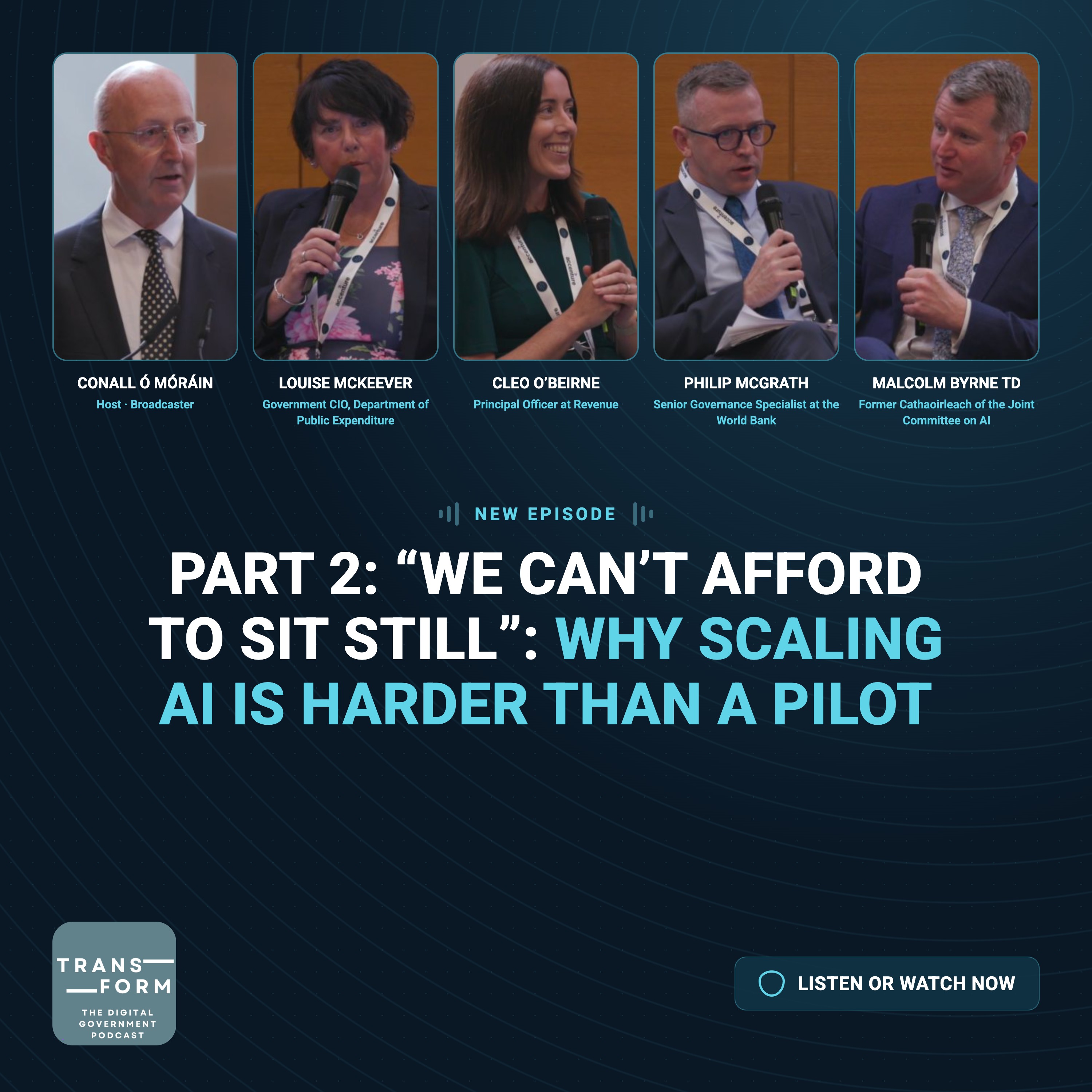
The pilot worked. Now what? In Part 2 of this panel discussion, four leaders explain how they're taking AI from pilot to scale, and what it takes to get data and governance right. This panel discussion took place at the Ireland eGovernment Awards and Leadership Summit 2026 on 24 September 2026 at UCD's O'Reilly Hall. We bring together Louise McKeever, Government CIO; Cleo O'Beirne, Principal Officer at Revenue; Philip McGrath, Senior Governance Specialist at the World Bank; and Malcolm Byrne TD, former Cathaoirleach of the Joint Committee on AI. The panel is chaired by Conall Ó Móráin. If you're taking AI beyond the pilot, here's what to do: Start small, prove it, then scale. Revenue tested agentic AI on a small application first, stage by stage. Redesign the whole process, not one stage. Individual productivity gains only go so far. Plan for lost knowledge, and recovered knowledge. As AI scales, people may know less, but AI can also capture knowledge that has already been lost. Reuse
On this episode, Hunter talks with law professor Evan Bernick about his law review article, succinctly titled "Abolish Conspiracy." In the article, Evan takes us through the long history of conspiracy laws in England and the U.S. to reveal a clear truth: Conspiracy laws have drifted so far from their original purpose that they now do more to threaten civil liberties than to guard against the harms they first targeted. Guest: Evan Bernick, Associate Professor of Law, Northern Illinois University College of Law Resources: Read the article: https://virginialawreview.org/articles/abolish-conspiracy/ Contact Evan: https://www.niu.edu/law/about/directory/bernick.shtml Follow Evan on Bluesky: https://bsky.app/profile/evanbernick.bsky.social If you are facing criminal charges, talk to a lawyer.
The Ninth Circuit considers a shareholder's challenge to disclosures used to sell UserTesting. During negotiations, Thoma Bravo reduced a proposed ten-dollar-a-share offer to seven dollars and fifty cents. The board initially rejected that lower price, but later recommended a deal at that price to shareholders. The shareholder alleges that the merger's proxy statement wrongly made the company's revenue performance look worse than it was. The disputed sentence grouped revenue with calculated billings and said both had fallen short of expectations. Her theory is that this depressed picture helped persuade shareholders to accept too little for their stock. That is an allegation, not a finding that the deal was unfair. The district court dismissed the revised complaint. Although it had treated the disputed sentence as false or misleading, it said the allegations still sounded in fraud and failed the stricter requirements for pleading the executive's responsibility. The shareholder will arg
The Second Circuit considers a plan to help homebuyers who need mortgages compete with cash offers. Canandaigua National Corporation, a New York financial holding company, wanted to guarantee purchases arranged through its mortgage subsidiary. If a preapproved customer failed to obtain final mortgage approval, the company would buy the home itself and later resell it. The proposal capped the value of homes held at any one time at five million dollars and promised resale within two years. Canandaigua says those safeguards make the risk small. The Federal Reserve Board rejected the plan on safety-and-soundness grounds, looking beyond the risk to this particular company. It did not finally decide the remaining statutory factors. Canandaigua will argue that the Board ignored the limits in its actual application. The Board will defend considering what could happen if financial holding companies generally began buying property under such guarantees. This is a dispute over permission for a pr
The Ninth Circuit hears a dispute over a proposed waste-processing project in California. Nortech already operated the Western Placer Waste Management Authority's facility. It worked with EcoHub on a proposal for the facility's future, first seeking a contract extension and then preparing for competitive bidding. The collaboration broke down. Nortech ended discussions after EcoHub failed to produce a requested financing commitment. EcoHub says the financing demand was a pretext, and that Recology pushed Nortech to abandon their joint effort. EcoHub and Nortech eventually submitted separate bids. Neither won. EcoHub nevertheless says their work together had already created a legal partnership, with duties Nortech could not simply walk away from. The district court ruled against EcoHub before trial, finding insufficient evidence of shared control. It also found EcoHub's interference claims against Recology were brought too late. EcoHub will argue that the companies' conduct and board dis
Customers should receive compensation for prolonged failure of essential paid online services.
Share your view, then see how readers voted. No sign-in required. This poll is shared across stories.
Do you agree or disagree?
Common Quandary
A Common Quandary to discuss
Another conversation to explore, separate from this news story.
A $300 package lands at your door by mistake. Do you keep it?
A package containing expensive headphones arrives with your address but another person's name. The retailer says it has already replaced the order and does not ask you to return it.
If no one appears to lose, what still makes keeping it right or wrong?