Mansa Musa and Islam in Africa: Crash Course World History #16
16 min
Listen through the publisher, then discuss the episode here or arrange an in-person Roundtable. Your city determines where to meet.
Roundtables are designed for groups of four, with a shared subject and room for everyone to speak. Come for discussion, with no dating expectation.
In which John Green teaches you about Sub-Saharan Africa! So, what exactly was going on there? It turns out, it was a lot of trade, converting to Islam, visits from Ibn Battuta, trade, beautiful women, trade, some impressive architecture, and several empires. John not only covers the West African Malian Empire, which is the one Mansa Musa ruled, but he also discusses the Ghanian Empire and even gets over to East Africa as well to discuss the trade-based city-states of Mogadishu, Mombasa, and Zanzibar. In addition to all this, John considers emigrating to Canada. Chapters: Introduction: African History 00:00 King Mansa Musa of Mali 1:22 Mali, the Berbers, and the Islamization of West Africa 3:23 An Open Letter to Ibn Battula 5:29 The End of the Malian Empire 6:17 The Swahili Civilizations of Eastern Africa 6:55 Credits 9:56 Crash Course is on Patreon! Want to find Crash Course elsewhere on the internet? Facebook - http://www.facebook.com/YouTubeCrashCourse Twitter - http://www.twitter.com/TheCrashCourse Instagram - https://www.instagram.com/thecrashcourse/ CC Kids: http://www.youtube.com/crashcoursekids
Episode information is provided by the publisher. Listening takes place on the publisher’s service.
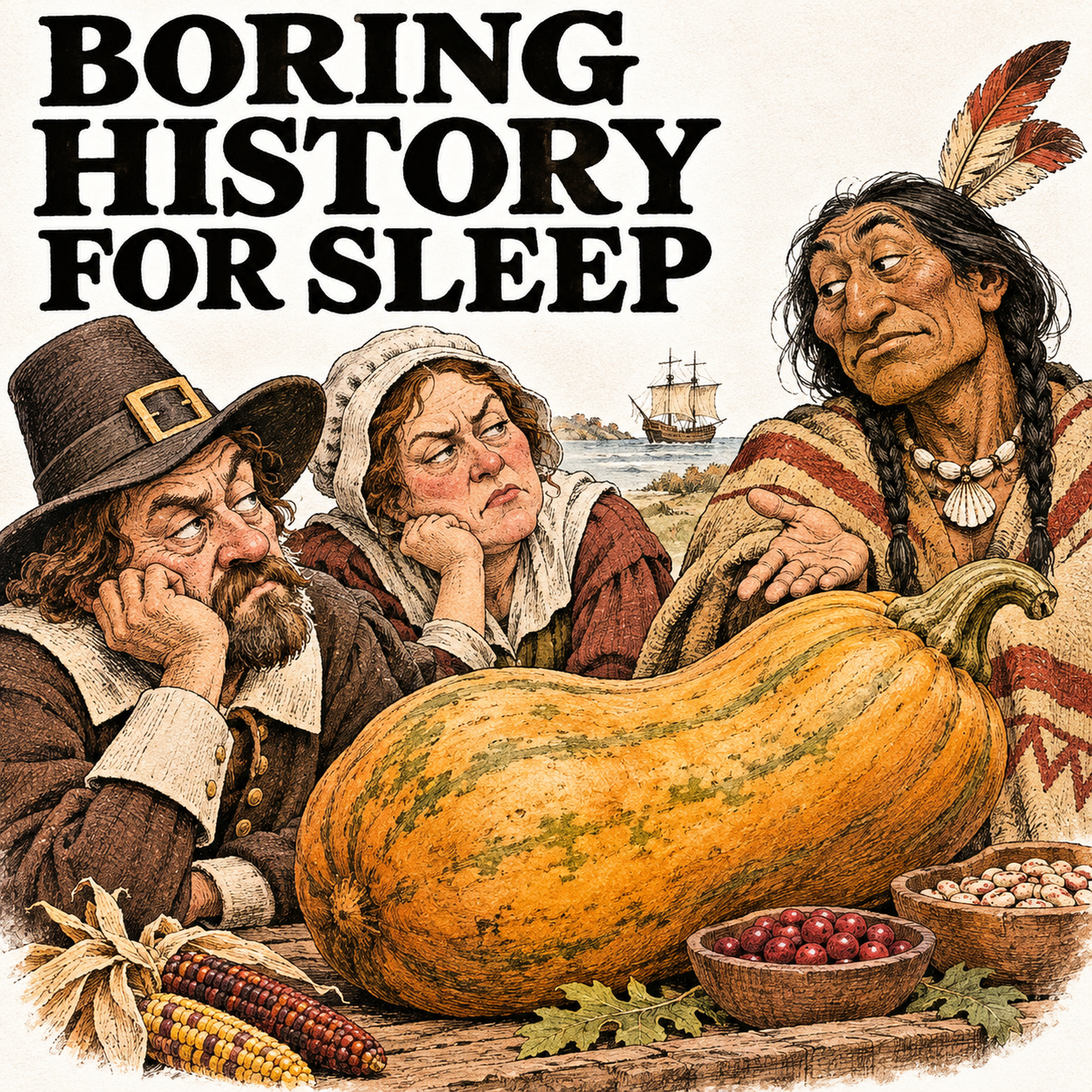
In 1620, a small ship called the Mayflower crossed the Atlantic carrying English settlers in search of a new life. Their arrival in North America became one of the most familiar stories in American history, but the reality behind the legend was far more complicated than the traditional Thanksgiving tale suggests. Discover why the Pilgrims left England, what their dangerous voyage was really like, and how they survived their first winter in an unfamiliar land. Explore their encounters with the Wampanoag people, the role of Tisquantum, also known as Squanto, and the assistance that helped the struggling settlers establish their colony. Uncover what happened at the harvest gathering of 1621, who actually attended, what was served, and how this event became connected to the modern Thanksgiving holiday. Follow the history beyond the familiar celebration and discover the people, cultural encounters, and historical realities behind the Mayflower story. Boring History for Sleep — Soft stories
Have you ever tried something so hard, failed, and then tried again anyway? Meet Tony Hawk, the boy who turned his restless energy into skateboarding history! Growing up in sunny San Diego, California, Tony was a frustrated kid until his brother gave him a scratched-up blue skateboard. It was pure magic! By age 14, he was a fearless professional skater inventing wild, sky-high tricks on massive wooden ramps. Imagine being at the 1999 X Games, watching Tony attempt the ultimate, "impossible" trick: the 900! That's two and a half dizzying spins high in the air. Crash after crash, he fell ten times. But on his eleventh try? He landed it perfectly, while the crowd went absolutely wild! That same year, his smash-hit video game made him a superstar all around the world. But Tony didn't just want fame. He wanted every kid to have a safe place to ride, fall, and get back up. Through his charity, he has helped build hundreds of free public skateparks everywhere! Grab your helmet and drop in as
Sometimes, all it takes is one powerful Islamic reminder to bring your heart closer to Allah ﷻ and change the way you see your life. In a world filled with distractions, taking even a few moments to remember Allah can help us reconnect with our faith, reflect on our purpose, and find peace through the beautiful teachings of Islam. These short but meaningful Islamic reminders share timeless lessons inspired by the Holy Quran and the Sunnah of Prophet Muhammad ﷺ, offering spiritual motivation, wisdom, and encouragement in less than a minute. Whether you are searching for inner peace, struggling with life's challenges, or simply looking to strengthen your Iman, these reminders invite you to reflect on what truly matters. Discover the beauty of trusting Allah, practising Sabr, expressing gratitude, seeking forgiveness, and living each day with greater faith and purpose. Every reminder is an opportunity to pause, reflect, and remember that our ultimate success lies in pleasing Allah and pre
Dr. Al Grauer hosts. Dr. Albert D. Grauer ( @Nmcanopus (https://twitter.com/Nmcanopus) ) is an observational asteroid hunting astronomer. Dr. Grauer retired from the University of Arkansas at Little Rock in 2006. travelersinthenight.org (http://travelersinthenight.org/) From June & July, 2026. Today's 2 topics: - My Catalina Sky Survey teammate Josh Hogan has discovered a 2 football field diameter asteroid that was placed on NASA's Sentry list because it has a tiny minuscule but non-zero chance of impacting our home planet. With this motivation my team the Catalina Sky Survey, the Pan STARRS group in Hawaii, the ATLAS group with telescopes Hawaii, Chile, and South Africa , the Vera C. Rubin telescope in Chile, will be soon joined NASA's NEO Surveyor and groups world wide in a planet wide defense network. - The visually stunning Lunar Crater Pierazzo, named for the late Planetary Scientist Elizabeth "Betty" Pierazzo was observed by the Artemis II Crew as they passed over the Moon's far
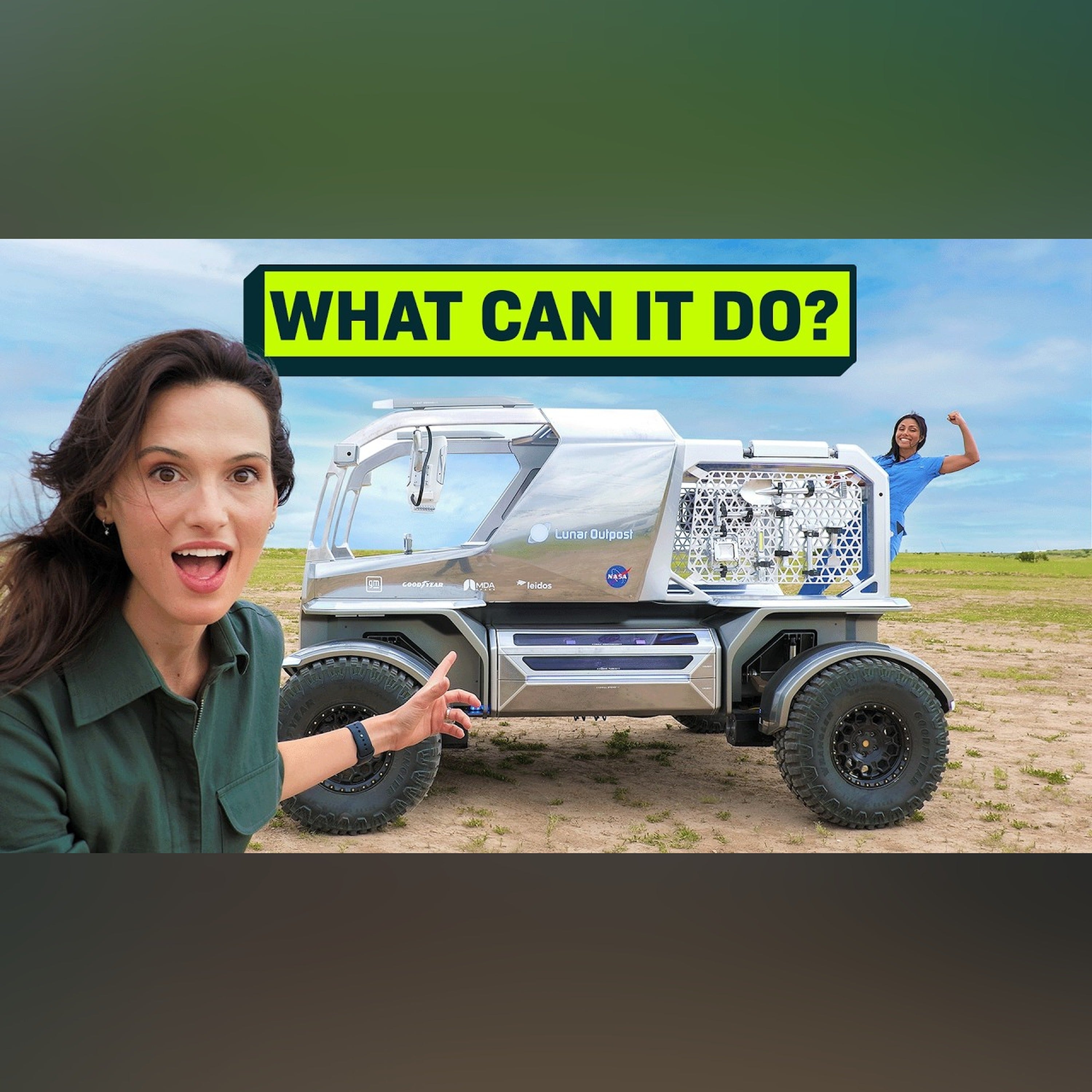
This truck is going to the moon. So we put it to the test… Get an exclusive 15% discount on Saily data plans. Use code CLEO at checkout. Download Saily app or go to https://saily.com/cleo This is the world’s first “space truck.” It’s going to the moon to help us go farther, faster, and discover places we’ve never been… Because humans are about to go back to the moon for the first time in 50 years! And no one but its builders have ever driven it… until today. In this video I'm going to put this brand new space truck to the test in a series of 5 challenges. And I've invited someone who knows a thing or two about challenges: YouTube daredevil and host of Challenge Accepted… Michelle Khare! Let’s go. Chapters: 0:00 This is the world’s first space truck 0:38 Introducing Michelle Khare! 01:04 What is a space truck? 01:52 How do astronauts drive? 02:21 First impressions! 02:47 Moon truck v normal truck 04:47 How fast can you drive on the moon? 05:18 Will we crash? 08:36 Can we break the lunar
Charlie Kirk’s assassination will dominate the headlines—but before the truth is even clear, the disinformation machine is already spinning. This video exposes how suppression, radicalization, and division are weaponized—not by ideology, but by systems designed to keep you outraged, divided, and distracted. Uploaded 11-09-25 We’ll reveal: • Why suppression is the biggest red flag in history—and why it always signals weakness, not strength. • How highly suggestible people are radicalized—not by one side or the other, but through media outrage loops, algorithmic echo chambers, and deliberate manipulation. • The illusion of “left vs. right”—a distraction designed to pit neighbors against each other while corruption, corporate power, and elites escape untouched. • The common ground we all share: freedom, safety, stability, fairness—and what none of us want: corruption, endless wars for profit, elites with different rules, surveillance states, and justice systems that bend for the powerful
The majority of the universe is made up of a currently mysterious entity that pervades space: dark energy. We don’t know exactly what it is, but we do know that dark energy accelerates the expansion of space. We think this means the Universe will expand forever, even as our view of it shrinks while space expands faster all the time. Check out the Crash Course Astronomy solar system poster here: http://store.dftba.com/products/crashcourse-astronomy-poster If you want to learn more about the creation and death of the universe, watch Crash Course Big History here: https://youtube.com/playlist?list=PL8dPuuaLjXtMczXZUmjb3mZSU1Roxnrey -- Chapters: Introduction: The Expanding Universe 00:00 The Expansion of Space is Accelerating 2:17 What is Dark Energy? 4:19 Will the Universe Expand Forever? The Geometry of the Universe 5:20 The Cosmic Horizon of the Observable Universe 6:50 Review 10:20 -- GEOMETRY OF THE UNIVERSE RESOURCES Geometry: Expanding faster than light: General expansion: -- PBS Di
Have you ever wondered where cured meats like salami or pepperoni get their bright red color? Of course its from organic chemistry! A chemical called nitric acid gives them that bright color, while also increasing their shelf. It's also involved in some other interesting reactions. In this episode of Crash Course Organic Chemistry we'll see how nitrous acid reacts with primary amines to form diazonium salts, we'll learn about alkyldiazonium salts and aryldiazonium salts, and see what conditions are necessary for nucleophilic aromatic substitutions. Series Sources: Brown, W. H., Iverson, B. L., Ansyln, E. V., Foote, C., Organic Chemistry; 8th ed.; Cengage Learning, Boston, 2018. Bruice, P. Y., Organic Chemistry, 7th ed.; Pearson Education, Inc., United States, 2014. Clayden, J., Greeves, N., Warren., S., Organic Chemistry, 2nd ed.; Oxford University Press, New York, 2012. Jones Jr., M.; Fleming, S. A., Organic Chemistry, 5th ed.; W. W. Norton & Company, New York, 2014. Klein., D., Organ
Like a trendy dance, a fighting combo, or a secret handshake, organic reactions can be broken down into simpler steps. In this episode of Crash Course Organic Chemistry, we’ll specifically be looking at alkene addition reactions, and with each new reaction ask ourselves three questions to help us puzzle through the mechanism and understand what’s going on. Episode Sources: Le Couteur, P, Burreson, J. Napoleon’s Buttons: 17 molecules that changed history., Penguin, New York, 2004, Chapter 1. Whipps, H., “How the Spice Trade Changed the World,” https://www.livescience.com/7495-spice-trade-changed-world.html Last accessed, 3/28/2020. Henriques, Martha, “How spices changed the ancient world,” http://www.bbc.com/future/bespoke/made-on-earth/the-flavours-that-shaped-the-world/ Last accessed, 3/28/2020. Hashimoto, K., Yaoi, T., Koshiba, H., Yoshida, T., Maoka, T., Fujiwara, Y., Yaamoto, Y, Mori, K., “Photochemical Isomerization of Piperine, a Pungent Constituent of Pepper”, Food Sci. Technol.
Conservation policies should include practical support for affected local livelihoods.
Share your view, then see how readers voted. No sign-in required. This poll is shared across stories.
Do you agree or disagree?
Common Quandary
A Common Quandary to discuss
Another conversation to explore, separate from this news story.
An old friend refuses to use someone's new name. Do you correct them at the reunion?
At a reunion, an old friend repeatedly uses the name a former classmate had years ago. They say shared history gives the old name affectionate meaning; the classmate has clearly introduced themselves with a different name.
When does preserving your shared past deny who someone is now?