Melton v. County of Maricopa, et al. — 9th Cir. (Nov 19, 2026)
45 min
Listen through the publisher, then discuss the episode here or arrange an in-person Roundtable. Your city determines where to meet.
Roundtables are designed for groups of four, with a shared subject and room for everyone to speak. Come for discussion, with no dating expectation.
The Ninth Circuit hears Melton versus the County of Maricopa. Kayla Melton's husband was shot and killed by sheriff's deputies. She brought a civil-rights lawsuit alleging that the county failed to train its deputies to de-escalate a suicidal crisis, and that this failure deprived her family of their relationship with him. The appeal concerns the county's own training responsibilities, not an individual damages claim against each deputy. You will hear the term Monell. It means the county is not liable merely because it employs an officer who violates someone's rights. The injury must be connected to the county's own policy or custom. A failure to train can qualify, but it must amount to deliberate indifference, not just negligence, and must actually cause the constitutional harm. The family will rely on the narrow possibility of proving an obvious training need without a pattern of earlier incidents. Listen for the difference between evidence of inadequate training and disagreement about how officers applied training they received. The discussion will focus on supervising an encounter, responding to a suicidal person, and warnings before a less-lethal shot. The judges will also test causation: whether an identified training gap, rather than something else, explains the fatal outcome. Keep those two questions separate as the court considers whether the evidence can support holding the county itself responsible. Melton v. County of Maricopa, et al. (No. 25-6291) — U.S. Court of Appeals for the Ninth Circuit, argued November 19, 2026. Sources: Official Ninth Circuit oral argument: Official argument archive: Prior same-case appellate memorandum (2022; not this appeal's outcome): Monell — actual Supreme Court opinion: City of Canton — actual Supreme Court opinion:
Episode information is provided by the publisher. Listening takes place on the publisher’s service.
Training Wednesday is back, and Aaron, Trent, and Peaches spend the live answering Air Force Special Warfare candidate questions — but first, there is an update from the current SWAS class. According to the numbers discussed on the live, 78 candidates failed the initial IFT and 52 still failed the refire. The guys try to understand how that happens after months of development and preparation, discuss reports that some candidates struggled with the swim and high-volume masks, and once again return to the same message they keep giving candidates: you need to arrive ready. From there, the live turns into a full candidate-training clinic. The guys talk about periodizing strength and endurance work, building Zone 2 capacity, gradually increasing mileage, why running with a weighted vest is probably not solving the problem you think it is, preparing for A&S, training with the equipment you will actually use, and why the goal is not simply to pass a minimum standard. They also answer question
The Fair Work Tribunals edition of Tuesday 17 November 2026: 129 decisions, one with a headnote: a Full Bench on redundancy pay reduced to nil where the employer itself found other acceptable employment, and what a reasons gap is worth on appeal. Fair Work Desk: redundancy pay, the job on offer and the reasons gap (opening story). Phuong Nam (Kenny) Ha v Asuria People Services Pty Limited [2026] FWCFB 289 (https://jade.io/article/1297741) - Asbury VP, Wright and Butler DP, 6 November 2026. Signal Practice & Procedure. Fair Work Act 2009 (Cth) ss 119(1)(a), 120(1)(b)(i), 120(2), 604. Whether other acceptable employment was obtained under s 120(1)(b)(i), and the s 120(2) discretion, attract the deferential House v The King standard; acceptability is assessed objectively against the employee's current role, not a withdrawn or alternative offer (those go to s 120(2)); the duty to give reasons extends to remedy, and a move to a nil reduction without disclosed reasoning is a gap in the path
Chuck Todd argues the country is living through two crises at once — competence and confidence — and the second one may be harder to fix. Trump’s answer to a week of cascading outages was “it’s life… it’s fine,” which Todd says lands exactly like his Covid-era shrugs, from a president who has never wanted the part of the job that involves managing a crisis rather than cutting a ribbon. The speculation about AI integration remains unproven, but what isn’t in dispute is that CISA lost nearly a third of its workforce in 2025 and still has no confirmed director, and the test of a functioning government isn’t preventing every failure — it’s containing and recovering from them. Chuck also sees Trump shrinking: Quad leaders visibly annoyed, Vance publicly breaking with him, Rubio distancing himself from Iran, and Republican senators finally criticizing the administration — though mostly by screaming at each other, as when Cornyn told Cruz “I don’t find you credible, I’m mad at you” on the Sen
“By a process of elimination, he didn't die from a natural cause. He didn't die from old age in his cell, and he didn't die from an accident. So the only option that we have is that he died as a result of a homicide.” BBC Newsnight presenter Victoria Derbyshire speaks to forensic medicine expert Michael Freeman, who says he's reviewed Jeffrey Epstein's autopsy records and contends Epstein's death in jail was the result of homicide rather than suicide. Epstein was a wealthy American financier and convicted sex offender, with links to prominent figures around the world. He died in a New York jail in 2019 while awaiting trial on charges of sex trafficking involving underage girls. His death was ruled a suicide by New York City's medical examiner. A subsequent FBI investigation found no evidence of criminal activity connected to his death, while the US Department of Justice’s Inspector General also concluded there was no evidence of foul play. In an interview with BBC Newsnight, Freeman ch
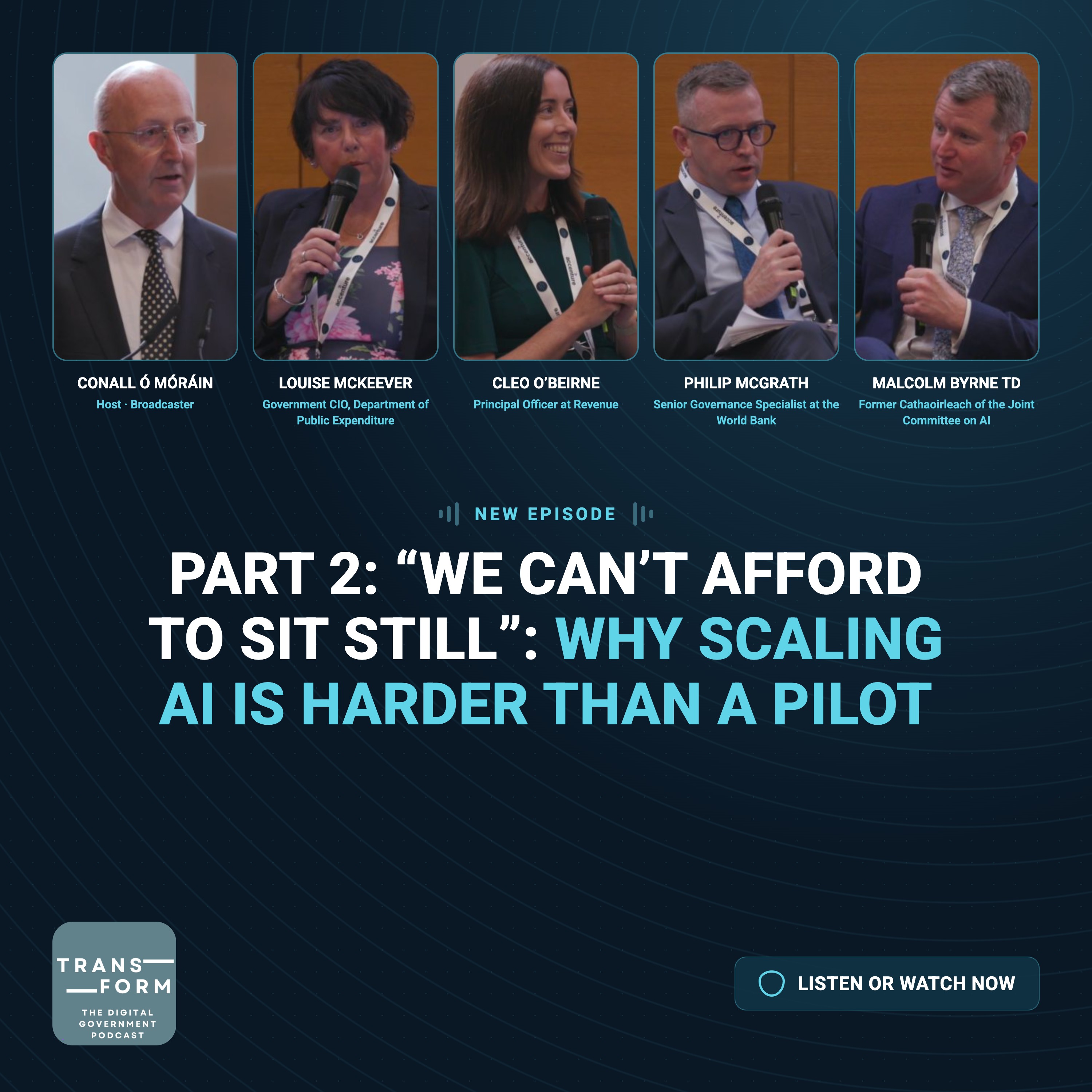
The pilot worked. Now what? In Part 2 of this panel discussion, four leaders explain how they're taking AI from pilot to scale, and what it takes to get data and governance right. This panel discussion took place at the Ireland eGovernment Awards and Leadership Summit 2026 on 24 September 2026 at UCD's O'Reilly Hall. We bring together Louise McKeever, Government CIO; Cleo O'Beirne, Principal Officer at Revenue; Philip McGrath, Senior Governance Specialist at the World Bank; and Malcolm Byrne TD, former Cathaoirleach of the Joint Committee on AI. The panel is chaired by Conall Ó Móráin. If you're taking AI beyond the pilot, here's what to do: Start small, prove it, then scale. Revenue tested agentic AI on a small application first, stage by stage. Redesign the whole process, not one stage. Individual productivity gains only go so far. Plan for lost knowledge, and recovered knowledge. As AI scales, people may know less, but AI can also capture knowledge that has already been lost. Reuse
What happens inside the mind of a special operations soldier when training becomes a real-life decision to use lethal force? From the psychological demands of combat to the moral consequences that can follow, elite military units must prepare operators for situations that cannot be fully recreated in training. This episode examines stress conditioning, threat perception, moral injury, and why the ability to use lethal force does not necessarily make someone immune to its psychological consequences.
The Ninth Circuit considers a shareholder's challenge to disclosures used to sell UserTesting. During negotiations, Thoma Bravo reduced a proposed ten-dollar-a-share offer to seven dollars and fifty cents. The board initially rejected that lower price, but later recommended a deal at that price to shareholders. The shareholder alleges that the merger's proxy statement wrongly made the company's revenue performance look worse than it was. The disputed sentence grouped revenue with calculated billings and said both had fallen short of expectations. Her theory is that this depressed picture helped persuade shareholders to accept too little for their stock. That is an allegation, not a finding that the deal was unfair. The district court dismissed the revised complaint. Although it had treated the disputed sentence as false or misleading, it said the allegations still sounded in fraud and failed the stricter requirements for pleading the executive's responsibility. The shareholder will arg
The Second Circuit considers a plan to help homebuyers who need mortgages compete with cash offers. Canandaigua National Corporation, a New York financial holding company, wanted to guarantee purchases arranged through its mortgage subsidiary. If a preapproved customer failed to obtain final mortgage approval, the company would buy the home itself and later resell it. The proposal capped the value of homes held at any one time at five million dollars and promised resale within two years. Canandaigua says those safeguards make the risk small. The Federal Reserve Board rejected the plan on safety-and-soundness grounds, looking beyond the risk to this particular company. It did not finally decide the remaining statutory factors. Canandaigua will argue that the Board ignored the limits in its actual application. The Board will defend considering what could happen if financial holding companies generally began buying property under such guarantees. This is a dispute over permission for a pr
The Ninth Circuit hears a dispute over a proposed waste-processing project in California. Nortech already operated the Western Placer Waste Management Authority's facility. It worked with EcoHub on a proposal for the facility's future, first seeking a contract extension and then preparing for competitive bidding. The collaboration broke down. Nortech ended discussions after EcoHub failed to produce a requested financing commitment. EcoHub says the financing demand was a pretext, and that Recology pushed Nortech to abandon their joint effort. EcoHub and Nortech eventually submitted separate bids. Neither won. EcoHub nevertheless says their work together had already created a legal partnership, with duties Nortech could not simply walk away from. The district court ruled against EcoHub before trial, finding insufficient evidence of shared control. It also found EcoHub's interference claims against Recology were brought too late. EcoHub will argue that the companies' conduct and board dis
Similar work should receive similar pay despite differences in workers' bargaining power.
Share your view, then see how readers voted. No sign-in required. This poll is shared across stories.
Do you agree or disagree?
Common Quandary
A Common Quandary to discuss
Another conversation to explore, separate from this news story.
You are training the software that may replace your team. Do you warn them?
A manager is asked to help test software that could eliminate several jobs on their team. Leadership insists the project is uncertain and confidential, while employees are making major financial decisions.
When does loyalty to colleagues override professional confidentiality?