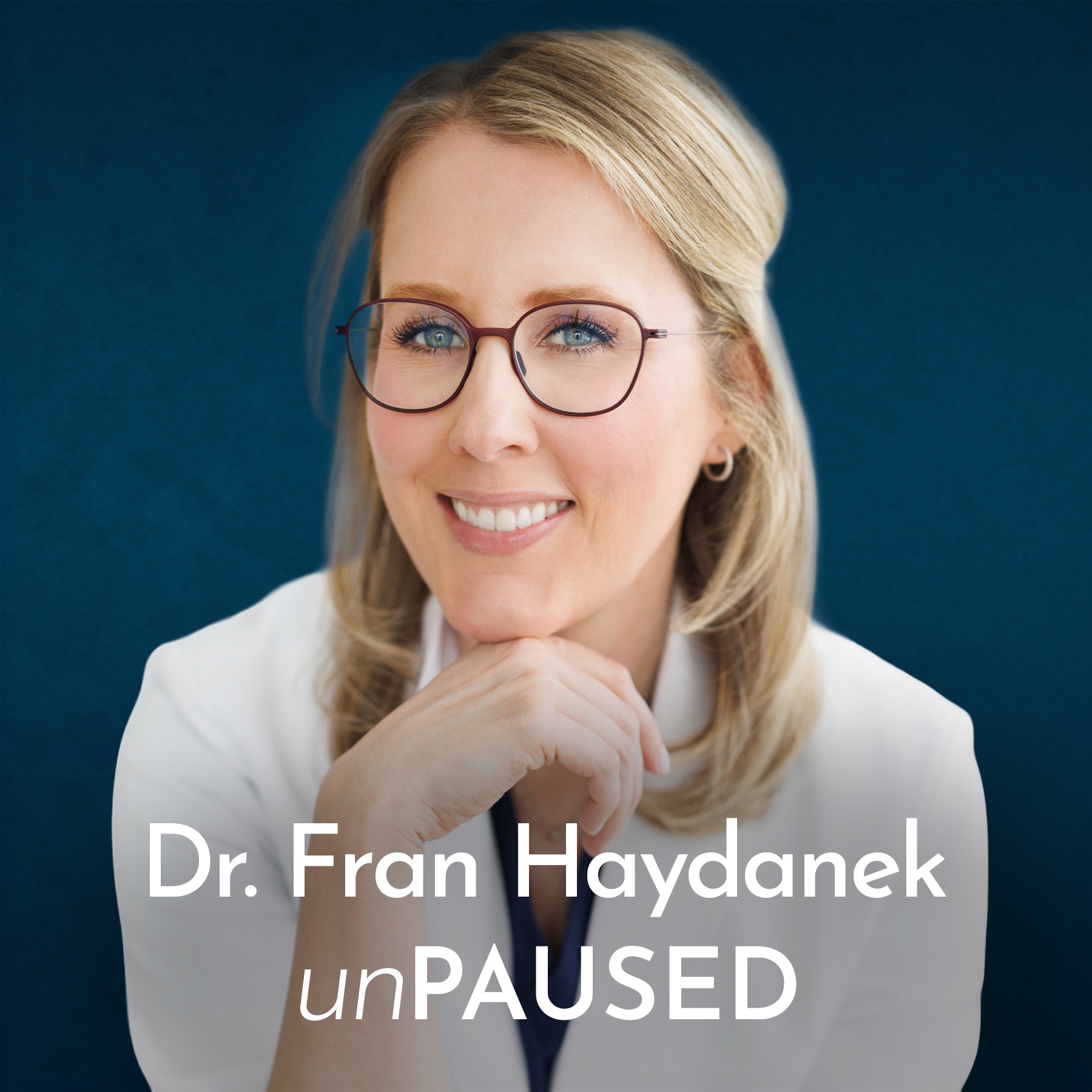
Menopause or Something Else? Brain Fog, Anxiety & Fatigue with Dr. Fran Haydanek
46 min
Listen through the publisher, then discuss the episode here or arrange an in-person Roundtable. Your city determines where to meet.
Roundtables are designed for groups of four, with a shared subject and room for everyone to speak. Come for discussion, with no dating expectation.
What happens in the gap between your last baby and your first hot flash? Dr. Mary Claire Haver sits down with Dr. Fran Haydanek — board-certified OB/GYN and the science communicator behind Paging Dr. Fran — to connect the dots most women are never shown. They unpack “reproductive hormone sensitivity”: why women whose brains react to hormone fluctuations with PMS, PMDD, or postpartum depression face a dramatically higher risk of depression in perimenopause — in the largest study to date, almost 13-fold — and why that history sits unread in your own chart. They also get practical about diagnosis: why there’s no blood test for perimenopause, the conditions that mimic it — iron deficiency (and the new ferritin guidelines), thyroid disease, sleep apnea, diabetes — and what your pregnancy history predicts about your future health, from gestational diabetes to preeclampsia and heart disease. Because knowing your own history means you never have to be blindsided by symptoms that were completely predictable. Guest links: Dr. Fran Haydanek (Website): https://www.pagingdrfran.com/ Dr. Fran Haydanek (YouTube): https://www.youtube.com/@PagingDrFran Dr. Fran Haydanek (Instagram): https://www.instagram.com/pagingdrfran Dr. Fran Haydanek (TikTok): https://www.tiktok.com/@pagingdrfran Dr. Fran Haydanek (Threads): https://www.threads.com/@pagingdrfran Dr. Fran Haydanek (Facebook): https://www.facebook.com/pagingdrfran/ I Did My Own Research (Apple Podcasts): https://podcasts.apple.com/us/podcast/i-did-my-own-research/id1879906055 Books: The New Menopause: https://www.amazon.com/dp/B0CKBZ4K1Z
Episode information is provided by the publisher. Listening takes place on the publisher’s service.
For a written breakdown and key references, see the associated letter: https://open.substack.com/pub/staycuriousmetabolism/p/the-carb-loading-myth-is-finally?r=40ekz2&utm_campaign=post&utm_medium=web&showWelcomeOnShare=true (https://open.substack.com/pub/staycuriousmetabolism/p/the-carb-loading-myth-is-finally?r=40ekz2&showWelcomeOnShare=true) Paper: https://academic.oup.com/edrv/advance-article/doi/10.1210/endrev/bnaf038/8432248?login=false Description: Do you really need to carb-load for peak performance, or is that just sports nutrition inertia? In this conversation, Nick sits down with Dr. Andrew Koutnik to break down a new meta-analysis of randomized controlled trials challenging the classic “you need carbs for performance” narrative. The key twist is that the strongest predictor of fatigue across studies isn’t muscle glycogen, but a subtle drop in blood glucose and overall brain fuel. You’ll learn where the carb-loading doctrine came from, what the original studies missed, why gl
Does your relationship feel like home, or does it feel like standing on the edge of something you might lose? In Part 3 of our Relationship Anxiety series, clinical hypnotherapist and former paramedic Martin Hewlett guides you through the process of teaching your nervous system that love doesn't have to hurt to be real. We explore the physical manifestations of anxiety—the tight chest, the 2:00 AM racing mind, and the "stomach drop" when a text takes too long—and provide the tools to "turn down the alarm" of your internal survival response. If you are ready to stop "cherry-picking" evidence of disaster and start building a foundation of trust, this session is for you. In This Episode, We Cover: The Science of Safety: Understanding how your nervous system confuses love with danger. Guided Visualization: A journey into your own "safe room" where you are already enough. Rewiring the Brain: Moving from worst-case disaster reels to the reality of small, daily kindnesses. Breaking the Cycle:
This week Kiley and I discuss Carb Cycling while Pregnant. Is it safe to Carb Cycle and break Ketosis during Pregnancy? I also talk about my experience at a conferences were I learned about Carb Cycling and explain the interesting research done on Carb Cycling. I also talk about Ketones for Brain development and more specifically, Ketones for Brain development as an Infant. It’s incredible to know how much significance Ketones for Brain development has as an Infant. Thanks for tuning into my channel. Find more stories and information at my website: www.BozMD.com BOOK-LINK - ANYWAY YOU CAN. AUDIBLE: https://adbl.co/2SLLfS1 PAPERBACK= (Affilate link) https://amzn.to/2Cq1IVC The two most common questions I get ... 1) "Doc, what BLOOD METER do you recommend?" ANSWER: FORACARE: http://bit.ly/2QKGmKG For years my diabetics told me this system was great. I tried several others before I bought this one. I can't count the number of times I have tested my blood only to get an ERROR message from
Disclaimer: This is not medical advice. I'm not a doctor. Uploaded 20-09-24 Methylene Blue: https://www.mitozen.club/?ref=JNn9OgsqRy1P_X *this is an affiliate link which will cost you nothing extra *melatonin that I've been using is also in this link ***You can also get these elsewhere and I encourage you to shop around, there's no need to use my link whatsoever. Nine months ago, my brain was falling apart—I was having up to 9 seizures a day and didn’t even recognize my own family at times. Diagnosed with temporal lobe epilepsy, I was losing hope until I discovered something that changed everything: methylene blue. This blue dye from the 1800s, combined with melatonin and psychedelic therapy, helped me reverse my brain damage and regain my life. In this video, I’ll share how these powerful molecules transformed my brain health, stopped my seizures, and might even help someone you know. Dr. John Lieurance’s channel: https://www.youtube.com/@DrJohnLieurance My Neurology Protocol: [screen
Happy Sunday! Welcome to Heal Squad’s The Sunday Set Up. Life lessons to help you start the week. How much of success comes down to simply showing up? This week, we talk keeping an open mind, taking chances, and recognizing the doors that open along the way. From Olympic athletes appearing on national television alongside Mercedes Moné to performers who keep showing up week after week hoping for their big break, we explore why success isn't always about talent or luck. Sometimes it's about making connections, putting in the effort, and being willing to try without knowing what we'll get in return. We talk knowing when to stop investing time in people who aren't willing to help themselves, and why even experiences that don't work out can teach us something valuable. The takeaway: don't wait for the perfect moment or expect someone else to make things happen. Be willing to take a chance, walk through the doors that open, and remember that half of life is just showing up. Plus, a little b
November 21, 2026 On November 22, 1963, President John F. Kennedy and First Lady Jacqueline Kennedy were visiting Texas, They hoped to heal a rift in the Democratic Party, as the white supremacists who made up the base of the party’s southern wing loathed the Kennedy administration for its support for Black rights, That base was furious about the administration’s backing of James Meredith, the first Black American to enroll at the University of Mississippi, By going to Dallas, Kennedy hoped to mend some fences in the state Democratic Party, The President's motorcade began with high spirits, Lady Bird Johnson thought, when she heard three shots, that it “must be firecrackers or some sort of celebration,” The Secret Service, knowing what had happened, rushed the motorcade to a hospital, When Vice President Johnson and Lady Bird were told that the President was dead, officials rushed LBJ away, In the confusion - in addition to the murder, it wasn't clear how extensive the plot was against
Heart disease is the number one killer of women — not breast cancer — and the window that sets the trajectory opens during perimenopause. Dr. Mary Claire Haver sits down with Dr. Jeremy London, a board-certified cardiovascular surgeon with more than 25 years of experience and thousands of heart surgeries behind him, to put cardiovascular health at the center of the menopause conversation. They break down what heart disease actually is, why 80–90% of it comes down to blockages in the coronary arteries, and what really happens in the transition: LDL cholesterol rising an average of 18%, blood pressure starting to accelerate, and visceral fat appearing — all as estrogen’s lifelong protection of the arteries withdraws. Dr. London explains cholesterol the way no one learns it at the doctor’s office — why ApoB and Lp(a) matter more than your LDL number, and why menopause raises cholesterol because the liver clears less, not makes more. They also cover why women get missed: risk factors that
Welcome to The We Do Not Care Club Podcast hosted by Melani Sanders, content creator, founding member of the WDNC, and New York Times bestselling author of The Official We Do Not Care Club Handbook. What started as Melani’s hilarious and all-too-true social media declaration that she simply did not care much anymore has become a global movement centered on sisterhood, laughter, honesty, and understanding that we are not alone, and we are enough. From menopause to marriage, motherhood, sex, relationships, changing bodies, mental health, work, money, food, and the everyday chaos of midlife, no topic is off-limits. Available now: link.pscrb.fm/f0281/wdnccfdup-dc41f (https://link.pscrb.fm/f0281/wdnccfdup-dc41f)
Dr. Mary Claire Haver sits down with Dr. Fran Haydanek — board-certified OB/GYN and the voice behind Paging Dr. Fran — to get practical about perimenopause. They break down what’s normal when your periods change, the bleeding patterns that mean you should get checked — including why PMOS carries a five-times-higher risk of endometrial cancer — the growing overlap of postpartum and perimenopause, and the “just a tired mom” trap that delays diagnosis. Then it’s treatment: birth control vs hormone therapy through the transition (and why Dr. Fran calls the IUD “a three-for-one”), what the guidelines actually recommend, workarounds for the estrogen patch shortage, GLP-1s and PMOS, and the real Women’s Health Initiative numbers behind two decades of fear. They close with the three things every woman in her late 30s and 40s should do for her health right now. Guest links: Dr. Fran Haydanek (Website): https://www.pagingdrfran.com/ Dr. Fran Haydanek (YouTube): https://www.youtube.com/@PagingDrF
Local events should make a deliberate effort to welcome people attending alone.
Share your view, then see how readers voted. No sign-in required. This poll is shared across stories.
Do you agree or disagree?
Common Quandary
A Common Quandary to discuss
Another conversation to explore, separate from this news story.
You are training the software that may replace your team. Do you warn them?
A manager is asked to help test software that could eliminate several jobs on their team. Leadership insists the project is uncertain and confidential, while employees are making major financial decisions.
When does loyalty to colleagues override professional confidentiality?