Moving Plants Inside – What to Do and What Not to Do | 218
61 min
Listen through the publisher, then discuss the episode here or arrange an in-person Roundtable. Your city determines where to meet.
Roundtables are designed for groups of four, with a shared subject and room for everyone to speak. Come for discussion, with no dating expectation.
As winter approaches, many people wonder which plants they should move inside and which should be left out. Don’t worry, we’ve got you! Learn the do’s and don’ts of bringing plants inside, which plants to move in and which to leave out, and how best to care for your new roommates.
Episode information is provided by the publisher. Listening takes place on the publisher’s service.
In this calm and sleepy facts episode, we spend eight peaceful hours exploring some of the quietest wonders of the natural world. We begin beneath a gathering thunderstorm, following warm air as it rises into towering clouds and learning how a single flash of lightning can briefly heat the air to several times the temperature of the surface of the Sun. From there we settle into the hidden world of hibernation, where animals slow their breathing and their heartbeats to just a few beats a minute and wait out the long winter in stillness. Next, we wander among the trees, discovering how they lift water hundreds of feet into the air without a single moving part and quietly record each passing year in rings of wood. Finally, we cross the deserts, where the heat of the day gives way to cold, clear nights and some dunes hum softly as the sand slides down their slopes. Each story unfolds slowly and gently, with no sudden sounds, so the whole night can pass in calm and quiet wonder. Let these c
Brain chips don't read your mind. They do something weirder... This is Neuralink’s Next Gen R1 surgical robot. It’s one of several new ways scientists are now trying to combine the human brain with a computer, which sounds like science fiction because… it is! But not anymore. And you need to know about this right now, because human clinical trials are happening and this tech is moving fast. Some people want to use it to make you superhuman. But I think most people aren’t seeing what’s really huge if true here. This story isn’t about how to make us more like machines Instead, this might be one of the most cutting edge ways to keep us human. Visit http://mercury.com (http://mercury.com/) to join over 300 thousand entrepreneurs who love Mercury. Mercury is a financial technology company, not an FDIC-insured bank. Banking services provided through Choice Financial Group and Column N.A., Members FDIC. Chapters: 00:00 What if you put a chip in your brain? 01:02 What does a human brain feel l
You can learn more about CuriosityStream at https://curiositystream.com/spacetime Uploaded 24-04-19 PBS Member Stations rely on viewers like you. To support your local station, go to: http://to.pbs.org/DonateSPACE We’ve been failing to detect dark matter for decades. Finally, the latest failure to detect dark matter may have actually proved its existence. One of these is true: either most of the matter in the universe is invisible and formed of something not explained by modern particle physics OR our understanding of gravity is completely broken. The debate over which is true has raged for decades, but may finally have been resolved in an unlikely way: the proof that dark matter exists, and really is an exotic, unknown substance, may have come from the discovery of two galaxies that appear to have no dark matter at all. Today on Space Time Journal Club we’ll look at the papers that reveal this discovery: Check out the new Space Time Merch Store! Support Space Time on Patreon Need a Re
In this in-depth conversation with Dr. Nic Verhoeven, PhD. creator of Physionic, we explore the controversial world of seed oils and their impact on health. Together, we – “the Nicks” –delves into the science behind seed oils, separating fat from fiction. Importantly, we try to approach this topic with the nuance and humility we both feel is deserves. This isn’t about what we know for certain as much as it is about what the biomedical and scientific community should admit we don’t know but need to study further. Get ready for a thought-provoking discussion on nutrition science, the impact of seed oils on metabolic health, and practical insights to make more informed dietary choices. To Learn More about Seed Oils see my prior video on topic, as well as a recent Newsletter covering a key paper that Nic and I briefly discuss in this interview. Hint: It’s all about “Perspective.” Prior Seed Oil video https://youtu.be/3rwbL5HrRUc Newsletter on Omega-6/3 Ratio and “Perspectives” https://open
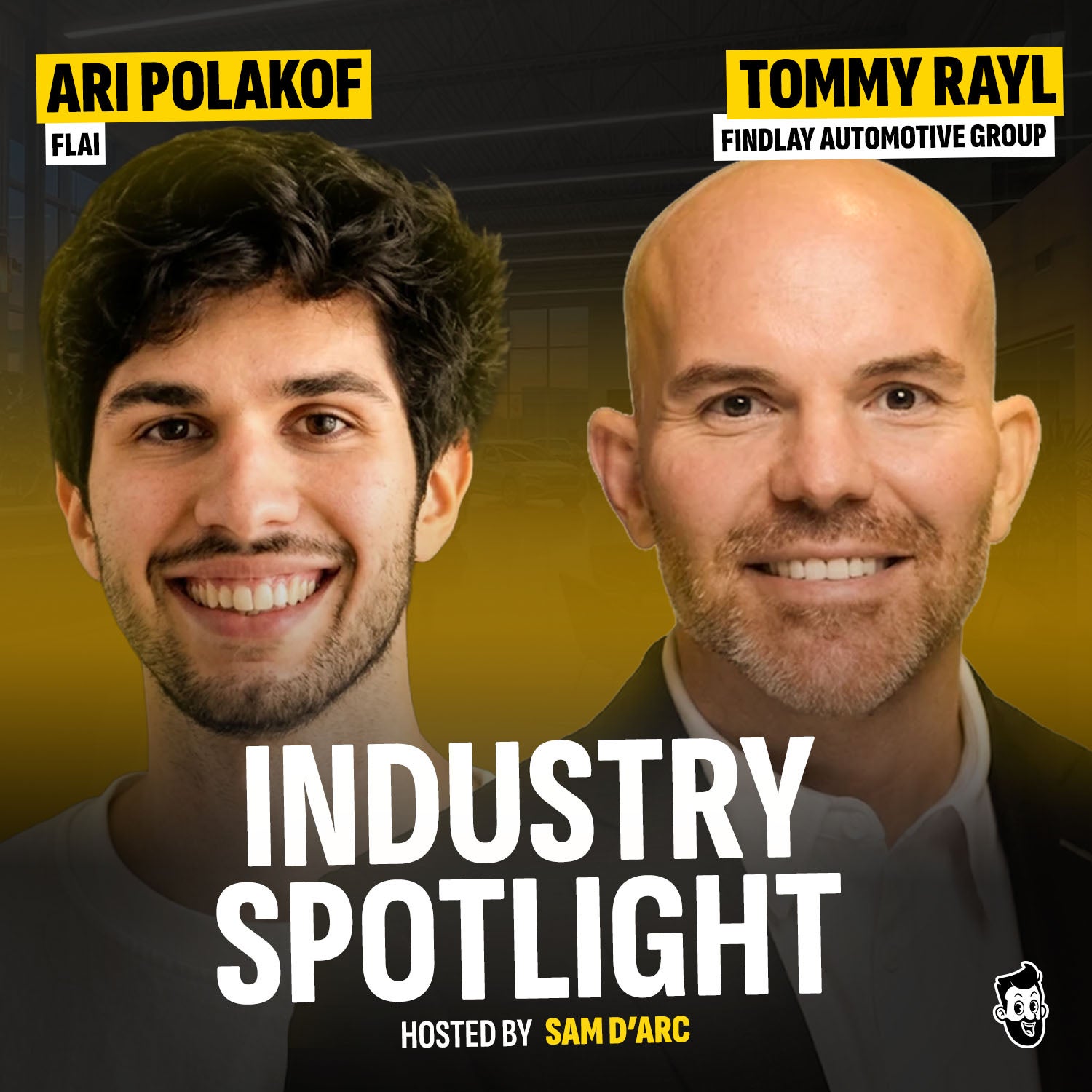
In this episode of the Industry Spotlight, joining host Sam D'Arc are Ari Polakof, CEO at Flai, and Tommy Rayl, Operations Director at Findlay Automotive Group to discuss how unanswered calls, voicemail dead ends, and 10-minute hold times are quietly sending service customers to the shop down the street, and how Findlay put an AI receptionist on the phones across 34 dealerships to win them back. Tommy shares how Findlay's paid service visits went from falling every single month to up 5.7% year over year, with some stores booking more than 85% of appointments without a human ever picking up. He and Ari break down what went wrong early (including an AI that offered every caller a free Uber ride), why most dealers are worse on the phone than they believe, and the simple late-night test every dealer should run on their own store tonight. This episode of the Car Dealership Guy Podcast is brought to you by Flai. Topics: 02:45 Retention Beats Unit Sales As A Metric. 06:15 Sales Sells One, Ser
What actually works when it comes to detecting lies, and why are so many popular ideas about reading people and nonverbal behavior at odds with the scientific research? I talk with Aldert Vrij, one of the world's leading deception-detection researchers, who has spent almost four decades studying these topics. We discuss why what people say is far more revealing than their body language; why the perceived “sexiness” of reading nonverbal behavior has contributed to widespread myths and misconceptions; whether vocal behaviors like pitch, volume, and hesitation contain meaningful clues; and whether there's value in analyzing minor word choices and turns of phrase, as is done in so-called “statement analysis.” We discuss Paul Ekman's legacy as a source of faulty ideas about deception, micro-expression-based deception detection training, and the strategies that popular “body language experts” use to appear scientifically credible while simultaneously promoting ideas that conflict with the sc
Being observant is an important part of being a gardener and the more we observe, the more we learn! Hear about visual signs to look for on your plants to determine their health and help solve issues.
Health advice should account for people's income, time, and practical circumstances.
Share your view, then see how readers voted. No sign-in required. This poll is shared across stories.
Do you agree or disagree?
Common Quandary
A Common Quandary to discuss
Another conversation to explore, separate from this news story.
Your adorable child could pay for college by becoming an influencer. Do you start filming?
Parents post cheerful videos of their young child and earn enough to fund the child's education. The child enjoys filming now but cannot understand what it means for strangers to watch those moments years later.
Can parents consent to a permanent public identity on a child's behalf?