Listen through the publisher, then discuss the episode here or arrange an in-person Roundtable. Your city determines where to meet.
Roundtables are designed for groups of four, with a shared subject and room for everyone to speak. Come for discussion, with no dating expectation.
We can now follow where Monarch butterflies go when they leave our gardens with tiny sensors that track their impressive 3,000-mile migrations from Canada to Mexico. The significant challenges that the journey poses are depicted in a new science exhibit at the American Museum of Natural History featuring artwork by Mad Magazine illustrator and environmentalist Peter Kuper. Their plight highlights the threats that chemicals and habitat loss pose to all insects, but all is not dire. Surprising research into how Monarchs protect themselves from disease shows the remarkable self-healing capacities of not only our colorful, vital pollinators but a diversity of species, from birds to dogs to chimpanzees. Guests: Sean Decatur (https://www.amacad.org/person/sean-m-decatur) – President of the American Museum of Natural History in New York City Jessica Ware (https://www.amnh.org/research/staff-directory/jessica-ware) – Entomologist, Chair of the Division of Invertebrate Zoology, Curator, Monarch’s Journey at the American Museum of Natural History Peter Kuper (https://www.peterkuper.com/about) – Graphic novelist whose work appears regularly in Charlie Hebdo, The New Yorker, The Nation, and Mad Magazine, where he has written and illustrated “Spy vs. Spy” since 1997, illustrator of the AMNH exhibition, Monarch’s Journey Mark Moffett (https://www.doctorbugs.com/bio/) – Tropical biologist, research associate at the National Museum of Natural History in the Smithsonian Institution, visiting scholar, Department of Human Evolution, Harvard University Jaap de Roode (https://biology.emory.edu/people/bios/faculty/de-roode-jaap.html) – Biologist, Emory University, author of “Doctors by Nature: How Ants, Apes, and Other Animals Heal Themselves (https://bookshop.org/p/books/doctors-by-nature-how-ants-apes-and-other-animals-heal-themselves-jaap-de-roode/a1112c964031ddb1)" You can get early access to ad-free versions of every episode by joining us on Patreon (https://www.patreon.com/bigpicturescience). Thanks for your support! Big Picture Science is part of the Airwave Media (http://airwavemedia.com/) podcast network. Please contact [email protected] (https://mail.google.com/mail/?fs=1&tf=1&to=advertising%40airwavemedia.com&view=cm) to inquire about advertising on Big Picture Science.
Episode information is provided by the publisher. Listening takes place on the publisher’s service.
Explore how the Hubble Space Telescope reveals the Universe, from iconic images to major discoveries, and how it complements the James Webb Space Telescope. "ASTROMAN: the Dark Sky Guardian" is a podcast channel that aims to explore popular science in multiple disciplines and research on interdisciplinary approaches, such as sustainability, dark-sky protection, astrophotography, space exploration, astronomy innovation, inclusive science communication, and STEAM Education by integrating science and arts. Exodus Chun-Long Sit, also known as the ASTROMAN, is a transmedia astronomy educator, popular science author, STEAM educator, and science communicator in Hong Kong. He is recently the National Astronomy Education Coordinator (Chair of Hong Kong, China) of the International Astronomical Union and President of Starrix. He was also an International Committee Member of the Dark Sky International, regularly organizing public lectures at the Hong Kong Space Museum and the Hong Kong Science Mu
Explore what makes polio so dangerous, what is causing the 21st century resurgence of cases, and how we can eradicate the disease. -- In 1952, polio was everywhere: killing or paralyzing roughly half a million people annually. Yet just 10 years later, paralytic polio cases in the US dropped by 96% and we were on track to get rid of polio for good. But in recent years, the virus started striking back. So, what’s behind these recent spikes? Explore the dangers of poliovirus and the possibility of eradicating this deadly disease. Directed by Anton Bogaty. This video made possible in collaboration with Gates Ventures Learn more about how TED-Ed partnerships work: https://bit.ly/TEDEdPartner A special thanks to Ananda Bandyopadhyay, Amber Zeddies, and Kathleen O'Reilly who provided information and insights for the development of this video. Support Our Non-Profit Mission ---------------------------------------------- Support us on Patreon: http://bit.ly/TEDEdPatreon Check out our merch: htt
In Brought to You By: How Corporations Warped the Truth, Conned the Public, and Broke Democracy (https://bookshop.org/a/12343/9781639736331), Amy Westervelt exposes the plot hidden within the familiar story of science denial. Over the last century, Big Industry has built a vast apparatus of think tanks, lobbyists, sponsored university labs, and obliging news networks to con the public and fool decision-makers, poisoning the informational ecosystem and warping the nature of truth along the way. With her signature wit and incisiveness, Westervelt introduces the masterminds of corporate misinformation: Herb Schmertz, the public relations pioneer who made Mobil “the thinking man's oil company;” Richard Edelman, the PR guy who helped the dairy industry vilify oat milk; David Petraeus, the disgraced spy chief using counter-insurgency tactics to discredit climate science; and many more. She shows how these company men have worked to usher in an era of unprecedented corporate control. Only by
THE SEARCH FOR THE ULTIMATE RED LIGHT THERAPY IS OVER! After decades of exploring wellness technologies, Michael Jaco sits down with Rob Rene, founder of Exodus Strong, to explore the Red Light+ Total Body Reset system, the science behind red and near-infrared light, and why this technology has become such an important part of their wellness conversation. Rob's remarkable personal journey—including surviving five near-death experiences—inspired his mission to develop practical wellness tools that people can incorporate into their everyday lives. Discover the full-body Red Light+ Mat, designed for convenient 20-minute sessions, and the portable Red Light+ Wand, created for targeted use on areas such as the knees, shoulders, hands, and lower back. Michael and Rob discuss the technology, personal experiences, and how red light therapy may support a daily wellness routine. BLACK FRIDAY–CYBER MONDAY LISTENER EXCLUSIVE! This is your opportunity to explore Exodus Strong's special holiday offe
Remove your personal information from the web at https://joindeleteme.com/SPACETIME One of the most important reasons we go to space is to know our own planet better. Today I'm going to tell you about an orbiting facility that literally watches Earth's biosphere breath and grow and die with incredible resolution. I'll talk about its profound existential and economic importance, and about why it's in danger of being lost. PBS Member Stations rely on viewers like you. To support your local station, go to:http://to.pbs.org/DonateSPACE Sign Up on Patreon to get access to the Space Time Discord! Check out the Space Time Merch Store Pale Blue Dot By Carl Sagan Search the Entire Space Time Library Here: https://search.pbsspacetime.com/ Hosted by Matt O'Dowd Written by Fernando Franco Félix & Matt O'Dowd Post Production by Leonardo Scholzer, Yago Ballarini & Stephanie Faria Directed by Andrew Kornhaber Associate Producer: Bahar Gholipour Executive Producer: Andrew Kornhaber Executive in Charge
At a concert, most listeners hear the melody. A trained singer hears the breath control that carries a difficult phrase. At a football match, the crowd follows the ball while a coach notices the defender who quietly closes off an attack. Knowing more changes who seems extraordinary. Audiences have traditionally borrowed that knowledge from commentators, critics, and friends, whose explanations help determine which achievements receive applause and which pass unnoticed. AI could make that guidance a routine part of watching almost anything. Tools already track players’ movements, analyze musical pitch and timing, and explain technical processes. As those abilities become integrated into broadcasts and personal assistants, viewers could ask what made a particular passage difficult or why a player chose one route over another. Instead of receiving occasional commentary, someone could explore an entire performance with detailed explanations tailored to their questions. The consequential sh
As their name suggests, “forever chemicals” have extraordinary staying power. When these nearly indestructible compounds find their way into our soil and water, they don’t break down for hundreds or thousands of years. PFAS – the name for these synthetic chemicals – isn’t just in our natural environment. Scientists have found it everywhere, including in the blood of nearly every living being. In this episode, we talk to the reporter who broke open the story about a decades-long corporate coverup regarding forever chemicals, look at what we know about their health effects, and consider how a kneecapping of the EPA’s regulatory power may weaken the best tool we have for protecting ourselves from PFAS contamination. Guests: Nathaniel Rich (https://nathanielrich.com/) – Author of “Second Nature: Scenes from a World Remade (https://bookshop.org/p/books/second-nature-scenes-from-a-world-remade-nathaniel-rich/ced7f351cb7854eb),” and the New York Times Magazine article, “The Lawyer Who Became
Experiencing art in person offers something that online viewing cannot fully replace.
Share your view, then see how readers voted. No sign-in required. This poll is shared across stories.
Do you agree or disagree?
Common Quandary
A Common Quandary to discuss
Another conversation to explore, separate from this news story.
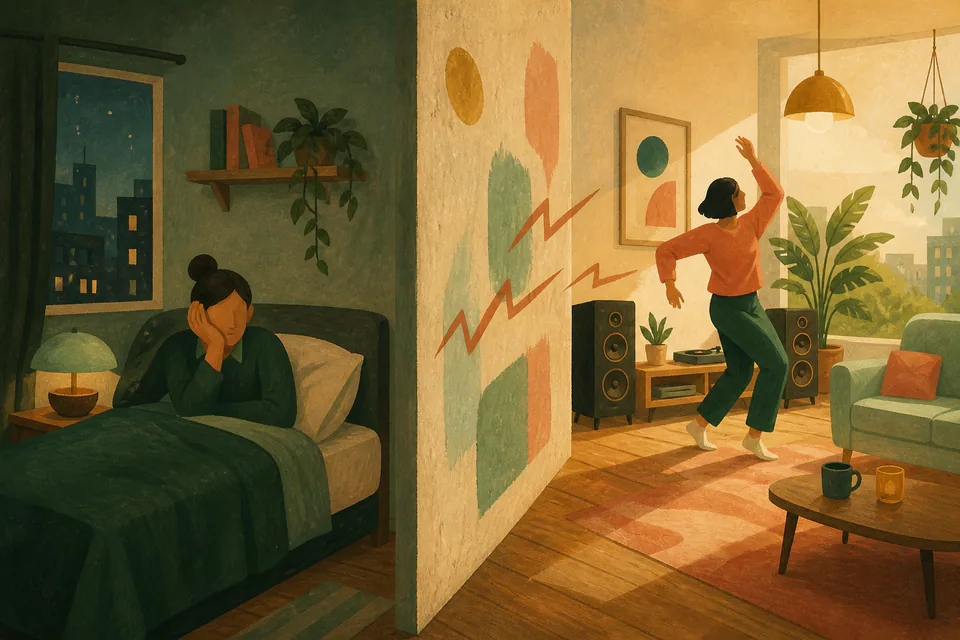
Your neighbor keeps playing music at midnight. How many friendly warnings do they get?
A neighbor regularly plays music late enough to disturb your sleep. Friendly requests help briefly, but a formal complaint could threaten their lease in a building with few affordable options.
How far should empathy extend when someone repeatedly ignores your needs?