Listen through the publisher, then discuss the episode here or arrange an in-person Roundtable. Your city determines where to meet.
Roundtables are designed for groups of four, with a shared subject and room for everyone to speak. Come for discussion, with no dating expectation.
A guest post by Drew Housman This is a guest post by Drew Housman (https://expandingcircle.substack.com/), whose review of Dominion (https://readscottalexander.com/posts/acx-your-book-review-dominion-by-matthew) earned finalist status in the 2024 ACX book review contest. If you are unsuccessful for long enough on your pregnancy journey, and none of the many doctors you see can identify a problem, you get branded with a label. You now have "unexplained infertility." This is good because there's still hope of fixing the problem but dreaded because once you've reached this point the system is less interested in you. The fertility doctors don't become unkind, but they also don't give you the sense they are poring over medical journals trying to figure out your problem. They have looked for the keys under the streetlight and come up empty. Once you have unexplained infertility, the doctors start saying things like, "Have you considered using a surrogate?" and, "Sure, the last 5 embryo transfers failed, but what if we try a 6th and cross our fingers really hard?" My wife and I could make healthy embryos, but none of the transfers were sticking. It was so frustrating to be able to create life only to have it trapped forever in a cooler at a hospital in Milwaukee, our babies like so many forgotten Miller Lights. That's when our LLM doctor stepped in.
Episode information is provided by the publisher. Listening takes place on the publisher’s service.
A kiss can be wonderful. It can create an instant connection, spark romance, or make you feel closer to someone. But a kiss can also have the opposite effect — and sometimes ruin everything. So what makes kissing so powerful, and why can one kiss make such a difference? There's some fascinating science behind it. https://www.scientificamerican.com/article/why-we-kiss/ We spend an enormous amount of time worrying about what's going to change. What's next? What's coming? How do we prepare? But what if we're paying attention to the wrong things? Some of the most important forces shaping our lives never change, and understanding them may be far more valuable than trying to predict the future — something humans are notoriously bad at. Morgan Housel, partner at The Collaborative Fund and author of Same as Ever: A Guide to What Never Changes (https://amzn.to/3SwWn6u) (https://amzn.to/3SwWn6u)), joins me to explain why the things that stay the same may be the most important things to understan
Thanks to LastPass for sponsoring PBS DS. You can check out LastPass by going to https://lastpass.onelink.me/HzaM/2019Q3JulyPBSspace Uploaded 18-07-19 PBS Member Stations rely on viewers like you. To support your local station, go to: http://to.pbs.org/DonateSPACE Our universe started with the big bang. But only for the right definition of “our universe”. And of “started” for that matter. In fact, probably the Big Bang is nothing like what you were taught. A hundred years ago we discovered the beginning of the universe. Observations of the retreating galaxies by Edwin Hubble and Vesto Slipher, combined with Einstein’s then-brand-new general theory of relativity, revealed that our universe is expanding. And if we reverse that expansion far enough – mathematically, purely according to Einstein’s equations, it seems inevitable that all space and mass and energy should once have been compacted into an infinitesimally small point – a singularity. It’s often said that the universe started wi
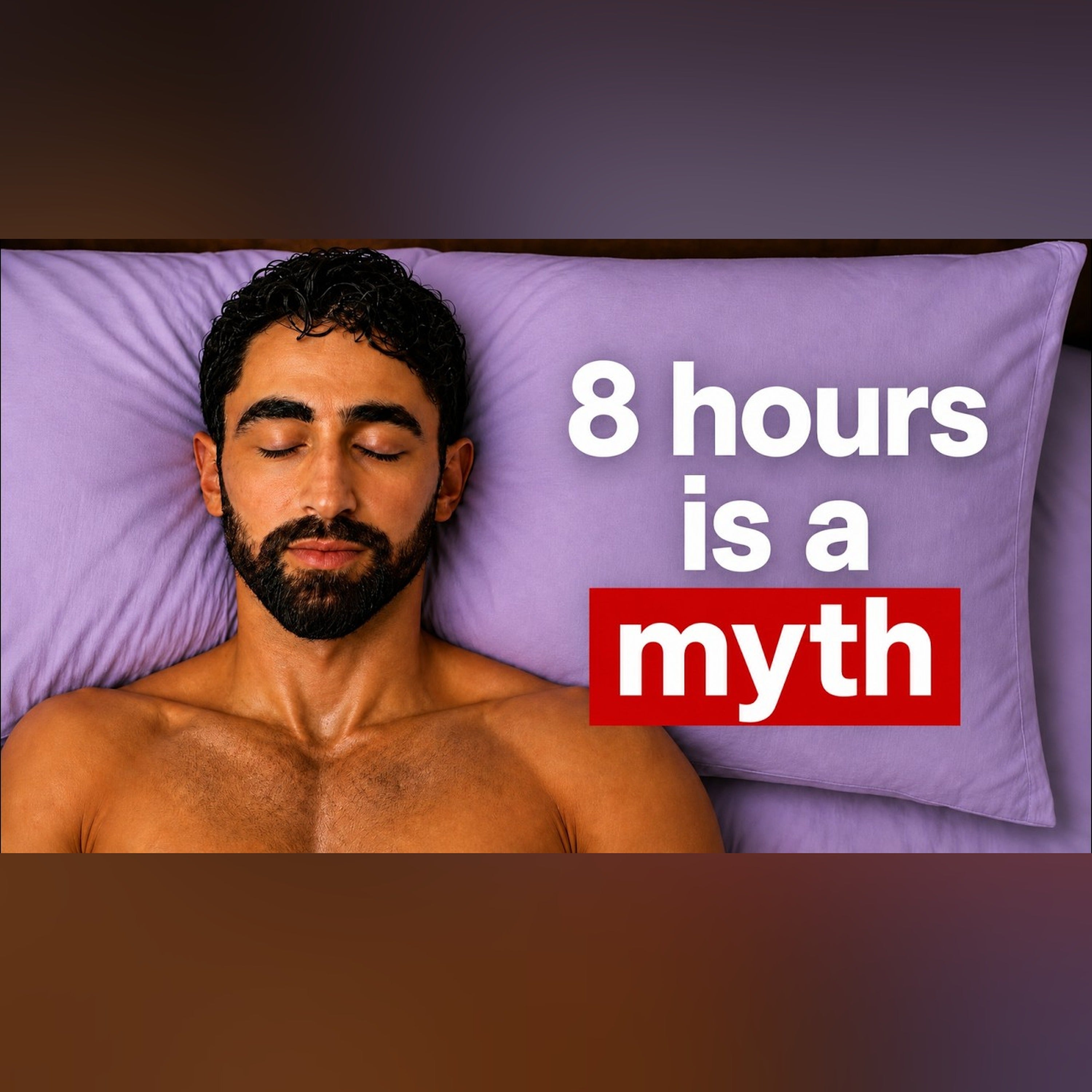
For a written breakdown, early access to content like this, and extra nuances, see the associated StayCurious Metabolism newsletter: https://open.substack.com/pub/staycuriousmetabolism/p/stop-chasing-8-hours-of-sleep?r=40ekz2&utm_campaign=post&utm_medium=web&showWelcomeOnShare=true (https://open.substack.com/pub/staycuriousmetabolism/p/stop-chasing-8-hours-of-sleep?r=40ekz2&showWelcomeOnShare=true) Pinealon Letter: https://staycuriousmetabolism.substack.com/p/why-im-trying-this-peptide-for-sleep?r=40ekz2 No Sleep Letter: https://staycuriousmetabolism.substack.com/p/what-if-you-didnt-need-to-sleep-this?r=40ekz2 Deep Sleep Masterclass: https://staycuriousmetabolism.substack.com/p/how-to-help-your-brain-clean-itself?r=40ekz2 I review several gamma entrainment devices in the Deep Sleep letter, along with the evidence supporting this tool. The only device I have personal experience with is Gamma Light Therapy, which was developed based on some of the early Nature research and is also one of
What NVIDIA is trying to build next… You're probably hearing a lot about AI, DeepSeek, NVIDIA and more right now. If you want the big picture (and to start from the beginning), watch this Huge Conversation with NVIDIA CEO Jensen Huang. In the last few years, NVIDIA has skyrocketed to become one of the world's most valuable companies. That's because, beginning in the 90s, they led a fundamental shift in how computers work, now unleashing the current explosion of what’s possible with technology. A huge amount of the most futuristic tech you’re hearing about - in AI, robotics, gaming, self-driving cars, breakthrough medical research - relies on new chips and software designed by him and his company. During the dozens of background interviews I did to prepare for this, what struck me most was how much Jensen Huang has already influenced all our lives over the last 30 years, and how many are saying it’s just the beginning of something even bigger… We all need to know what he’s building and
A.I. for Building Self-esteem: Seeing Yourself More Clearly and Kindly, a practical, beginner-friendly look at how artificial intelligence can help you see yourself a little more clearly and kindly. Building Self-esteem? Press play on Episode 427 of A.I. for Beginners and learn exactly how artificial intelligence, especially ChatGPT, alongside a journaling app, can help you see yourself a little more clearly and kindly. WHAT YOU WILL LEARN IN THIS EPISODE - Why building self-esteem is so hard to handle alone, and what is actually going on underneath it - A specific way to use a journaling app to work through it, step by step - An example prompt you can copy word for word: "Help me notice when I'm judging myself far harsher than I'd judge a friend" - A second practical technique, with another ready-to-use prompt: "Help me write down three qualities I actually like about myself, beyond achievements" WHO THIS EPISODE IS FOR - Anyone currently working on building self-esteem - Anyone curio
Project Synapse: Markets in Freefall, Fragile Infrastructure, and AI's Perfect Storm The hosts banter through the show's intro before focusing on a sense that "things are out of control," citing a WallStreetBets suicide-hotline post amid a market crash and discussing cascading system failures involving Microsoft, the FAA, and a reported NSA internal communications outage. They argue politicians and leadership lack technical competence and clear messaging, increasing panic, while emphasizing that many problems stem from aging, underfunded infrastructure and complex, brittle software (PHP, NGINX, Java), not proven AI attacks—more a "perfect storm" of crises. They debate whether AI should help fix complexity, stressing critical thinking, accountability, and using multiple AIs to verify each other. In a lightning round they cover Anthropic's IPO performance, mixed reactions and token limits with ChatGPT 6.2 (favoring "Sol" over "Astra"), Google's cheaper Neon model and confusing UX, Loblaw
Dear Steven: Earlier this month, frustrated by some of your social media posts, I challenged you to a public debate on AI. I hadn't realized that debate offers are to New Media what chum is to sharks. My inbox was deluged by podcasters, debating societies, and general influencers, all offering to host. When I objected that maybe we should wait for you to accept before figuring out details, they all said great, that's absolutely right, they would contact you right away. Their people would reach out to your people. Their nephew knew your friend's babysitter and they were confident they could relay the message. They had already rented an empty lot near your house where they would place a speaker blaring "RESPOND TO SCOTT ALEXANDER'S DEBATE OFFER!" at max volume, day and night. I protested that probably asking you directly on Twitter was enough to get your attention, and maybe now we should give you some time to make up your mind before pressing further, but they said that no, sorry, they'
Finalist #10 in the Book Review Contest [This is one of the finalists in the 2026 book review contest, written by an ACX reader who will remain anonymous until after voting is done. I'll be posting about one of these a week for several months. When you've read them all, I'll ask you to vote for a favorite, so remember which ones you liked] Book 1: The Singapore Story Lee Kuan Yew1 (https://readscottalexander.com/posts/acx-your-book-review-lee-kuan-yews-memoirs) was the Prime minister of Singapore, rationalist folk hero, and one of the few world leaders to successfully become a household name despite not being primarily associated with a major war2 (https://readscottalexander.com/posts/acx-your-book-review-lee-kuan-yews-memoirs). He was also, as it turns out, a surprisingly compelling writer. Aside from being interesting for his own sake, he also ended up implicitly producing the closest thing we have to a firsthand account of the fall of the British Empire and rise of the new world ord
Tax increases should include clear measures for judging whether the promised benefits occur.
Share your view, then see how readers voted. No sign-in required. This poll is shared across stories.
Do you agree or disagree?
Common Quandary
A Common Quandary to discuss
Another conversation to explore, separate from this news story.
A $300 package lands at your door by mistake. Do you keep it?
A package containing expensive headphones arrives with your address but another person's name. The retailer says it has already replaced the order and does not ask you to return it.
If no one appears to lose, what still makes keeping it right or wrong?