Post-Labor Economics: What happens when AI changes work forever? | Artificial Intelligence Masterclass
53 min
Listen through the publisher, then discuss the episode here or arrange an in-person Roundtable. Your city determines where to meet.
Roundtables are designed for groups of four, with a shared subject and room for everyone to speak. Come for discussion, with no dating expectation.
Post-Labor Economics: What happens when AI changes work forever? Episode release date: 7 Jun 2023 Core Ideas: Metamodernism: Narratives and emergence view of reality - Reduce suffering - Increase prosperity - Increase understanding mantra: Seek knowledge. DISCLAIMER: This is a community-driven show. -------------- Keywords: heuristic imperatives, ai masterclass, ai philosophy, superintelligence, ai innovation, machine learning, gpt, singularity
Episode information is provided by the publisher. Listening takes place on the publisher’s service.
Access the masterclass instantly for free: https://nci.university/learn Uploaded 10-01-26 Your goals don’t fail because you lack discipline — they fail because they were aimed at the wrong system. Optimizing behavior without fixing brain chemistry is like issuing commands to a damaged machine. Until the chemical environment is right, effort just increases friction and burnout. All goals live in the conscious mind — but control does not. Real behavior is governed by the mammalian brain, the ancient systems that decide safety, threat, and energy allocation. Every resolution collapses when those lower systems detect risk, even if you consciously “want” the outcome. Goal-setting ignores this hierarchy — and that’s why it keeps failing. Once you target the parts of the brain actually in charge, change stops feeling like force. Discipline becomes unnecessary when the system itself is aligned. Please note that the content provided in this broadcast is for informational and educational purpose
Dig into the science of how kidney transplants work, how donors are matched and find out how this surgery saves lives. -- In 1954, Joseph Murray attempted a type of kidney swap that no doctor had tried before. The surgery was a success, and the patient would go on to live with the transplanted organ thanks to one key factor: it came from his identical twin. 70 years later, nearly 100,000 kidneys are transplanted annually in the US alone. So how does this surgery work today? Alexander H. Toledo explains the procedure. Lesson by Alexander H. Toledo, directed by Biljana Labović. Support Our Non-Profit Mission ---------------------------------------------- Support us on Patreon: http://bit.ly/TEDEdPatreon Check out our merch: http://bit.ly/TEDEDShop ---------------------------------------------- Connect With Us ---------------------------------------------- Sign up for our newsletter: http://bit.ly/TEDEdNewsletter Find us on Twitter: http://bit.ly/TEDEdTwitter Peep us on Instagram: http://
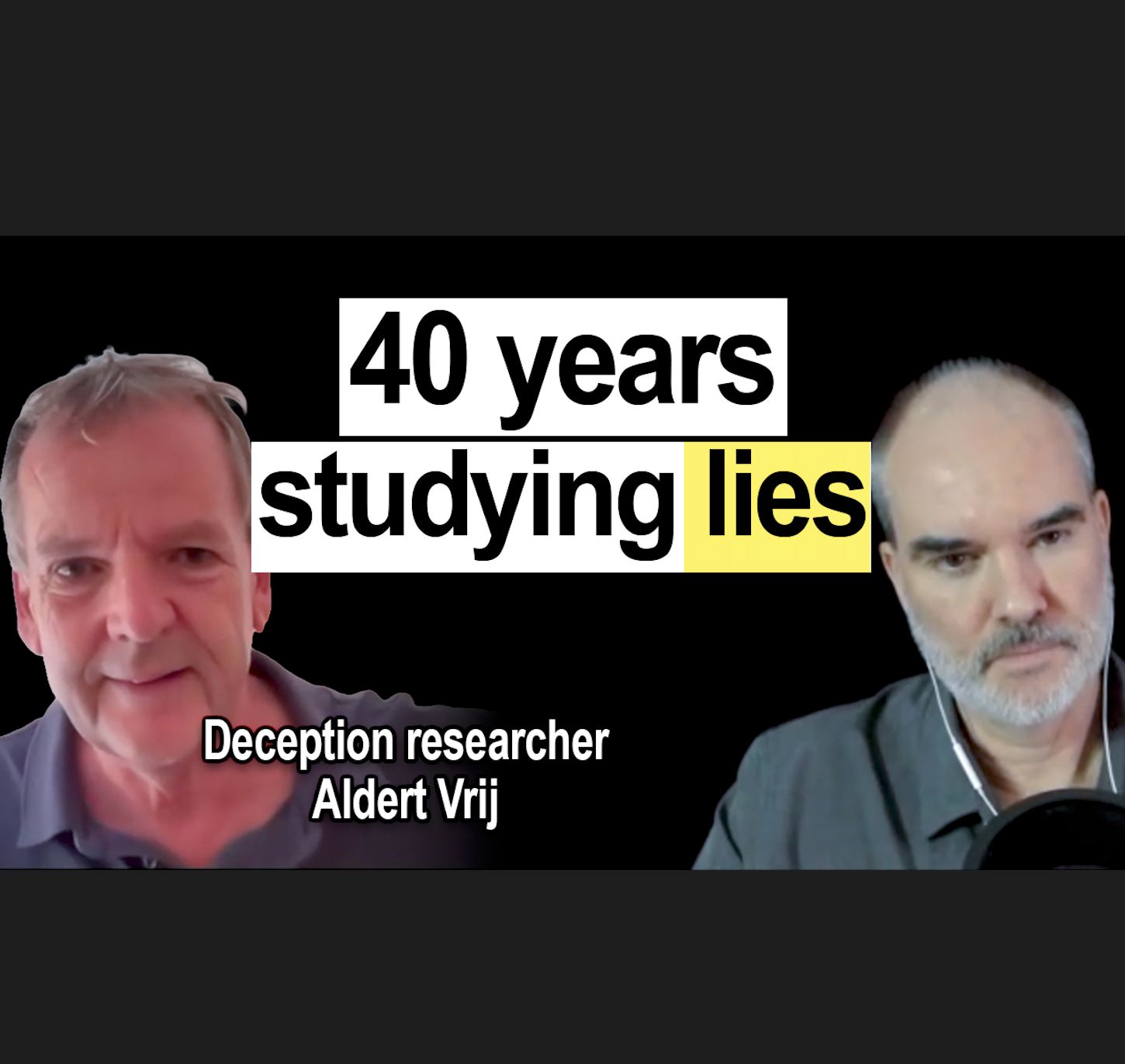
What actually works when it comes to detecting lies, and why are so many popular ideas about reading people and nonverbal behavior at odds with the scientific research? I talk with Aldert Vrij, one of the world's leading deception-detection researchers, who has spent almost four decades studying these topics. We discuss why what people say is far more revealing than their body language; why the perceived “sexiness” of reading nonverbal behavior has contributed to widespread myths and misconceptions; whether vocal behaviors like pitch, volume, and hesitation contain meaningful clues; and whether there's value in analyzing minor word choices and turns of phrase, as is done in so-called “statement analysis.” We discuss Paul Ekman's legacy as a source of faulty ideas about deception, micro-expression-based deception detection training, and the strategies that popular “body language experts” use to appear scientifically credible while simultaneously promoting ideas that conflict with the sc
At a concert, most listeners hear the melody. A trained singer hears the breath control that carries a difficult phrase. At a football match, the crowd follows the ball while a coach notices the defender who quietly closes off an attack. Knowing more changes who seems extraordinary. Audiences have traditionally borrowed that knowledge from commentators, critics, and friends, whose explanations help determine which achievements receive applause and which pass unnoticed. AI could make that guidance a routine part of watching almost anything. Tools already track players’ movements, analyze musical pitch and timing, and explain technical processes. As those abilities become integrated into broadcasts and personal assistants, viewers could ask what made a particular passage difficult or why a player chose one route over another. Instead of receiving occasional commentary, someone could explore an entire performance with detailed explanations tailored to their questions. The consequential sh
Project Synapse: Markets in Freefall, Fragile Infrastructure, and AI's Perfect Storm The hosts banter through the show's intro before focusing on a sense that "things are out of control," citing a WallStreetBets suicide-hotline post amid a market crash and discussing cascading system failures involving Microsoft, the FAA, and a reported NSA internal communications outage. They argue politicians and leadership lack technical competence and clear messaging, increasing panic, while emphasizing that many problems stem from aging, underfunded infrastructure and complex, brittle software (PHP, NGINX, Java), not proven AI attacks—more a "perfect storm" of crises. They debate whether AI should help fix complexity, stressing critical thinking, accountability, and using multiple AIs to verify each other. In a lightning round they cover Anthropic's IPO performance, mixed reactions and token limits with ChatGPT 6.2 (favoring "Sol" over "Astra"), Google's cheaper Neon model and confusing UX, Loblaw
PBS Member Stations rely on viewers like you. To support your local station, go to: http://to.pbs.org/DonateSPACE ↓ More info below ↓ Uploaded 10-08-20 The second in our two event series about Theories of Everything! Watch the first one: https://www.youtube.com/watch?v=_izocEgArtQ Please subscribe to Brian Keating's YouTube Channel to watch one-on-one interviews with the guest speakers and more: https://www.youtube.com/DrBrianKeating Existing Theories of Everything have not yet produced experimental evidence that solves the fundamental challenges facing physics. That lack of progress has opened up a sea of controversy, from disagreements about the very necessity of TOEs, to questioning the cost/benefit of mega-billion dollar particle accelerators in search of them, to the emergence of competing TOEs from physicists outside of the academic community. In this 90 minute chat we dive into the existential questions around TOEs. Special thanks to Brian Keating, Lee Smolin, Sabine Hossenfelde
Best books for Prompt Engineering with GPT-3 and LLMs - Crash Course in AGIEpisode release date: 27 Dec 2022Spreading awareness about the works of some of the leading educators in the AI revolution. Core Ideas: Metamodernism: Narratives and emergence view of reality - Reduce suffering - Increase prosperity - Increase understanding mantra: Seek knowledge. ELABORATE: Add depth and detail to understanding, weaving comprehensive and nuanced explanations.DISCLAIMER: This is a community-driven show. ----------------Best books for Prompt Engineering with GPT-3 and LLMs - Crash Course in AGIEpisode release date: 27 Dec 2022Spreading awareness about the works of some of the leading educators in the AI revolution. Core Ideas: Metamodernism: Narratives and emergence view of reality - Reduce suffering - Increase prosperity - Increase understanding mantra: Seek knowledge. ELABORATE: Add depth and detail to understanding, weaving comprehensive and nuanced explanations.DISCLAIMER: This is a community
Cognitive AI Lab Community Update + consensus, books, and my next steps Episode release date: 19 Aug 2022 Core Ideas: Metamodernism: Narratives and emergence view of reality - Reduce suffering - Increase prosperity - Increase understanding mantra: Seek knowledge. DISCLAIMER: This is a community-driven show. ------------ Keywords: tech singularity, post labor economics, ai agents, chatbots, agi, machine learning
"Principle Driven Self-Alignment" and "Preference Ranking Optimization" [Best Alignment Papers!]Episode release date: 16 Jul 2023Spreading awareness about the works of some of the leading educators in the AI revolution. Core Ideas: Metamodernism: Narratives and emergence view of reality - Reduce suffering - Increase prosperity - Increase understanding mantra: Seek knowledge. ELABORATE: Add depth and detail to understanding, weaving comprehensive and nuanced explanations.DISCLAIMER: This is a community-driven show. ----- Keywords: deep learning, prompt engineering, artificial general intelligence, agi, future technology
Improving employee pay should take priority over increasing shareholder payouts.
Share your view, then see how readers voted. No sign-in required. This poll is shared across stories.
Do you agree or disagree?
Common Quandary
A Common Quandary to discuss
Another conversation to explore, separate from this news story.
You find a family secret after a relative dies. Does the truth come out?
Sorting through a deceased relative's papers, you discover evidence of a serious betrayal that would change how the family remembers them. Revealing it could answer old questions—and cause fresh pain.