Listen through the publisher, then discuss the episode here or arrange an in-person Roundtable. Your city determines where to meet.
Roundtables are designed for groups of four, with a shared subject and room for everyone to speak. Come for discussion, with no dating expectation.
Australia has a productivity problem. We're working more, but not producing much more for every hour we work. Over the year to June, Australia's labour productivity actually fell 0.2 per cent. Why? Is it that Australia simply hasn't invested enough in businesses, technology, infrastructure, skills, or the systems that allow people to work more efficiently? Or is it all the red tape flying around, on a state and national level? How did Australia end up here - and what actually fixes it? Ian Verrender and economist Professor Ross Garnaut, Emeritus Professor at the University of Melbourne and Australian National University and former Australian ambassador to China and adviser to Bob Hawke, break it all down on ABC Business Daily. Got a burning business question? We'd love to hear your questions!
Episode information is provided by the publisher. Listening takes place on the publisher’s service.
Sit down with Tony Robbins and Danny Meyer behind-the-scenes at Business Mastery. Danny reveals how every business strategy starts with the idea of “enlightened hospitality” – and how leading with hospitality at the top of mind not only transforms business outcomes for stakeholders but inspires a healthy internal culture within any company. Uploaded 20-05-21 In their conversation, Danny shares the story of how Shake Shack grew from a hot dog cart into a world-famous restaurant sensation. He also unveils an essential trait that all entrepreneurs have in common and what is absolutely necessary to stay relevant and how to constantly innovate in one of the most competitive industries in the world. If you’re in the hospitality industry or restaurant business, do not miss this insightful interview! About Business Mastery Business Mastery is the world’s premier business training event designed and hosted by the world’s #1 authority on personal growth, business transformation and peak performa
Thursday 26th November 2026 Another volatile session on Wall Street as markets digested Donald Trump’s new Section 301 tariffs alongside lingering questions over AI valuations and circular financing. NAB’s Ray Attrill says while Australia was spared from the latest round of duties (remaining at 12.5%), China faces a new 20% tariff (taking its total to 32.5% rather than 45%, as it is not stacked on forced-labour penalties), lifting the average US import tariff rate from 11% to roughly 14%. Locally, Australia’s October headline CPI jumped more than expected to 4.9% driven by fuel, electricity, and new dwelling costs—but markets kept RBA expectations anchored around a prolonged hold and potential 2027 cuts, while US Q3 GDP was revised sharply higher to 4.3% alongside sticky core PCE inflation at 3.3%. Today Australian Q3 Capex data will be the focus, with the US on holiday for Thanksgiving. Hosted on Acast.
#JimRohnMotivation #JimRohn #JimRohnSpeech In this Jim Rohn Motivation video, discover why success isn’t an accident—it’s engineered. It’s the product of habits, systems, focus, and emotional resilience. Learn how to build the five foundational habits that transform ambition into achievement. Key Topics From This Motivational Video: Why your habits matter more than your motivation The power of owning your time and building systems How to sharpen focus in a distracted world The link between energy management and performance How emotional regulation and self-trust drive long-term success Success doesn’t come from what you do once—it comes from what you do daily. This Jim Rohn motivational video breaks down the blueprint of lasting success, showing you how to align your behaviors with your vision, structure your day with clarity, and lock in habits that move you forward no matter what life throws at you. This Jim Rohn Motivational Video Is Perfect For: Entrepreneurs, professionals, and st
Grain Markets and Other Stuff Links— TikTok (https://www.tiktok.com/@grainmarketsandotherstuf) 🇺🇸🇨🇳 Tariffs & Trade The Trump administration is getting ready to put new tariffs on most goods from China, the EU and 14 other countries, after an investigation into their industrial subsidies. China is likely to face the steepest rates, though the US and China did hold their first "agriculture working group" meeting this week. Grain Markets Soybeans rose about 5¢ to around $12.34 on strong meal demand, and corn added a penny to about $4.50 in light pre-Thanksgiving trading. Wheat slipped as winter wheat conditions improved for a third straight week, and the strong US dollar is still weighing on grains. Farmer Mental Health Years of high input costs, bad weather and volatile markets are wearing on farmers: 72% report high stress during the growing season, and suicide rates are 2–5x the national average. Check in on your farming friends and neighbors, and if you need help, reach out to Jo
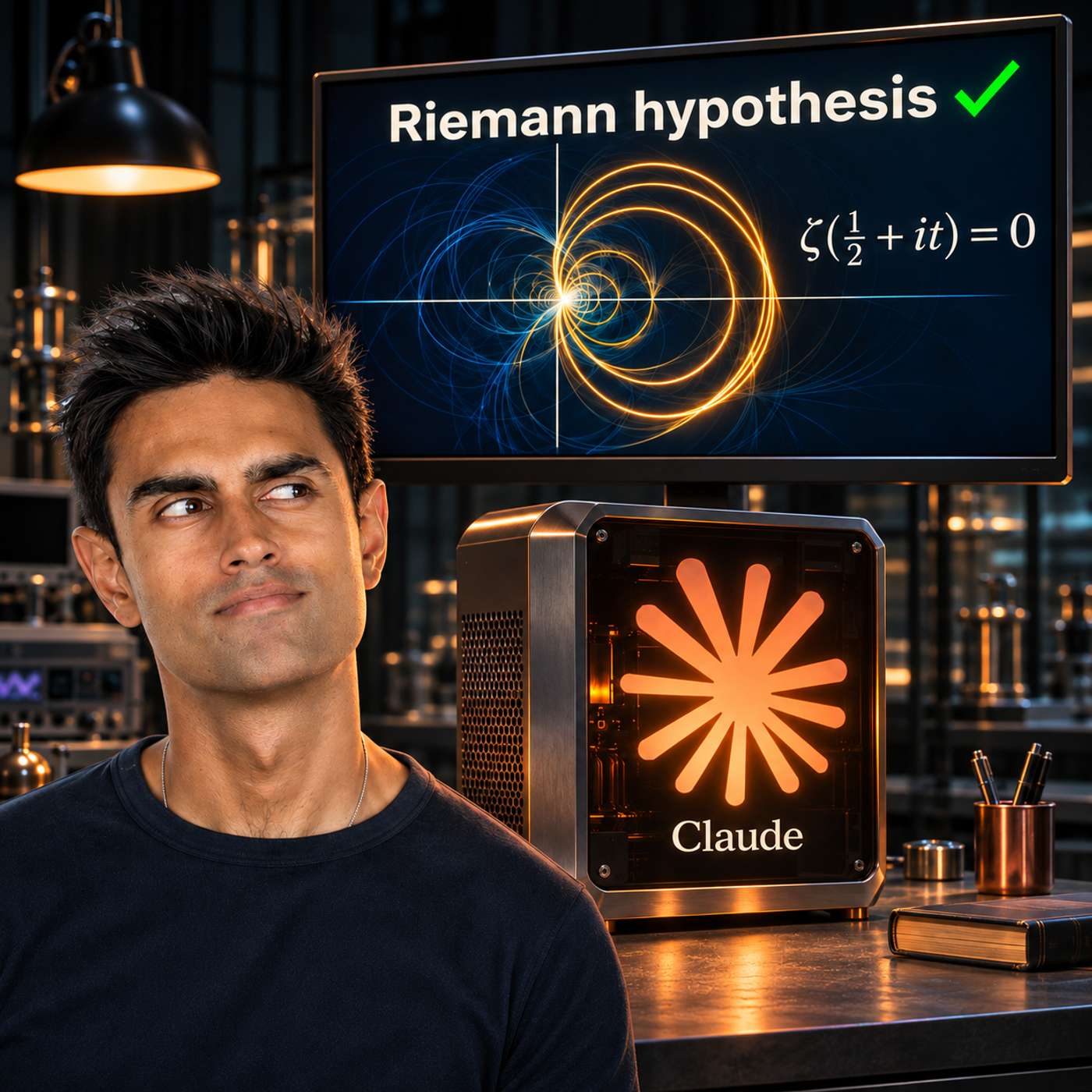
On Nov. 20, Anthropic mathematician Levent Alpöge, working with an internal version of Claude, released a proof of the Riemann hypothesis, the 167-year-old question about how the prime numbers are spread out. The proof is 17 million lines of Lean code. Computers have checked it and Lean's maintainers certified it as correct, but no human, including Alpöge, can follow it. Ejaaz explains what the hypothesis says and why so much of mathematics rests on it. He covers the human proof that surfaced the same day, the drama over OpenAI's Navier–Stokes result, and the question of what humans are for when AI makes discoveries nobody understands. He also asks what it means that the biggest breakthroughs come from models only a few companies can use, and why he thinks this is the start of a golden age of discovery. == FOLLOW EJAAZ ON TWITTER: == Timestamps 00:00 AI Solves the Riemann Hypothesis 00:45 What Are Humans For? 01:58 The Millennium Prize Problems 02:32 Are the Primes Random? 03:08 A Thou
After years of looking foolish, value investing has suddenly reminded everyone why patient diversification matters. Don and Tom revisit the century-long value premium, the painful stretch when growth dominated, and the sharp 2026 reversal that rewarded investors who stayed disciplined. They compare how broad global funds such as AVGE, DFAW, and VT expose investors to value, size, and profitability. Then a 32-year-old listener with a high tolerance for volatility asks how far he can push risk without simply making a concentrated bet. The final questions cover Roth conversions, Medicare IRMAA surcharges, and a short shelf of investing books that are actually worth reading. 00:49 Value returns after a long drought 08:55 How global funds tilt toward value 13:19 How much risk is too much at 32? 20:16 Roth conversions and IRMAA surcharges 27:57 Investing books worth reading Questions? Comments? Click! (https://www.buzzsprout.com/2607021/fan_mail/new)
The numbers are in, and it's not good. Inflation rose to 4.9 per cent in October, up from 4.3 per cent in September. The fresh ABS figures give us another look under the bonnet of an economy still grappling with stubbornly high inflation, following five interest rate hikes this year. So what's the detail behind the numbers? Where are the price pressures, where are we seeing signs of relief, and how might these latest figures shape the Reserve Bank’s decisions in the coming months? Lin Lin and Besa Deda, Chief Economist at William Buck Australia break it all down on ABC Business Daily. Got a burning business question? We'd love to hear your questions!
Jensen Huang is back at the helm of Nvidia - just 11 days after his dramatic exit. His return has sent Wall Street roaring, and US President Donald Trump says he played a key role in the decision, claiming he intervened to make the return happen. There are serious questions about corporate governance that, for now, remain unanswered - but with Huang is still scheduled to testify before lawmakers next week and a congressional committee confirmed, will more be revealed? And with an AI boom already showing signs of strain, is this comeback really the good news investors seem to think it is? Lin Lin and ABC's Chief Business Correspondent Ian Verrender break it all down on ABC Business Daily. Read Ian's analysis here (https://www.abc.net.au/news/2026-11-24/ai-bubble-has-not-burst-but-it-has-significantly-deflated/107416578). Listen to our conversation on the risks of a celebrity CEO here (https://www.abc.net.au/listen/programs/abc-business-daily/the-risk-of-a-celebrity-ceo/107382406). Got a
After five interest rate hikes this year, Australia's economy is starting to show some worrying signs. Unemployment has hit a five-year high, and recession fears are growing. Has the Reserve Bank gone too far in its cutting? And what is a closely watched recession indicator telling us? Plus, it's been a brutal week on Wall Street - even the biggest IPO in history couldn't rescue the AI trade. Is this a correction we had to have, or the start of something much worse? Lin Lin and ABC Business Reporter Steph Chalmers break it all down on ABC Business Daily. Read Lin's latest analysis here (https://www.abc.net.au/news/2026-11-23/sahm-rule-recession-indicator-australia-november-2026/107408750). Got a burning business question? We'd love to hear your questions!
Acting on preliminary research can be justified when the risks of waiting are high.
Share your view, then see how readers voted. No sign-in required. This poll is shared across stories.
Do you agree or disagree?
Common Quandary
A Common Quandary to discuss
Another conversation to explore, separate from this news story.
One sibling did years of caregiving. Should they get more of the inheritance?
One sibling lives near an aging parent and handles appointments, errands, and emergencies. The others live far away, call regularly, and assume the nearby sibling will receive the same inheritance despite years of unpaid work.
When does family care become labor that should be repaid?