Q&A Conversation with Nick Smith and Laura Brandon
57 min
Listen through the publisher, then discuss the episode here or arrange an in-person Roundtable. Your city determines where to meet.
Roundtables are designed for groups of four, with a shared subject and room for everyone to speak. Come for discussion, with no dating expectation.
This week I’m joined by two returning guests, Nick Smith and Laura Brandon, who answered questions that have come in from listeners over the past year. Nick is the founder and director of N. Smith Gallery in Sydney, representing artists across Australia and exhibiting internationally through museums, art fairs and major projects. Laura is a Sydney based art consultant and artist mentor with over 20 years’ experience across art archives and collections, public art education and arts writing. I enjoyed their conversation about the questions emerging artists should be asking themselves, how much social media matters for representation, and what to do when your work is being copied. There were also questions about prizes, how much work to show a gallery, when to raise your prices and what promotion to expect from your gallery. We finish with what makes an artist hard to work with, pay-to-enter competitions, and the etiquette of approaching a gallery or asking an arts professional for advice. I loved hearing where Nick and Laura agreed, how they built on each other’s answers, and the different perspectives they brought to this conversation. You can find Nick Smith here on Instagram (https://www.instagram.com/nw.smith/) and here at N. Smith Gallery Instagram (https://www.instagram.com/n.smithgallery/) & Website (https://www.nsmithgallery.com/) You can find Laura Brandon here on Instagram (https://www.instagram.com/laurambrandon/) and here on her website (https://www.laurabrandon.com.au/) Previous episodes: Nick Smith: What Does it Mean to Represent an Artist - With Nick Smith (https://podcasts.apple.com/cy/podcast/what-does-it-mean-to-represent-an-artist-with-nick-smith/id1738378716?i=1000779641835&l=tr) Laura Brandon: Opportunities Beyond the Gallery Wall with Laura Brandon (https://podcasts.apple.com/au/podcast/opportunities-beyond-the-gallery-wall-with-laura-brandon/id1738378716?i=1000721615292) Hosted on Acast.
Episode information is provided by the publisher. Listening takes place on the publisher’s service.
Is the property downturn shifting from city to city, or are national headlines hiding what is happening on the ground? On this week's Australian Property Podcast, Pete Wargent and Chris Bates look at changing listings, buyer demand and price movements across Australia's housing markets. If you're considering a first home, an upgrade or an investment property, this episode offers questions to ask before acting. Check current lending and tax rules, and seek qualified personal advice rather than treating a podcast discussion as a recommendation. Episode resources Show partner resources Rask resources – Pete's Buyers Agency (https://www.allenwargent.com.au/) – All services (https://bit.ly/R-services) – Financial Planning (https://bit.ly/R-plan) – Invest with us (https://bit.ly/R-invest) – Access Show Notes (https://bit.ly/R-notes) – Ask a question (https://bit.ly/R-quest) – We love feedback! (https://raskau.typeform.com/to/ZbfHy6IP) – Instagram: @rask.invest (https://www.instagram.com/rask
Journalist Simon Moya-Smith and Indigenous studies professor Julie Francella join John Fugelsang for a wide-ranging conversation on Indigenous rights, environmental protections, media representation, and the cost of speaking out. They explain how the proposed American Affordability and Jobs Act could weaken environmental reviews, tribal consultation, and protections for sacred sites—and why pipelines, data centers, and other development projects can bring serious risks to Indigenous communities, including threats to water, land, and safety. They also examine racist stereotypes in political and media coverage, from a cartoon targeting Deb Haaland to a U.S. attorney’s letter mocking Senator Elizabeth Warren with harmful tropes. Simon and Julie discuss why these depictions persist, how underrepresentation in newsrooms contributes to the problem, and why precise language and Indigenous voices matter. Along the way, callers share perspectives on community activism, Native traditions, and th
What is Business Mastery? Tony Robbins himself says it best: “Business Mastery for me is a unique combination of everything I’ve done in my life integrated into five days.” And it has been a big life: from overseeing a business empire worth more than $6 billion annually, to writing best-selling books, to his life-changing philanthropy, Tony has reached the highest highs – and experienced plenty of obstacles along the way. Uploaded 04-02-20 At Business Mastery, Tony shares the insights and skills that helped him turn those obstacles into opportunities – unlock some tips to get you started at https://www.tonyrobbins.com/career-business/is-it-an-obstacle-or-opportunity and watch this video to discover what to expect at this immersive five-day event. Business Mastery features world-class speakers in the areas of real-time marketing, news jacking, digital marketing, social media, business financials, crowdfunding, creating winning stories and more. Attend panels with the world’s top entrepr
What if your AI agent could find the people you should know before you even start looking? Cosign is building a professional network around reputation and trusted recommendations, and now agents can use that network too. MTS host Sophia Dew sits down with a16z’s David Booth and Cosign’s Bella Nazzari to discuss what they’ve learned since launching Cosign, why traditional profiles often miss the operators doing the most important work, and how the Cosign Awards are surfacing talent through the people willing to vouch for them. They also explore an emerging behavior: people connecting their agents to Cosign to continuously find relevant people, lists, and opportunities, and what professional networking could look like when both humans and their agents participate. Resources: Follow David Booth: https://x.com/davidbooth Follow Bella Nazzari: https://x.com/nazzari Follow Sophia Dew: https://x.com/sophiadew Learn more about Cosign:https://cosign.co/ Connect your agent to Cosign:https://cosi
There's a pattern that has ruined more lives than almost anything else. Uploaded 02-06-26 People decide what they want. They set a goal. They write down the number. They put a date on it. They tell their friends. They make a plan. And somewhere between week 3 and week 6, the goal quietly dies. The plan falls apart. The date is going to come and go. And the person who set the goal sits in their disappointment and tries to figure out what went wrong. They blame their willpower. They blame their schedule. They tell themselves next January will be different. But that isn't what went wrong. They didn't fail because the goal was wrong. They failed because they had it backwards. They tried to install the goal before they built the habit. They built the destination before they built the road. They wrote the postcard before they laid the bricks. A goal without a habit underneath it is a wish dressed up in a deadline. It cannot survive. It was never going to survive. This seminar lays out why th
Hey everybody, Tom Bilyeu here. On today’s episode of Impact Theory, we’re taking on a topic that’s got the whole world holding its breath: the escalating crisis between the United States and Iran. As tensions ratchet up, we’re asking the tough questions—how did we get stuck in this “escalation trap,” and what does it mean for America’s global leverage, our economy, and our very sense of security? The conversation focused on why the traditional idea of “strategy” might be failing policymakers, using powerful analogies—like chess versus roulette—to show how doubling down in conflict can spiral out of control. We’ll break down the risks of tactical “wins” that create even bigger crises, the real leverage Iran holds with control of the Strait of Hormuz, and the mounting pressure on President Trump as political support erodes and legacy hangs in the balance. A key theme that emerged is what happens when military might runs into decentralized opposition, and why high-stakes gambles—like the
This week I’m joined by Lilli Waters, a Thai-Australian fine art photographer living and working in Melbourne on Wurundjeri Country. Lilli’s photographs explore her history and identity, drawing on visual languages including Dutch still life painting. She builds symbolic worlds of women in elemental landscapes and underwater arrangements of flowers, fish and shells, with water recurring as a symbol of rebirth, transformation and renewal. We talk about how Lilli develops ideas and themes across her work and how she balances her fine art practice with commercial photography. We also get into the practicalities and difficulties of working in natural light on location, how introducing fabrics changed when and how she works, and the challenges and pressure that comes with working the way she does. I loved how openly Lilli spoke about the pressure and persistence behind her work and what keeps her coming back to the camera. You can find Lilli Watershttps://www.instagram.com/lilliwaters/here
This week I’m joined by two returning guests, Wendy Marinich and Lucy Hersey, who answered questions that have come in from listeners over the past year. Wendy is a West Australian painter who paints with a mid-century modern twist, drawing on nostalgia and experimenting with memory and colour. Lucy is a painter from Loch in regional Victoria who came to art from scientific research and now lives on a cattle farm, where she makes earth paintings by grinding local soil, rocks and clay into her own paint. I enjoyed their conversation about how to find your people when you haven’t come through art school, whether imposter syndrome ever really goes away, and what to look for in a mentor. We also get into the pressure to make your work make sense as a neat story, how much of the messy, unfinished side of your practice to share, and how they’re thinking about AI and protecting their work online. We finish with pricing mistakes, moments of considering stepping back from being an artist, guilt
Synthetic images and videos should carry clear labels when presented as real events.
Share your view, then see how readers voted. No sign-in required. This poll is shared across stories.
Do you agree or disagree?
Common Quandary
A Common Quandary to discuss
Another conversation to explore, separate from this news story.
You scratched a borrowed heirloom and repaired it perfectly. Do you confess?
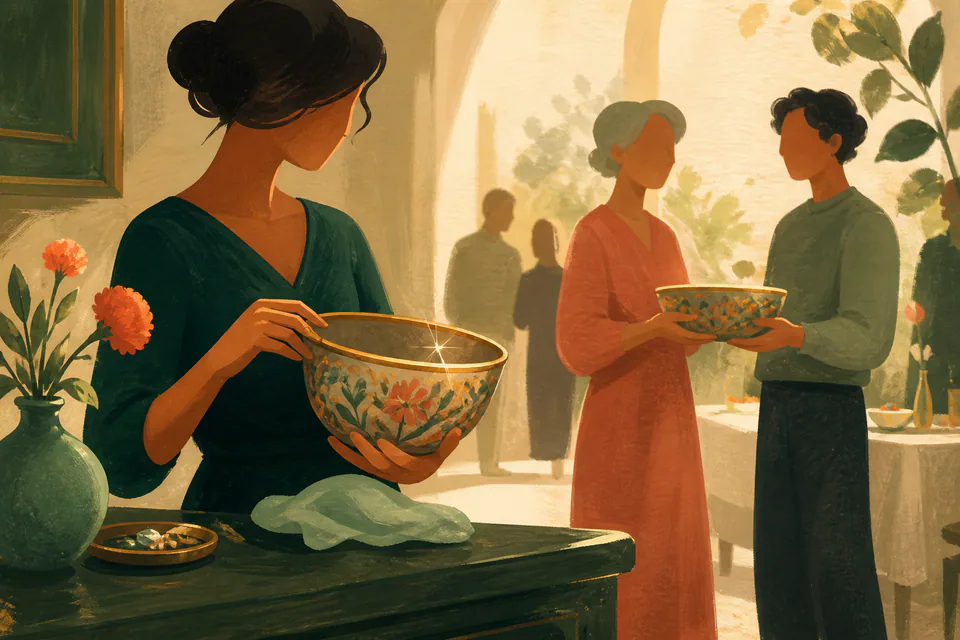
You borrow a family heirloom for an event and accidentally leave a small scratch. A careful repair makes it almost invisible, and its owner happily accepts it back without noticing anything.
What is confession for when the harm has already been repaired?