Quantum Gravity and the Hardest Problem in Physics | Space Time
22 min
Listen through the publisher, then discuss the episode here or arrange an in-person Roundtable. Your city determines where to meet.
Roundtables are designed for groups of four, with a shared subject and room for everyone to speak. Come for discussion, with no dating expectation.
Viewers like you help make PBS (Thank you ) . Support your local PBS Member Station here: https://to.pbs.org/DonateSPACE Uploaded 20-09-18 Between them, general relativity and quantum mechanics seem to describe all of observable reality. You can further support us on Patreon at https://www.patreon.com/pbsspacetime Get your own Space Time t-shirt at http://bit.ly/1QlzoBi Tweet at us! @pbsspacetime Facebook: facebook.com/pbsspacetime Email us! pbsspacetime [at] gmail [dot] com Comment on Reddit: http://www.reddit.com/r/pbsspacetime Help translate our videos! Previous Episode: How Much Information is in the Universe? Hosted by Matt O'Dowd Written by Matt O'Dowd Graphics by Luke Maroldi Assistant Editing and Sound Design by Mike Petrow Made by Kornhaber Brown (www.kornhaberbrown.com) The first few decades of the 20th century was a time of miracles for physics. First, Einstein’s relativity utterly changed the way we think about space, time, motion and gravity. Then the quantum revolution of the 20s and 30s overturned all of our intuitions about the subatomic world. Together, general relativity and quantum mechanics have allowed us to explain nearly every fundamental phenomenon observed, and have predicted many unexpected phenomena that have since been verified. And yet the two theories contradict each other in fundamental ways. In the century since that golden era of physics, we’ve been trying to reconcile the two … without success. But today on space-time I’m going to begin our discussion of the great quest for this union – the quest for a theory of quantum gravity, and for a theory of everything. Special thanks to our Patreon Big Bang, Quasar and Hypernova Supporters: Big Bang Anton Lifshits CoolAsCats David Nicklas Fabrice Eap Quasar Dean Fuqua Mark Rosenthal Mayank M. Mehrota Roman Pinchuk Tambe Barsbay Vinnie Falco Hypernova Brent Mullins Chuck Zegar Donal Botkin Edmund Fokschaner John Hofmann Jordan Young Joseph Salomone Matthew O’Connor Ratfeast Thanks to our Patreon Gamma Ray Burst Supporters: Alexander Rodriguez Alexey Eromenko Benoit Pagé-Guitard Brandon Cook Brandon Labonte Daniel Lyons David Crane Deborah Whittaker Fabian Olesen Greg Allen Greg Weiss James Flowers James Hughes JJ Bagnell Jon Folks Kevin Warne Malte Ubl Mark Vasile Nicholas Rose Nick Virtue Scott Gossett Shannan Catalano سلطان الخليفي
Episode information is provided by the publisher. Listening takes place on the publisher’s service.
Scientists are rethinking how particles behave when moving at extreme speeds through matter. New research into quark-gluon plasma, the exotic fluid that existed moments after the Big Bang, reveals unexpected patterns in particle motion that challenge traditional physical models. The findings could offer a powerful new way to investigate the properties of the universe’s earliest matter. This episode includes AI-generated content.
This new tech is changing how movies get made. So @mkbhd and I tested it out... Watch MKBHD's video: https://youtu.be/RM7SobH8ZO0 I’ve been obsessed with sci-fi movies since I was a kid. I love being transported to another world. But lately, I’ve been wondering: How do those worlds look so… REAL? The tech behind movies has exploded in complexity and realism, changing how stories come to life on screen. Luckily, at the same time, those tools are becoming more and more available to more people telling stories. It’s not just blockbusters like Avatar 2 or Avengers or Dune. It’s also smaller budget films like Everything Everywhere All at Once or even… YouTube creators? In this video, Marques Brownlee and I test out 3 movie-making tools that are changing how movies, shows, and maybe even YouTube videos (??) get made. We’re at ZeroSpace Studios in New York to show you how each of these crazy technologies work - and how you might be able to use them. Along the way, we hit big questions like: W
Conscious parenting doesn't begin with our children, it begins with us. In this heartfelt conversation, Sage Robbins and Mary B. sit down with Tony Robbins to explore what conscious parenting truly looks like: parenting ourselves first, claiming responsibility (not blame), and bringing our most present, connected selves to the table. Uploaded 16-09-26 At its heart, conscious parenting is a shift from a fear-based model to an awareness-based one. Instead of "be careful," we learn to say "be mindful." Instead of reacting, we pause and notice. Because children don't do what we say, they do what we are. Our state becomes their first imprint, and in so many ways, our children become our greatest mirrors and teachers. Watch more videos like this The #1 Secret to Helping ANY Child Self Regulate Their Emotions: https://youtu.be/PwrCX73x9LI Why Your 'Busy' Mind Is Actually Lying to You: https://youtu.be/yq8DFwlEpyg The One Question That Changed My Marriage: “How Am I Being?”: https://youtu.be/3
In this video, Disability Attorney Walter Hnot of the Disability Resolution Law Firm goes over why the wealthy are sour about social security benefits, and whether they have a good reason to end the program in general. Americas Most Viewed Disability Attorney Like the content? Review us here: https://g.page/r/CcwyektC7nCPEAg/review . If the link does not work, Google: Disability Resolution, P.A. Welcome to the largest Social Security Disability Tutorial Video Library On Earth. PRIVATE ONE HOUR SESSION PHONE CALL THIS IS HOW YOU CAN GIVE BACK TO HELP GROW THE CAUSE: Option 1: Leave 5 |==================5 STAR REVIEWS==================| Google (Search Disability Resolution Orlando, FL)- https://www.google.com/search?authuse... (https://www.google.com/search?authuse...=) AVVO (Search Walter Hnot) - https://www.avvo.com/attorneys/32817-... BBB (Search Disability Resolution Orlando, FL)- https://www.bbb.org/us/fl/orlando/pro... MARTINDALE (Search Walter Hnot Orlando, FL) - https://www.marti
Explore how the Hubble Space Telescope reveals the Universe, from iconic images to major discoveries, and how it complements the James Webb Space Telescope. "ASTROMAN: the Dark Sky Guardian" is a podcast channel that aims to explore popular science in multiple disciplines and research on interdisciplinary approaches, such as sustainability, dark-sky protection, astrophotography, space exploration, astronomy innovation, inclusive science communication, and STEAM Education by integrating science and arts. Exodus Chun-Long Sit, also known as the ASTROMAN, is a transmedia astronomy educator, popular science author, STEAM educator, and science communicator in Hong Kong. He is recently the National Astronomy Education Coordinator (Chair of Hong Kong, China) of the International Astronomical Union and President of Starrix. He was also an International Committee Member of the Dark Sky International, regularly organizing public lectures at the Hong Kong Space Museum and the Hong Kong Science Mu
After her father died suddenly, she inherited more than the family farm. She inherited the responsibility of keeping it running without the man who had spent nearly his entire life there. Then the longtime farmhands began quietly sharing strange experiences. One heard her father whistling outside the machine shed. Another heard his familiar footsteps in an empty barn. Someone else saw a man wearing his old brown work jacket standing beside a gate—only to look again and find no one there. She told them grief and memory could make familiar sounds feel more meaningful than they were. Then one evening, while working alone after everyone else had gone home, she heard three notes outside the barn. It was a whistle she had known since childhood. And nobody else on the farm would have understood what it meant. #GhostStories #FamilyGhost #SpiritVisit #HauntedFarm #Afterlife #SignsFromBeyond #Paranormal #FatherAndDaughter #Unexplained #Signs Love real ghost stories? Want even more? Want even mor
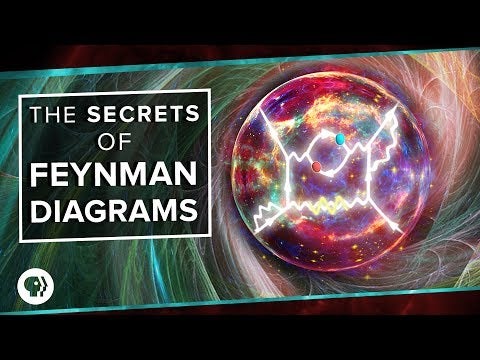
Viewers like you help make PBS (Thank you ) . Support your local PBS Member Station here: https://to.pbs.org/DonateSPACE Uploaded 26-07-17 Unlock the secrets of Feynman Diagrams. Part 5 in our Quantum Field Theory series. And if you're submitting an answer to our challenge question email your answer by August 2nd to pbsspacetime [AT] gmail.com with the subject line "Feynman Diagram Challenge." You can further support us on Patreon at https://www.patreon.com/pbsspacetime Get your own Space Time tshirt at http://bit.ly/1QlzoBi Tweet at us! @pbsspacetime Facebook: facebook.com/pbsspacetime Email us! pbsspacetime [at] gmail [dot] com Comment on Reddit: http://www.reddit.com/r/pbsspacetime Help translate our videos! https://www.youtube.com/timedtext_cs_... Previous Episode: The Real Star Wars Feynman’s path integral shows us that, to properly calculate the probability of a particle traveling from point A to point B, we need to add up the contributions from all conceivable paths between tho
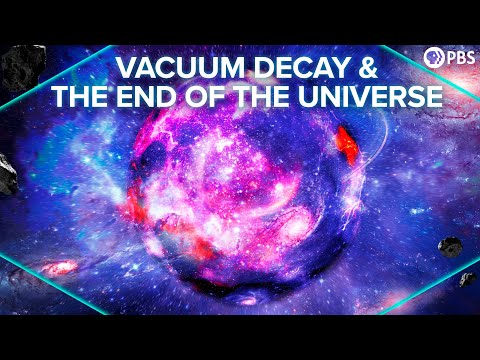
Sign Up on Patreon to get access to the Space Time Discord! Uploaded 18-08-21 The universe is going to end. But of all the possible ends of the universe vacuum decay would have to be the most thorough - because it could totally rewrite the laws of physics. Today I hope to help you understand exactly how terrified you should be. Check out the Space Time Merch Store Sign up for the mailing list to get episode notifications and hear special announcements! Hosted by Matt O'Dowd Written by Matt O'Dowd Graphics by Leonardo Scholzer, Yago Ballarini, Pedro Osinski, Adriano Leal and Stephanie Faria GFX Visualizations: Ajay Manuel Directed by Andrew Kornhaber Assistant Producer: Setare Gholipour Executive Producers: Eric Brown and Andrew Kornhaber End Credits Music by J.R.S. Schattenberg: https://www.youtube.com/user/MultiDroideka Special thanks to Our Patreon Sponsors Big Bang Supporters Ari Paul Kyle Bulloch Charlie Mrs. Tiffany Poindexter Leo Koguan Sandy Wu Matthew Miller Scott Gray Ahmad Jo
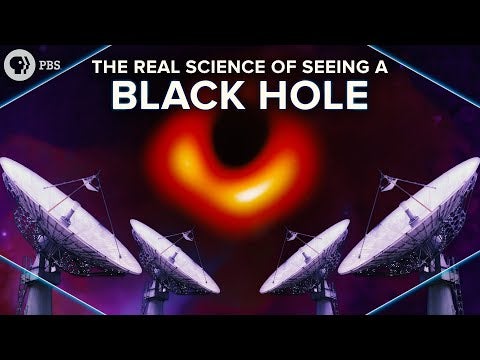
You can learn more about CuriosityStream at https://curiositystream.com/spacetime Uploaded 01-05-19 PBS Member Stations rely on viewers like you. To support your local station, go to: http://to.pbs.org/DonateSPACE How do you take a picture of a black hole and what can we learn from it? Our first ever actual bona fide photo of a black hole, made by the Event Horizon Telescope and revealed to the world in a press conference on April 10th. Since then it’s got plenty of coverage, because … I mean look at it. It’s a freaking black hole. It’s black, it’s holey, it’s everything we hoped it would be. Now that the giddiness has subsided and I personally have stopped spending hours on end staring at a black spot, we can take a breath and actually look at the real science here and discuss exactly how a picture like this could be taken and what we can learn from it. Check out the new Space Time Merch Store! Support Space Time on Patreon Need a Black Hole Refresher #Blackhole #astrophysics #spaceti
Environmental marketing claims should require independent verification.
Share your view, then see how readers voted. No sign-in required. This poll is shared across stories.
Do you agree or disagree?
Common Quandary
A Common Quandary to discuss
Another conversation to explore, separate from this news story.
A donor's family wants to hear their loved one's heart beating in you. Do you meet them?
A transplant recipient receives a letter from the donor's family asking to meet. The recipient feels profound gratitude but also discomfort and wants their recovery to remain private and separate from another family's grief.
Can receiving an extraordinary gift create a personal obligation to strangers?