Reading As an Act of Resistance (Notes on Harvard’s Hum 10)
20 min
Listen through the publisher, then discuss the episode here or arrange an in-person Roundtable. Your city determines where to meet.
Roundtables are designed for groups of four, with a shared subject and room for everyone to speak. Come for discussion, with no dating expectation.
Two years ago, The Atlantic featured a distressing story about elite college students who could no longer read books. Last week, The Wall Street Journal offered some hope that things are getting better. An article by Pamela Paul described how Harvard’s ‘brutal’ humanities course, Hum 10, which requires students to read one hefty book per week, has become extremely popular. In this short episode, Cal explores why this is happening and what it tells us about how best to resist our would-be digital overlords. More from Cal Download Cal’s FREE guide to cultivating a deeper life: calnewport.com/ideas Learn more about Cal’s books: calnewport.com/books Listen to Cal’s podcast: thedeeplife.com/listen Chapters: 00:00:00 Intro: Can college students still read books? 00:01:03 Harvard's Hum 10, the brutal class everyone wants 00:02:31 Why students are choosing the hard way 00:04:47 Reward shortcutting and early social media 00:08:21 TikTok and shortcut engagement 00:11:49 Generative AI and the shortcut to knowledge 00:16:27 Outro: The growing push against shortcuts Credits: Podcast Production: Jesse Miller Newsletter/Research: Nate Mechler Theme Music: Jay Kerstens
Episode information is provided by the publisher. Listening takes place on the publisher’s service.
#JimRohnMotivation #JimRohn #JimRohnSpeech 98% of people will never reach their full potential. They want success, but they are not willing to pay the price. The 2% who rise to the top? They think differently. They act differently. They push through resistance, stay disciplined, and never let failure define them. In this Jim Rohn Motivation video, learn the difference between those who win and those who settle for mediocrity. Key Topics From This Motivational Video: Why only 2% of people truly succeed in life The harsh reality—most people quit before success happens How discipline and resilience separate winners from quitters The truth about sacrifice and why success requires trade-offs How the 2% push through setbacks, distractions, and resistance ⚡ This Jim Rohn Motivational Video Is Perfect For: Those who are tired of starting and stopping and are ready to stay locked in High achievers who want to develop unshakable discipline and focus Entrepreneurs, leaders, and ambitious individu
The real story about “de-extinction”... The Tasmanian tiger was declared extinct in 1982. But now… scientists are trying to bring it BACK. And it’s not alone! You might’ve seen news about dire wolves, woolly mammoths, passenger pigeons… dodo birds… dinosaurs?? “De-extinction” has become a huge and urgent scientific debate. But when I took a deep dive into what’s really going on here, I realized we're getting this conversation very, very wrong. We're on the cusp of a huge genetic breakthrough… and yet the most "huge if true" thing happening here isn’t bringing back extinct animals. It's what this means for all the animals alive today! And very few people seem to know about it… Chapters: 00:19 Can we bring back extinct animals? 01:22 Can we bring back a mammoth? 02:24 Is Jurassic Park possible? 05:44 Are Dire Wolves brought back from the dead? 6:26 What is de-extinction? 09:04 How do we save cute little animals? 11:08 Is the Tasmanian tiger coming back? 12:50 When is it ok to bring back
In this week's Podcast: I’ve just pumped out a 300kg barrel of honey and at the bottom was a thick, granulated layer of sugary goodness. It got me thinking about why honey granulates, the science behind it all, why that’s a good thing and how, we beekeepers, can use it to our advantage. Hi, I’m Stewart Spinks, welcome to Episode 418 of my podcast, Beekeeping Short and Sweet. References: Manikis, I., & Thrasivoulou, A. (2001). The relation of physicochemical characteristics of honey and the crystallization rate. Apiacta, 36(2), 106–112. Escuredo, O., Míguez, M., Fernández-González, M., & Seijo, M. C. (2014). Nutritional value and antioxidant activity of honeys produced in a European Atlantic area. Food Chemistry, 154, 44–51. Venir, E., Spaziani, M., & Maltini, E. (2010). Crystallization in “Tarassaco” (Dandelion) Italian honey studied by DSC. Food Chemistry, 122(2), 410–415. Krishnan, R., Mohammed, T., Kumar, G. S., & Arunima, S. H. (2021). Honey crystallization: Mechanism, evaluation a
Get the 200+ Page Optimal Living Daily Workbook (PDF) - Free. Want to turn today's episode into an actionable plan? Episode 4234: In two short essays, Cylon George explains why we so often act against our own values: powerful unmet needs, not bad character, are usually what drive us. He then offers encouragement for anyone starting over after a setback, reminding listeners that beginning again never means starting from scratch and that treating yourself with kindness is part of the work of personal development. Read along with the original article(s) here: https://www.spirituallivingforbusypeople.com/why-you-do-what-you-do and https://www.spirituallivingforbusypeople.com/on-beginning-again Quotes to ponder: "We don't stray from our values because we're bad people." "To begin to understand why we do what we do, we must become intimately familiar with our needs." "It's hard work to begin again, and you don't need to be hard on yourself." We spend so much of our lives caught up in our tho
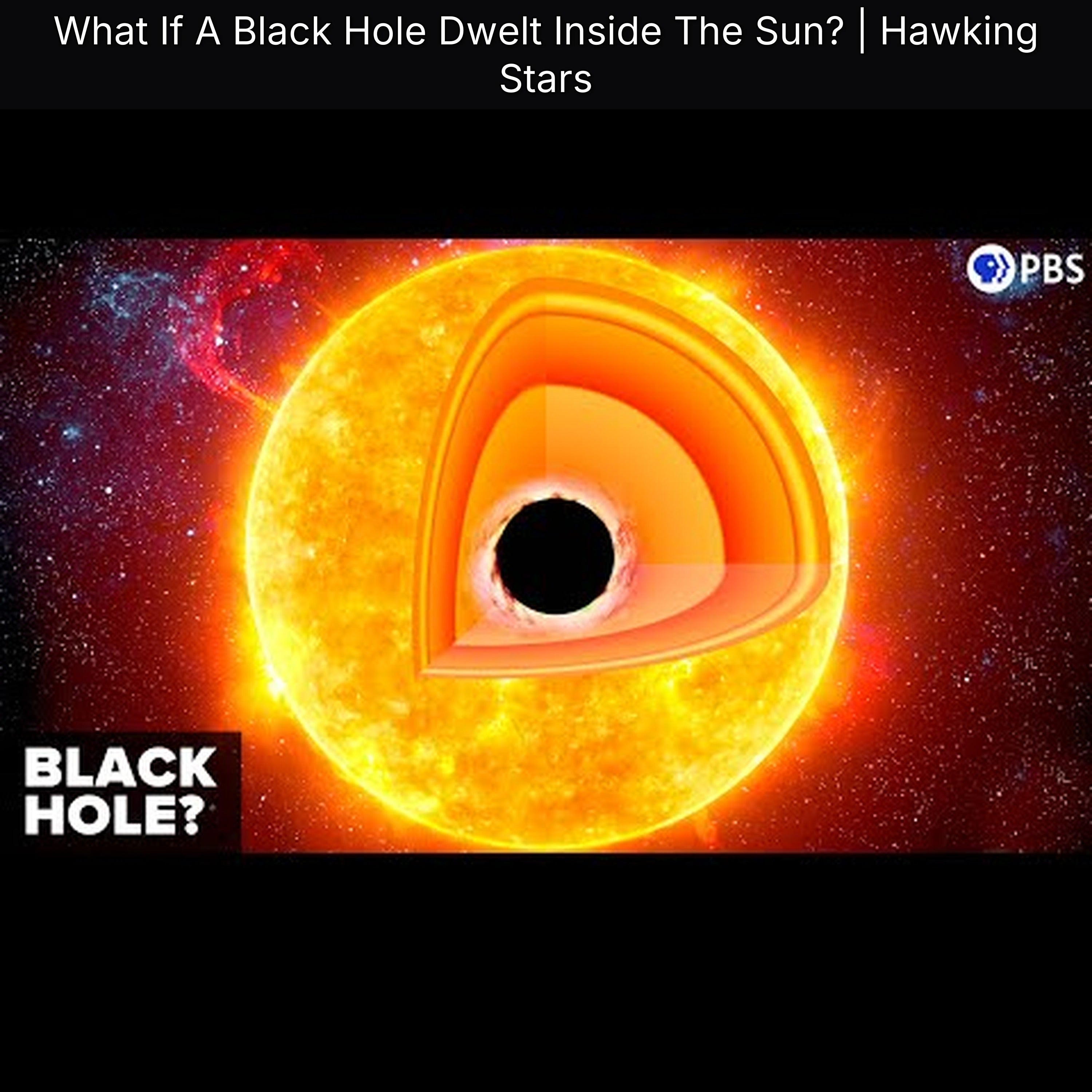
PBS Member Stations rely on viewers like you. To support your local station, go to:http://to.pbs.org/DonateSPACE Sign Up on Patreon to get access to the Space Time Discord! A fun nightmare sci-fi scenario is the sun being consumed by a black hole. Fortunately the chance of a black hole randomly wandering into our solar system is pretty tiny. That’s good news. But what if it’s already here, hiding in the core of the Sun and slowly eating it from the inside out? Hawking Stars Journal Papers: Search the Entire Space Time Library Here: https://search.pbsspacetime.com/ Hosted by Matt O'Dowd Written by Matt Caplan & Matt O'Dowd Post Production by Leonardo Scholzer, Yago Ballarini & Stephanie Faria Directed by Andrew Kornhaber Associate Producer: Bahar Gholipour Executive Producers: Eric Brown & Andrew Kornhaber Executive in Charge for PBS: Maribel Lopez Director of Programming for PBS: Gabrielle Ewing Assistant Director of Programming for PBS: John Campbell Spacetime is produced by Kornhaber
Best books for Prompt Engineering with GPT-3 and LLMs - Crash Course in AGIEpisode release date: 27 Dec 2022Spreading awareness about the works of some of the leading educators in the AI revolution. Core Ideas: Metamodernism: Narratives and emergence view of reality - Reduce suffering - Increase prosperity - Increase understanding mantra: Seek knowledge. ELABORATE: Add depth and detail to understanding, weaving comprehensive and nuanced explanations.DISCLAIMER: This is a community-driven show. ----------------Best books for Prompt Engineering with GPT-3 and LLMs - Crash Course in AGIEpisode release date: 27 Dec 2022Spreading awareness about the works of some of the leading educators in the AI revolution. Core Ideas: Metamodernism: Narratives and emergence view of reality - Reduce suffering - Increase prosperity - Increase understanding mantra: Seek knowledge. ELABORATE: Add depth and detail to understanding, weaving comprehensive and nuanced explanations.DISCLAIMER: This is a community
The theoretical capability of AI tools seems to be expanding rapidly. At the same time, however, their practical impact in the office has been uneven. Why? In this episode, Cal journeys through the history of the idea of “efficiency,” from the 1750s through today, exploring why this concept explains AI’s workplace struggles and what approach might solve them. Get your questions answered by Cal! Here’s the link: https://bit.ly/3U3sTvo Video from today’s episode: youtube.com/calnewportmedia (0:00) Beware of “efficiency” theater (48:18) The phenomenon of “AI Boomeranging” (52:03) Job numbers from the Bureau of Labor Statistics (55:24) Do school phone bans make a difference? (1:01:01) Early data on social media bans for kids (1:07:18) What Cal is up to Links: Thanks to our Sponsors: https://www.rayneo.com (https://www.rayneo.com/) https://www.mybodytutor.com (https://www.mybodytutor.com/) Thanks to Jesse Miller for production and mastering, Nate Mechler for research and newsletter, and Ben
Last week, Google announced that, in response to pressure from parents and educators, it would allow schools to turn off AI tools in their widely used education apps. Cal Newport analyzes this announcement and provides a logical explanation on how to react to this recent news. Chapters: 00:00 Intro: Google's ultimatum to schools 01:59 What's actually going on? 05:23 Can Google really not separate Search from AI? 07:25 The real reasons Google is doing this 08:43 How should we react? Option 1: Sue Google 10:54 Option 2: Switch search engines 13:37 Option 3: Legislation 16:12 Final thoughts: Get out of our classrooms
It’s becoming increasingly clear that the negative impact of phones on our lives is larger than we’d like to admit. Maybe it’s time to move beyond tips and hacks to explore more serious interventions. But what would these look like? In this episode, Cal dispatches correspondent Dale Davidson on a world-spanning investigation of some of the more extreme solutions people have deployed to reclaim their lives from their devices. Get your questions answered by Cal! Here’s the link: https://bit.ly/3U3sTvo Video from today’s episode: youtube.com/calnewportmedia (0:00) Can we escape our internet hell? (4:36) Act 1 (27:37) Act 2 (41:40) Act 3 (1:06:46) Closing comments Links: https://www.wsj.com/lifestyle/phone-screen-time-prison-pg-sittenfeld-8c3b186b?st=JjqsTg&reflink=desktopwebshare_permalink (https://www.wsj.com/lifestyle/phone-screen-time-prison-pg-sittenfeld-8c3b186b?reflink=desktopwebshare_permalink&st=JjqsTg) https://hangingup.substack.com/?utm_campaign=profile_chips (https://hangingup.
Landscape restoration needs funding commitments that extend beyond normal political terms.
Share your view, then see how readers voted. No sign-in required. This poll is shared across stories.
Do you agree or disagree?
Common Quandary
A Common Quandary to discuss
Another conversation to explore, separate from this news story.
A disgraced billionaire's name is on the beloved campus library. Does it come down?
A major donor funded a beloved public building decades ago. New evidence shows they also caused serious harm that was legal and accepted by many peers at the time. Removing the name may jeopardize future donations.
What does an institution owe the truth when its history funded the present?