Reducing Emotional Reactivity and Finding Inner Peace with Yung Pueblo
71 min
Listen through the publisher, then discuss the episode here or arrange an in-person Roundtable. Your city determines where to meet.
Roundtables are designed for groups of four, with a shared subject and room for everyone to speak. Come for discussion, with no dating expectation.
Why do we keep reacting in ways we don’t want to? Forrest sits down with the meditator and poet Yung Pueblo to talk about reactivity, letting go, and what it takes to slow down enough to choose something different. They get into why your first reaction usually isn’t the “real you,” how to stay present with someone else’s bad mood without getting pulled into it, and how to feel your feelings without becoming them. Key Topics: 00:00: Intro 01:22: Why aren’t men as interested in personal growth content? 05:29: Your first reaction isn't the real you 15:57: Staying present with someone else’s bad mood 22:47: Thoughts vs. what you feel in the body 28:45: Feeling without becoming the feeling 32:21: What is stress? 38:19: Writing Journey 43:27: Forgiveness without an apology 49:13: Who needs to let go, and who needs to try harder 52:48: Letting go of good attachments 1:02:14: Recap If you'd like to support the podcast, follow this link. (https://www.patreon.com/beingwellpodcast) Sponsors If you’re ready to simplify the business side of your practice, now is a great time to try SimplePractice. Just go to SimplePractice.com (https://simplepractice.com/) to claim the offer. Try Gusto today at gusto.com/BEINGWELL (https://gusto.com/BEINGWELL), and get three months free when you run your first payroll. Visit beopen.shokz.com/BEINGWELL (https://beopen.shokz.com/BEINGWELL) and use code BEINGWELL for an exclusive discount on all Shokz products. The offer can be combined with other official promotions. Visit Rula.com/BEINGWELL (https://rula.com/BEINGWELL) to find affordable, high-quality therapy that’s actually covered by insurance.
Episode information is provided by the publisher. Listening takes place on the publisher’s service.
What if you're already a meditator and just don't know it yet? In this conversation, Sage Robbins and Mary B talk about meditation and mindfulness in the most human way possible, one a devoted practitioner, the other a self-described skeptic who "still hasn't started." Together they take the pressure off: meditation isn't about emptying your mind, achieving a result, or doing it "right." It's a practice of noticing of catching the simple, precious moments that busyness makes us miss. Uploaded 12-08-26 Along the way they explore why you can't "effort" your way into stillness, how thoughts are like clouds drifting across a clear sky (a nod to Michael Singer's The Untethered Soul), why your body being breathed is a quiet miracle, and how even ten seconds of presence counts. Sage also shares simple, no-rules ways to begin starting with just one or two minutes, shaking out the body, letting sound and breath move energy and the gratitude and "coming home to now" that meditation has opened fo
Get the 200+ Page Optimal Living Daily Workbook (PDF) - Free. Want to turn today's episode into an actionable plan? Episode 3614: Kym Wilson shares how she left a corporate finance career to pursue scuba diving and a 2,000-kilometer pilgrimage, and the panic she felt when her savings fell behind her peers. She explains why she came to see that net worth and life's worth are different measures, and why the experiences that change us also ripple out to others. The takeaway is that the cost of neglecting a dream can be greater than the money it takes to follow one. Read along with the original article(s) here: https://tinybuddha.com/blog/value-following-dreams-dont-make-money/ Quotes to ponder: "When you answer the call to adventure, you never know where you will end up." "Your net worth is not your life's worth." "I know that one day, when I am old and dying, I won't regret the things I never had, but I will regret the moments I didn't seize and the adventures and growth I never experien
THE SEARCH FOR THE ULTIMATE RED LIGHT THERAPY IS OVER! After decades of exploring wellness technologies, Michael Jaco sits down with Rob Rene, founder of Exodus Strong, to explore the Red Light+ Total Body Reset system, the science behind red and near-infrared light, and why this technology has become such an important part of their wellness conversation. Rob's remarkable personal journey—including surviving five near-death experiences—inspired his mission to develop practical wellness tools that people can incorporate into their everyday lives. Discover the full-body Red Light+ Mat, designed for convenient 20-minute sessions, and the portable Red Light+ Wand, created for targeted use on areas such as the knees, shoulders, hands, and lower back. Michael and Rob discuss the technology, personal experiences, and how red light therapy may support a daily wellness routine. BLACK FRIDAY–CYBER MONDAY LISTENER EXCLUSIVE! This is your opportunity to explore Exodus Strong's special holiday offe
You went back. Maybe not to the same person, but to the idea of them. You rehearsed the conversation again in your mind. You thought of better words, sharper examples, a clearer way to say the thing you'd already said. You kept trying to win an argument that was already over, with a person who had already walked away. Uploaded 13-10-26 That hunger to be understood is one of the most natural things in the world. And it is also one of the quietest thieves of a person's peace that I know of. You explain yourself to one person, feel relief for a day, and then someone else shakes their head, and you're back building the case for your own life all over again. Here is the truth: it is not another person's job to understand you. It is your job to understand yourself. And once you've done that interior work, the opinions of people who don't understand you go from feeling like a verdict to feeling like weather. This seminar unpacks the single mechanic behind why you keep over-explaining your lif
Your body doesn't work like you think... Take your personal data back with Incogni. How and when people are having kids is changing, but our bodies aren't. As we get older, it can get harder to have kids when we want to. So smart people figured out it’s possible to remove eggs, freeze them, and unfreeze them to use later. They can even fertilize those eggs to make embryos and freeze those. Basically, humans invented cryosleep! … Just for tiny cells. It’s totally sci-fi - and you need to know about it. This is a level of control over our bodies no species has ever had before. It’s already changing people’s lives - and how our species can reproduce. But there are real concerns about whether it’s worth it. Because let me tell you, the process is not easy. I’ve been taking medication for two weeks. And at the same time, I’ve been doing research, talking to doctors, and learning as much as I can about the cutting edge of fertility tech. In this video, I'm going to take you behind the scenes
N = 1 science empowers people to become “citizen scientists,” experimenting and refining their health choices to find what works best for their own bodies. This self-application of the scientific method to one’s own metabolic health journey, if properly executed, almost guarantees long-term success. In this video, we will talk about eggs and Oreos, and I react to a new article that’s getting a low of attention. I’ll explain the “why” behind N = 1 science, and tease what’s to come. Get ready to get pumped! Chapters 0:00 – Why Eggs? Why N = 1? 1:10 – I React to News Article 2:33 – Two Parallel Objectives 5:09 – N= 1 Metabolic Health Science for Everyone 6:45 – What’s coming next, N = 2 Sheramy’s N =1 Article: https://www.theepochtimes.com/health/harvard-med-student-eats-720-eggs-in-30-days-highlighting-a-trend-in-n1-science-5735409?utm_source=partner&utm_campaign=healthnnorw (https://www.theepochtimes.com/health/harvard-med-student-eats-720-eggs-in-30-days-highlighting-a-trend-in-n1-scie
Dr. Rick and Forrest explore anhedonia, the loss of interest or pleasure in the things that used to feel good. They discuss the relationship between anhedonia and depression, why pleasure goes missing, and what brings it back. This includes the four kinds of “nothing feels good,” the difference between liking and wanting, and why anhedonia is actually more of a “wanting problem.” Then they get practical with Positive Affect Treatment, a therapy built to turn the good up rather than just turning the bad down, which turns out to look a lot like Rick’s practice of taking in the good. Rick then walks Forrest through a live demonstration of learning to want something again. Key Topics: 0:00: Introduction 1:33: What anhedonia feels like, and the four kinds of “nothing feels good” 8:29: Liking vs. wanting 11:29: Why the wanting goes missing, and why “just do stuff” isn’t enough 20:24: Why we stop noticing good things 27:41: Positive Affect Treatment: wanting, liking, learning 32:07: A demonst
Demonstration organizers should take reasonable steps to discourage violence by participants.
Share your view, then see how readers voted. No sign-in required. This poll is shared across stories.
Do you agree or disagree?
Common Quandary
A Common Quandary to discuss
Another conversation to explore, separate from this news story.
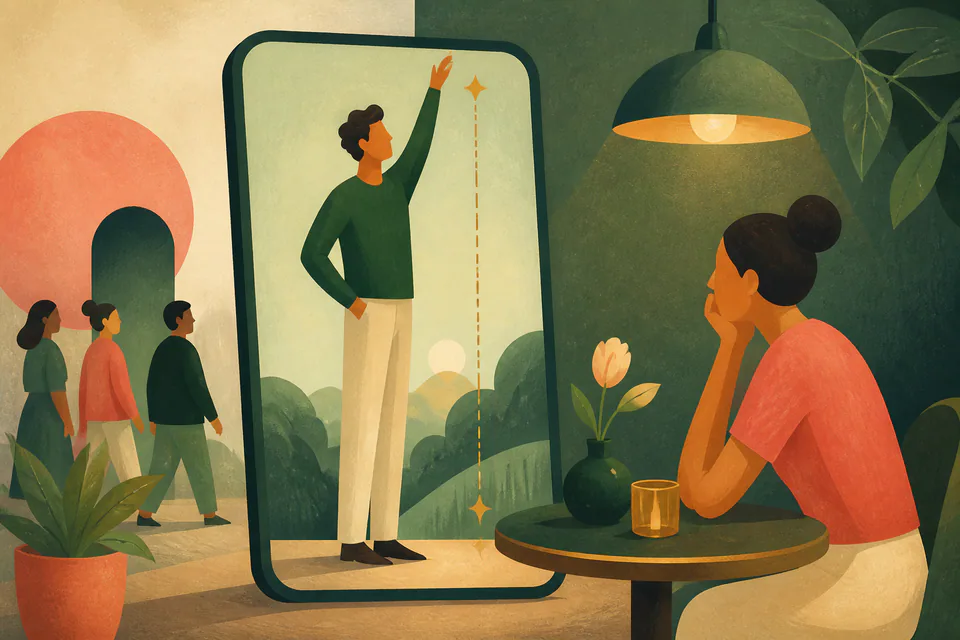
Everyone exaggerates on dating apps. Are two imaginary inches harmless?
A friend adds two inches to their listed height because they believe filters exclude them before personality has a chance. They plan to be charming enough that a date will not care once they meet in person.
Can deception be a fair response to superficial gatekeeping?