Sensation and Perception: Crash Course Psychology #5
16 min
Listen through the publisher, then discuss the episode here or arrange an in-person Roundtable. Your city determines where to meet.
Roundtables are designed for groups of four, with a shared subject and room for everyone to speak. Come for discussion, with no dating expectation.
Just what is the difference between sensing and perceiving? And how does vision actually work? And what does this have to do with a Corgi? In this episode of Crash Course Psychology, Hank takes us on a journey through the brain to better explain these and other concepts. Plus, you know, CORGI! Want more videos about psychology? Check out our sister channel SciShow Psych at https://www.youtube.com/scishowpsych! -- Chapters: Introduction: Face Blindness (Prosopagnosia) 00:00 Sensation vs. Perception 0:54 Sense Thresholds 1:43 How Human Vision Works 4:23 Visible Light Spectrum 5:00 How the Human Eye Processes Light 6:01 Rods & Cones 6:31 Human Color Vision 6:56 Visual Cortex 8:02 Parallel Processing 9:30 Review & Credits 9:52 -- Crash Course is on Patreon! Want to find Crash Course elsewhere on the internet? Facebook - http://www.facebook.com/YouTubeCrashCourse Twitter - http://www.twitter.com/TheCrashCourse Instagram - https://www.instagram.com/thecrashcourse/ CC Kids: http://www.youtube.com/crashcoursekids
Episode information is provided by the publisher. Listening takes place on the publisher’s service.
Best books for Prompt Engineering with GPT-3 and LLMs - Crash Course in AGIEpisode release date: 27 Dec 2022Spreading awareness about the works of some of the leading educators in the AI revolution. Core Ideas: Metamodernism: Narratives and emergence view of reality - Reduce suffering - Increase prosperity - Increase understanding mantra: Seek knowledge. ELABORATE: Add depth and detail to understanding, weaving comprehensive and nuanced explanations.DISCLAIMER: This is a community-driven show. ----------------Best books for Prompt Engineering with GPT-3 and LLMs - Crash Course in AGIEpisode release date: 27 Dec 2022Spreading awareness about the works of some of the leading educators in the AI revolution. Core Ideas: Metamodernism: Narratives and emergence view of reality - Reduce suffering - Increase prosperity - Increase understanding mantra: Seek knowledge. ELABORATE: Add depth and detail to understanding, weaving comprehensive and nuanced explanations.DISCLAIMER: This is a community
What causes the sensation of déjà vu? Dive into the theories and psychology that could explain why you’re having that feeling… again. Uploaded 28-08-13 -- You might have felt it -- the feeling that you've experienced something before, but, in reality, the experience is brand new. There are over 40 theories that attempt to explain the phenomenon of déjà vu. Michael Molina explains how neuroimaging and cognitive psychology have narrowed down the theories that could explain that feeling you're having...again. Lesson by Michael Molina, animation by Josh Harris. Sign up for our newsletter: http://bit.ly/TEDEdNewsletter Support us on Patreon: http://bit.ly/TEDEdPatreon Find us on Twitter: http://bit.ly/TEDEdTwitter Peep us on Instagram: http://bit.ly/TEDEdInstagram View full lesson: http://ed.ted.com/lessons/what-is-deja-vu-what-is-deja-vu-michael-molina
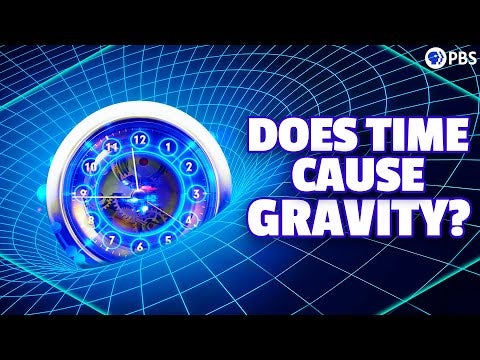
PBS Member Stations rely on viewers like you. To support your local station, go to: http://to.pbs.org/DonateSPACE ↓ More info below ↓ Uploaded 24-02-21 Sign Up on Patreon to get access to the Space Time Discord! We know that gravity must cause clocks to run slow on the basis of logical consistency. And we know that gravity DOES cause clocks to run slow based on many brilliant experiments. But I never explained WHY or HOW gravity causes the flow of time to slow down. And I’m not going to explain it now - because in a sense it’s not true. Gravity does NOT warp the flow of time. It’s the other way around - the warping of time causes gravity. Check out the Space Time Merch Store https://pbsspacetime.com (https://pbsspacetime.com/) Hosted by Matt O'Dowd Written by Matt O'Dowd Graphics by Leonardo Scholzer, Yago Ballarini, Pedro Osinski, Adriano Leal and Stephanie Faria GFX Visualizations: Katherine Kornei Directed by Andrew Kornhaber Assistant Producer: Setare Gholipour Executive Producers:
Instant Access to your FREE training course: https://nci.university (https://nci.university/) Uploaded 27-07-25 This is the simulation you already live inside of—and you’ve been breathing it like oxygen since the day you were born. In this video, we expose the invisible machinery beneath modern life—how symbols have replaced truth, how marketing has replaced meaning, and how our desires are manufactured by the very system that feeds on them. Drawing from the work of Jean Baudrillard and the hidden mechanisms of simulacra, we walk you through 10 real-life “glitches” that reveal the truth: • Why your food is rendered, not real • How social media replaced memory • Why you take photos of things you never actually see • And why even your “rebellion” is likely pre-approved This isn’t a conspiracy. It’s a mirror. And once you see it, you can’t unsee it. simulation theory, simulated reality, Baudrillard simulation, are we in a simulation, hyperreality explained, social media illusion, digital
Think you can’t get the same Tony Robbins experience when you attend a virtual event? Think again. Uploaded 29-09-20 Never one to let an outside situation affect his movement forward, Tony Robbins took the same energy he puts into his live, in-person events and packaged it for the screen. When he hosted Unleash the Power Within VIRTUAL Australia in 2020, it was jam-packed with the same nonstop energy, strong transformations and interactive activities that his events are famous for. Over 11,000 people in 68 countries in the South Pacific, including Australia, joined together to attend a life-changing virtual event. In the midst of a global pandemic full of uncertainty and fear, thousands of people took a chance on themselves and started the steps necessary to change their lives and outlook for the better. Surrounded by their families, partners, kids and pets, thousands of people connected virtually to learn that decisions change our lives more than situations. Over the course of four po
Follow the podcast & turn on notis Leave your review for this episode in the Q&A Section. Join the 10k Accelerator Course ------------------------------- ----------- Keywords: men's self improvement, high frequency living, male entrepreneurship, men's lifestyle, men's confidence, adventure lifestyle, men's psychology
The majority of the universe is made up of a currently mysterious entity that pervades space: dark energy. We don’t know exactly what it is, but we do know that dark energy accelerates the expansion of space. We think this means the Universe will expand forever, even as our view of it shrinks while space expands faster all the time. Check out the Crash Course Astronomy solar system poster here: http://store.dftba.com/products/crashcourse-astronomy-poster If you want to learn more about the creation and death of the universe, watch Crash Course Big History here: https://youtube.com/playlist?list=PL8dPuuaLjXtMczXZUmjb3mZSU1Roxnrey -- Chapters: Introduction: The Expanding Universe 00:00 The Expansion of Space is Accelerating 2:17 What is Dark Energy? 4:19 Will the Universe Expand Forever? The Geometry of the Universe 5:20 The Cosmic Horizon of the Observable Universe 6:50 Review 10:20 -- GEOMETRY OF THE UNIVERSE RESOURCES Geometry: Expanding faster than light: General expansion: -- PBS Di
Have you ever wondered where cured meats like salami or pepperoni get their bright red color? Of course its from organic chemistry! A chemical called nitric acid gives them that bright color, while also increasing their shelf. It's also involved in some other interesting reactions. In this episode of Crash Course Organic Chemistry we'll see how nitrous acid reacts with primary amines to form diazonium salts, we'll learn about alkyldiazonium salts and aryldiazonium salts, and see what conditions are necessary for nucleophilic aromatic substitutions. Series Sources: Brown, W. H., Iverson, B. L., Ansyln, E. V., Foote, C., Organic Chemistry; 8th ed.; Cengage Learning, Boston, 2018. Bruice, P. Y., Organic Chemistry, 7th ed.; Pearson Education, Inc., United States, 2014. Clayden, J., Greeves, N., Warren., S., Organic Chemistry, 2nd ed.; Oxford University Press, New York, 2012. Jones Jr., M.; Fleming, S. A., Organic Chemistry, 5th ed.; W. W. Norton & Company, New York, 2014. Klein., D., Organ
Like a trendy dance, a fighting combo, or a secret handshake, organic reactions can be broken down into simpler steps. In this episode of Crash Course Organic Chemistry, we’ll specifically be looking at alkene addition reactions, and with each new reaction ask ourselves three questions to help us puzzle through the mechanism and understand what’s going on. Episode Sources: Le Couteur, P, Burreson, J. Napoleon’s Buttons: 17 molecules that changed history., Penguin, New York, 2004, Chapter 1. Whipps, H., “How the Spice Trade Changed the World,” https://www.livescience.com/7495-spice-trade-changed-world.html Last accessed, 3/28/2020. Henriques, Martha, “How spices changed the ancient world,” http://www.bbc.com/future/bespoke/made-on-earth/the-flavours-that-shaped-the-world/ Last accessed, 3/28/2020. Hashimoto, K., Yaoi, T., Koshiba, H., Yoshida, T., Maoka, T., Fujiwara, Y., Yaamoto, Y, Mori, K., “Photochemical Isomerization of Piperine, a Pungent Constituent of Pepper”, Food Sci. Technol.
Students should help shape decisions about what and how they learn.
Share your view, then see how readers voted. No sign-in required. This poll is shared across stories.
Do you agree or disagree?
Common Quandary
A Common Quandary to discuss
Another conversation to explore, separate from this news story.
Your host demands shoes off, but their floor is filthy. Must you obey?
A host has a strict shoes-off rule and points to a neat row by the door. Inside, the floor is visibly sticky and covered with pet hair. You are wearing clean shoes, no socks, and would rather not spend the evening barefoot.
When does respect for a host's home yield to a guest's comfort?