Social Security’s New Age Names: Your Check Doesn’t Change
60 min
Listen through the publisher, then discuss the episode here or arrange an in-person Roundtable. Your city determines where to meet.
Roundtables are designed for groups of four, with a shared subject and room for everyone to speak. Come for discussion, with no dating expectation.
President Trump signed a new Social Security law—but what does it actually mean for YOUR monthly check? Former Social Security District Manager Dr. Ed Weir explains what was signed, what changes, and what it means for you. Need Medicare help? Contact our friends at Chapter Medicare for FREE HELP! 352-841-0632 The Claiming Age Clarity Act (H.R. 5284), signed on November 20, 2026, changes the terminology Social Security uses to explain retirement claiming ages. The law itself does not increase or cut your benefits or change the ages when you can claim retirement benefits. But the new wording deserves a closer look—especially if you’re deciding when to start your checks. In this video, we’ll cover: What President Trump signed into law. What happens to familiar terms like “full retirement age” and “delayed retirement credits.” Why these words matter when comparing your claiming options. What current beneficiaries and people planning retirement in 2027 should understand. Is this a “major” Social Security change? I’ll walk you through the actual law in plain English so you can understand the announcement and what it means for your retirement decisions. Do you think changing the names will make Social Security easier to understand—or more confusing? Leave your thoughts and questions in the comments. Get help with your Social Security questions: [24help.org/experts](https://24help.org/experts) Get Medicare help: [24help.org/chapter](https://24help.org/chapter) Share this video with someone who receives Social Security or is deciding when to retire. #SocialSecurity #SocialSecurityUpdate #DrEdWeir Originally recorded live with Restream.
Episode information is provided by the publisher. Listening takes place on the publisher’s service.
Mubix from Hak5 joins us to talk about what Artex is and why it's empowering malicious actors, how tools are both helping and hurting security defenders, and a group of younger people avoiding anything to do with AI. Starring Tom Merritt and Rob Fuller. In this episode ARTEX and the attacker’s advantage. What is ARTEX, how does it speed up familiar attacks, and how long might that advantage last? AI in threat hunting. Where do generative AI tools help defenders spot and investigate threats, and where do they make the job harder? Opting out of AI. Why are some younger people choosing not to use AI tools, and what could that mean for the next generation of security professionals? Further reading Offsec Harness Index (https://offsecharnesses.ai/) GitHub - BaaRai/ARTEX: Actively maintained ARTEX: AI autonomous penetration testing system. Self-hosted, model-agnostic, evidence-backed findings. Community continuation of Autumn-27/ARTEX, AGPL-3.0. (https://github.com/BaaRai/ARTEX) Microsoft Th
Do you want to know the FASTEST way to END SUFFERING? It’s actually very simple... Do this every day and your WHOLE WORLD will change in an instant. Uploaded 29-06-21 Learn the tools you need to turn this around: Prime Your Brain to STOP Suffering - https://youtu.be/60ROjGMqXUQ FULL Priming Routine Tony Uses Daily to Succeed In Life - https://youtu.be/faTGTgid8Uc The Proven HAPPINESS Formula You Need Now - https://youtu.be/AL7Cb2O6Lhk I truly believe that we’re living in the greatest time in HISTORY — creativity, innovation, and opportunity exist like never before. We’re blessed to live in an abundant time, where so many of our desires are met instantly — at the touch of a button, the click of your mouse, the swipe of your thumb. Social media links us to people all over the world — we can count the number of “friends,” and we get a dopamine boost with every , ️, or . The crazy thing is, that most of us believe that kind of instant gratification = happiness. But what we’re really experi
life is a game, one move can change everything, so play smart #Motivation, #MotivationalSpeech, #LifeLessons, #SuccessMindset, Life is a game of decisions, discipline, patience, and strategy. One smart move can change your direction, one powerful habit can transform your future, and one decision to invest in yourself can open doors you never imagined. In this powerful motivational speech, discover why you must stop wasting time, develop valuable skills, manage your money wisely, build assets, and take control of your future. Uploaded 20-10-26 This motivational speech will challenge you to think differently about success, money, personal growth, self-discipline, and financial independence. Learn why investing in yourself is one of the most important decisions you can make, how small daily actions compound over time, and why playing smart is more powerful than simply working hard without direction. Stop chasing appearances. Stop comparing your journey with others. Stop waiting for the pe
This new image will help us answer the biggest question: Are we alone? NASA just released the first pictures from the James Webb Space Telescope, the most powerful telescope ever built. They’re incredible. They show the deepest we’ve ever seen into space, stars being born, galaxies colliding. But the least beautiful one is my favorite. It’s the spectrum of exoplanet WASP 96-b. In simpler terms, it’s a picture of the atmosphere of a planet over 1,000 light years away. Most simply put… it’s our new way to find aliens. Chapters: 00:00 First images from the James Webb Space Telescope 00:52 Where are all the aliens? 01:34 How does the James Webb Space Telescope find life? 02:43 How do we know what's on other planets? 03:35 What did the James Webb Space Telescope find? 04:09 What does it mean that we found water?? 04:49 What happens next?? Be featured in an episode - upload questions for me to answer! https://www.dropbox.com/request/Edocsb2kErpueQ7F9T1Q You can find me on TikTok here for sho
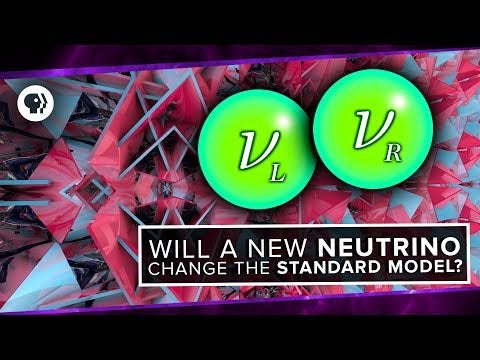
Viewers like you help make PBS (Thank you ) . Support your local PBS Member Station here: https://to.pbs.org/DonateSPACE Uploaded 04-07-18 Thanks to Curiosity Stream for supporting PBSDS. You can get the first 60 days free if you sign up at curiositystream.com/spacetime and use the code "spacetime" during the sign-up process. Since the discovery of the Higgs boson, physicists have searched and searched for any hint of new particles. That search has been fruitless. Until, perhaps, now. Today on Space Time Journal Club we’ll look at a paper that reports a compelling hint of a new particle outside the standard model: the sterile neutrino. You can further support us on Patreon at https://www.patreon.com/pbsspacetime Get your own Space Time t-shirt at http://bit.ly/1QlzoBi Tweet at us! @pbsspacetime Facebook: facebook.com/pbsspacetime Email us! pbsspacetime [at] gmail [dot] com Comment on Reddit: http://www.reddit.com/r/pbsspacetime Help translate our videos! Previous Episode: How Asteroid
As President Trump overhauls foreign policy, turning towards old adversaries and raising questions about national security, Richard Haas, President Emeritus of the Council on Foreign Relations, discusses what decades on the frontlines of American diplomacy tell him about the road ahead. Then, as the country takes stock after the midterms, Pulitzer Prize-winning author Barbara Kingsolver discusses her new novel 'Partita' and what her work reveals about America today. As millions of Americans reunite with loved ones for Thanksgiving, correspondent Rafael Romo reports on two brothers' journey to find the mother they were stolen from in Chile. Then, musician David Byrne tells Christiane about his new book 'Sleeping Beauties', which details the ideas, art styles and more that lie dormant before making a comeback. From the archives, a look back at Christiane's report from besieged Sarajevo on Thanksgiving Day, 1993, when an extraordinary aid effort managed to get food to the most vulnerable.
**STILL WORKING WHILE COLLECTING SOCIAL SECURITY? YOUR MONTHLY CHECK COULD INCREASE AT ANY AGE!** Whether you're in your 60s, 70s, 80s, or even 90s, continuing to work after starting Social Security retirement benefits could increase your monthly payment. Need help with Medicare plans? Contact our friends at Chapter Medicare: 352-841-0632 But does Social Security automatically recalculate your benefits? Why are FICA taxes still deducted from your paycheck? And why do some working retirees get an increase while others don't? In this video, Dr. Ed Weir, a former Social Security Administration District Manager, explains how continued earnings can affect your Social Security retirement check, what SSA reviews each year, and how to determine whether you might qualify for a higher payment. **You'll learn:** - How additional earnings may increase your benefit at any age. - Why you continue paying Social Security taxes. - How SSA's automatic earnings recalculations work. - Why higher earnings
You paid into Social Security for years. So why are you being told “it’s not your money”—and where did your money actually go? Get the truth about Social Security benefits, trust funds, and myths that can lead to costly decisions about your retirement. Need help with your Medicare plan? Contact our friends at Chapter Medicare: 352-841-0632 I’m Dr. Ed Weir, a former Social Security insider. In this LIVE discussion and Q&A, I’ll explain the claim behind “not your money,” how Social Security is funded, and what the debate means for your monthly check. We’ll discuss: - Where your Social Security payroll taxes go. - What the “not your money” claim leaves out. - What “running out of money” actually means for Social Security. - The projected funding shortfall and the risk to future benefits. - Other Social Security myths that can cost you money. - Your questions about retirement, benefits, and your check. What about the 22% figure? The 2026 Trustees Report projects that the retirement and sur
Is Social Security paying you too little? Learn how to check your monthly benefit, spot possible underpayments, and take action if you believe your Social Security payment is wrong. Need help with your Medicare plan? Contact our friends at Chapter Medicare for FREE HELP! 352-841-0632 Join me, Dr. Ed Weir, as I explain what to look for, what questions to ask, and how to challenge a decision you disagree with. An incorrect earnings record can affect your retirement or disability benefits, making it worth checking the information Social Security uses to calculate your payment. [Check your earnings record](https://www.ssa.gov/prepare/review-record-earnings). In this video, we’ll cover: - Where to start when your Social Security check seems too low. - What to review in your earnings history and benefit notices. - What documents can help support a correction. - How to request reconsideration and protect your appeal rights. Have your latest Social Security notice handy and follow along. You d
Officials should step aside from decisions involving a potential personal conflict of interest.
Share your view, then see how readers voted. No sign-in required. This poll is shared across stories.
Do you agree or disagree?
Common Quandary
A Common Quandary to discuss
Another conversation to explore, separate from this news story.
A disgraced billionaire's name is on the beloved campus library. Does it come down?
A major donor funded a beloved public building decades ago. New evidence shows they also caused serious harm that was legal and accepted by many peers at the time. Removing the name may jeopardize future donations.
What does an institution owe the truth when its history funded the present?