Listen through the publisher, then discuss the episode here or arrange an in-person Roundtable. Your city determines where to meet.
Roundtables are designed for groups of four, with a shared subject and room for everyone to speak. Come for discussion, with no dating expectation.
Synopsis Into the Woods, a musical by Stephen Sondheim and James Lapine, opened on Broadway on today’s date in 1987, and brought to the stage characters from the world of fairy tales: Jack and the Beanstalk, Little Red Riding Hood, Cinderella and not one, but two Prince Charmings. But in Lapine and Sondheim’s fairy tale, bad things happen to good people who make morally questionable decisions in their quest to “live happily ever after.” At the time, Sondheim said, “All fairy tales are parables about steps to maturity. The final step is when you become responsible for the people around you, when you feel connected to the rest of the world.” The New York Times review noted that this fairy tale’s quest was “the same painful, existential one taken by so many adults in Sondheim musicals past.” Granting the musical was “potent stuff,” some complained there was simply too much of it, with multiple plot lines resulting in a complicated story hampering Sondheim’s lyrical gifts from really taking off on their own. Even so, since its 1987 premiere, Into the Woods has gone on to become one of the most performed and popular of all Sondheim’s musicals. Music Played in Today's Program Stephen Sondheim (1930-2021): Into the Woods; original Broadway cast members; RCA 60752
Episode information is provided by the publisher. Listening takes place on the publisher’s service.
Thank you Zocdoc for sponsoring Today's video. Your health matters and taking care of yourself shouldn't be complicated. Go to https://www.zocdoc.com/professorofrock (https://www.youtube.com/redirect?event=video_description&q=https%3A%2F%2Fwww.zocdoc.com%2Fprofessorofrock&redir_token=QUlxb01IWkVKTDBwR3ZLWkFHTlhkNk1BMXMyYXxBQnJ0NjlsNTY5QW5PVGg3SmRpN3JZbzhtRmlraHRxaGNsZElZQnRuT2xibUdtNUhFQmV4bkJJamdCUVBJbFh3dWNELWtCVm9xQjIzVXdnQ3ZkcnpYbXhnWm01UE5ZYVhIcDJj&v=Js1l7xE1tko) to get started. Coming up… we're going back to 1983 for a unique perspective on a group of songs that deserved better than they got, including a bunch of special guests on the show. Including the story of Sting, who wrote a self-deprecating masterpiece after his girlfriend made fun of him. He turned it into a smash. Plus several controversial songs that became huge hits because, frankly, their double entendres went over censors' heads… Including the only time the naughty word about self-love was ever sung in a hit song, a
■ PUN He started with an 800-baht microphone in his bedroom — and at the height of it all, he stepped away to become a monk. PUN is a Thai R&B and indie-pop singer-songwriter signed to Universal Music Thailand. He started as a teenager in a school rock band, then recorded songs into an iPad through an 800-baht microphone. As PUNYARB he joined YARBCREW, an underground hip-hop crew, as its youngest member and the one who brought the melodies. He never studied theory; he wrote lyrics "10 times, 100 times, 1,000 times" until he found his voice. His debut single, "Kryptonite," on High Cloud Entertainment, was not hip-hop at all, a deliberate step out of his comfort zone. He moved to Universal Music Thailand in 2023 with "Therapist," then released "GOODBYE," which passed 30 million streams in two months, and "DAY ONE," written in a single day and now past 100 million. His 2024 debut album, "PUN," has passed 600 million streams and won Best New Artist and Best Album in 2025, the year his firs
This week the Deadpod returns to the Providence Civic Center for the second set of the November 4, 1979 show. Last week's first set had four songs that were only a few months old, and set two opens with one that was brand new. This is the first Alabama Getaway the Dead ever played. It already sounds finished on its first night, and it went on to be a regular rocker through most of the 1980s. Greatest Story Ever Told follows. The band had just brought it back in 1979 after more than four years away, and the two songs were often paired after this. Ship of Fools slows things down before Estimated Prophet leads into He's Gone. Instead of the usual opening, Jerry, Brent and Bobby trade licks on the riff that normally comes near the end of He's Gone, then settle into the song. The jam that follows goes in several directions, with a few sudden bursts of speed, before Space and Drums. The Other One and Wharf Rat carry the late part of the set, and Around and Around and U.S. Blues close the nig
Short version Laura Frank is an artist from the Scenic Rim in Queensland who has been releasing music since 2019 and toured Australia extensively with Tom Curtain and his Outback Experience. She has released her debut album, Life in the Front Seat, and the current single is ‘Living My Life in the Front Seat’. Long version Laura Frank (https://www.laurafrank.com.au/) is a multi-disciplined artist from Queensland’s Scenic Rim who has been releasing music since 2019 and also makes videos, both for her songs and for other people. She’s also a veteran of fellow artist Tom Curtain’s Outback Experience, sharing the stage with him and taking her own animals on the road, joining Curtain’s horses and dogs. Life in the Front Seat is her first album, a collection of songs written by Frank and her husband and collaborator, Nick Morrissey. ‘I’m really proud of the fact that Nick and I have written all of our material,’ Frank tells me in this new interview as we discuss only the album and several oth
Last month, Gracie Abrams joined Rolling Stone’s residency at New York’s historic Cherry Lane Theatre for a live edition of our deep-dive conversation series. Speaking with Rolling Stone’s Alex Morris, Abrams brought her signature humor and charm, discussing the her dream collaborations, the challenge of marketing herself, and how she’s trying to give herself some grace.Her latest album, ‘Daughter from Hell,’ is her most ambitious and musically varied offering to date — and a reflection on the perspective that comes from entering adulthood. Abrams shared her thoughts on releasing that album the day before flying to Berlin to star in her first feature film, ‘Please,’ the latest movie from ‘Babygirl’ director Halina Reijn.Of that experience, Abrams says: “I [was thrown into] the deepest end possible. And then it felt weirdly more relaxing than a lot of other parts of my life have felt over the past few years. I think it was a relief to spend three months not thinking about myself and
If meditation never worked for you, Amy Strauss has some good news: nothing is wrong with you. Your intuition just speaks a different language. Amy is a practicing psychic, the creator of Your Resident Intuitive, and the author of The Six Intuitive Archetypes. She grew up in Hinsdale, Illinois, found her way to Washington, D.C., and recently stepped back from client readings to focus on teaching. The archetypes came to her, fully formed, on a day she was sitting around incredibly bored. We walk through all six: the Mystic, the Black Cat, the Butterfly, the House Witch, the Healer and the Emperor, and why the daily practice for each one looks completely different. For one person it's silent meditation. For another it's channeling into a voice memo. For a House Witch, it might be baking cookies. Amy explains why forcing yourself to sit for 20 minutes can make things worse, why the biggest block to intuition is the voice in your head that says "who do you think you are?", and the rule she
Synopsis In August, 2019, thousands of women took to the streets of Mexico City to protest the outrageous police indifference to violent crimes against women, which largely went unpunished. Their protest became known as the “revolución diamantina” (glitter revolution), since they showered Mexico City’s security chief with pink glitter during their inaugural demonstration. Their protest inspired Mexican composer Gabriela Ortiz to collaborate with her compatriot, Pulitzer Prize-winning Mexican author Cristina Rivera Garza, in the creation of a ballet score that would chronicle their history and honor their action. The result of their collaboration was Revolución Diamantina, a 42-minute work of surprising power and beauty. Ortiz said, “It was up to me to imagine the music by using not only aesthetic languages already known to me, but by taking risks, learning, and experimenting with new tools. In this ballet, it has been my hope that the audience will explore different pathways that radic
Synopsis In 1974, St. Petersburg was still called Leningrad and still part of what we now call the former Soviet Union. Back then, the most famous living Soviet composer was Dmitri Shostakovich, whose health was rapidly failing from the cancer that would claim his life the following year. On today’s date in 1974, Shostakovich’s String Quartet No. 15, his final, was given its premiere performance by the Taneyev Quartet. The work was supposed to have been premiered by the Beethoven Quartet, but its cellist died unexpectedly, and, mindful of his own mortality, Shostakovich was reluctant to postpone the scheduled premiere. After all, he might not be around by the time the Beethoven Quartet found a replacement cellist. When his String Quartet No. 1 had premiered in 1938, Shostakovich had described that work as “joyful, merry, lyrical” and “springlike.” His String Quartet No. 15, on the other hand, is obviously a “winter work,” written by someone who knows he might never see another spring.
Synopsis On today’s date in 1922, the British Broadcasting Corporation began daily radio transmissions from London, at first offering just news and weather — the latter read twice, in case anyone wanted to take notes. The following month, on Dec. 23, 1922, the BBC broadcast its first orchestral concert. Over time, the BBC became affectionately nicknamed “the Beeb,” or, less affectionately “Auntie,” due to the upper-middle class, slightly patronizing tone of its music announcers in the 1940s and ‘50s. That said, Auntie has proven to be hip in one aspect: The BBC has been a major commissioner of and advocate for new music by a wide range of composers — and not just British ones. In 2007, for example, the BBC Symphony premiered the Doctor Atomic Symphony, by American composer John Adams, live on-air at a BBC Proms Concert at the Royal Albert Hall. And it’s not just famous, big-name composers who get an airing on the Beeb either. Each year, BBC Radio 3 hosts a competition for teenage compo
Urgent public needs can justify simplifying normal approval procedures.
Share your view, then see how readers voted. No sign-in required. This poll is shared across stories.
Do you agree or disagree?
Common Quandary
A Common Quandary to discuss
Another conversation to explore, separate from this news story.
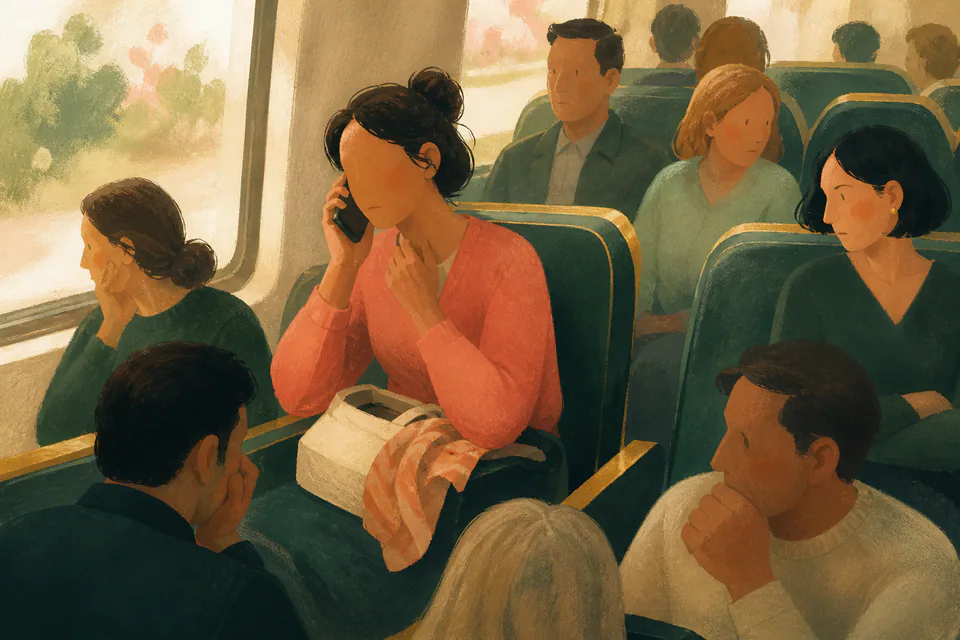
A stranger takes an emotional call in the quiet car. Do you shush them?
On a crowded train's designated quiet car, a passenger answers a call and begins discussing an apparent family emergency. They are speaking softly but continuously, and everyone nearby is listening despite trying not to.
Do public rules make room for private emergencies?