Listen through the publisher, then discuss the episode here or arrange an in-person Roundtable. Your city determines where to meet.
Roundtables are designed for groups of four, with a shared subject and room for everyone to speak. Come for discussion, with no dating expectation.
Putting data centers in space once seemed like science fiction. Today, a growing number of companies are seriously exploring doing so. Last week, host David Sandalow and a team of coauthors released a major report on Space-Based Data Centers: The Case for Caution. The report explores a range of topics related to space-based data centers, including technical issues, risks and impacts, and governance challenges. In this episode of the AI, Energy and Climate Podcast, David talks about the report with four of its lead authors: Alexis Abramson, Dean of the Columbia Climate School; Julio Friedmann, Chief Scientist at Relae; Colin McCormick, Chief Innovation Office at Relae; and Hari Osofsky, Founding Director of the Energy Innovation Lab and former Dean, Northwestern Law School.
Episode information is provided by the publisher. Listening takes place on the publisher’s service.
Before diving into today’s interview, Michael shares show updates for the new year—including Chris’s return and a regular Tuesday/Wednesday release cadence—followed by breaking news on Jensen Huang returning to NVIDIA after a $2 trillion stock drop. Michael also unpacks why Frontier Labs are lobbying to conflate "open" models with national security risks following Anthropic's $81B+ IPO, why local communities are pushing back on tax-subsidized data centers, and how enterprise AI token spend is starting to eclipse monthly payroll. Then, Ryan Sipes of Thunderbird joins the show to discuss Thunderbolt, Mozilla’s open-source, self-hostable AI client. Ryan explains how organizations are using Thunderbolt as an on-premise, air-gapped, or confidential-compute replacement for ChatGPT and Claude, how interactive "mini apps" are moving AI workflows beyond basic chat, and why businesses need to own their AI stack rather than rent it. Key Topics Covered Show Updates: Chris returns in the new year w
The recent upheaval in the world economy, driven by unsettling news from the AI tech oligarchy Nvidia scandal, is a wake-up call for all of us. The urgent need to protest against dangerous data centres has never been more critical. In Alberta, we are witnessing a remarkable shift: traditional conservatives are distancing themselves from Premier Danielle Smith and her chaotic MAGA party, creating an unprecedented opportunity for the NDP. This shift highlights the public’s growing concern over unregulated AI and data centres — an issue that affects us all.While PM Mark Carney focuses on attracting investment to Canada’s energy sector, his strategy may be a bluff aimed at outmaneuvering Smith and messaging investors. This landscape is shifting rapidly, and we must stay informed. Join Max Fawcett, Lead Columnist for Canada's National Observer, as he delivers a thought-provoking assessment of Alberta’s state and the risks AI poses. This isn't just another political discussion; it's a rallyi
A fake job interview helped open the door to a reported $6.3 billion theft from Binance. The FBI attributed the heist to North Korea, which has used cryptocurrency theft to raise revenue and evade sanctions. This week, former federal prosecutor Maya Song joins Frank Cilluffo to explain why tracing stolen cryptocurrency is easier than getting it back, what prosecutors need to turn an attribution into a criminal case, and how companies and law enforcement can work together to limit the damage after a breach. Main Topics The fake recruiting scheme the led to $6.3B loss The theft and fraudulent IT work funding North Korea Tracing, freezing, and recovering stolen cryptocurrency Public attribution and the evidence needed for an indictment When companies should contact law enforcement How indictments and asset seizures can disrupt future operations Key Quotes "Law enforcement generally, when it comes to the cybercrime threat, they have at the federal level taken an attitude of deter, disrupt,
What happens when the CEO of one of the world's most influential AI companies becomes the target of a foreign intelligence operation? And what does that mean for the future of artificial intelligence, corporate leadership, and global technology security? In this episode of TechDaily.ai, host David and guest Sophia examine a dramatic Nvidia leadership story described in the episode: the November 23, 2026, reinstatement of CEO Jensen Huang following an alleged foreign intelligence targeting incident. The discussion explores the reported unanimous board decision, the involvement of senior United States government officials, and the sweeping corporate governance changes described as part of Nvidia's response to growing national security concerns. As AI infrastructure becomes increasingly important to global economic and technological competition, the conversation raises a critical question: Are the executives leading the AI revolution becoming high-value targets in an international intelli
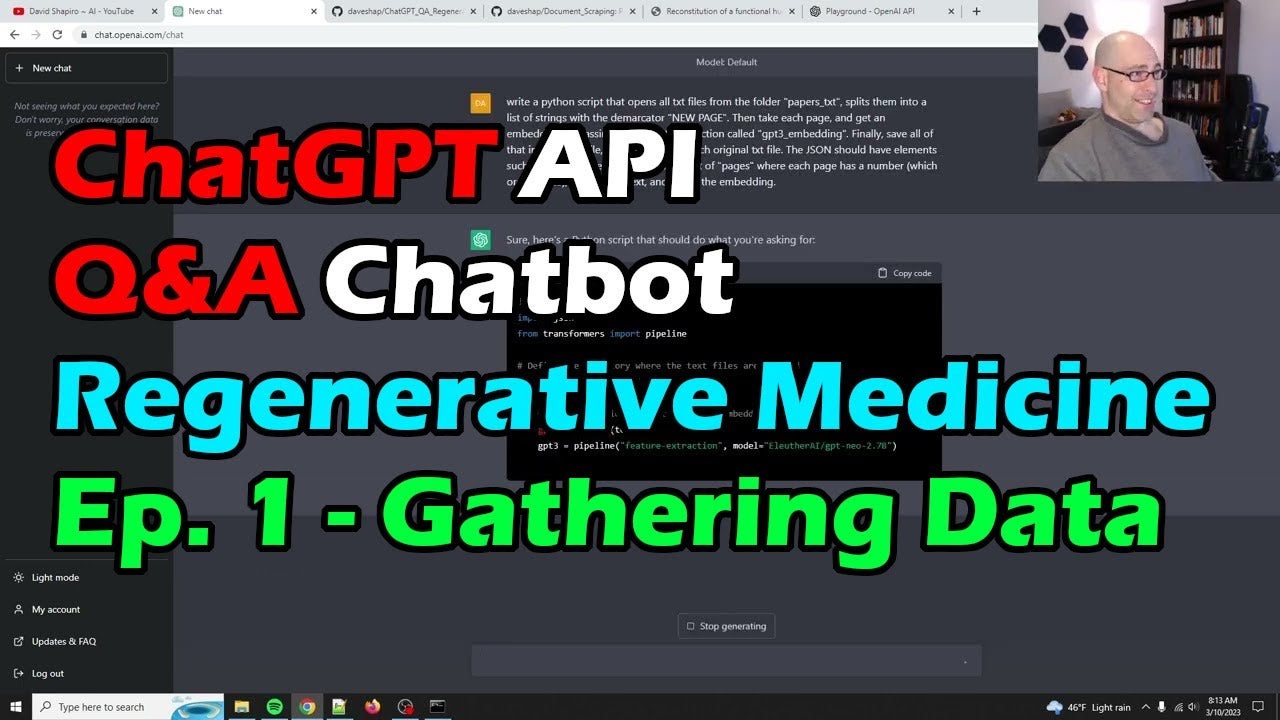
ChatGPT API QA Chatbot ep 1 - Data Prep [Automating Regenerative Science] Episode release date: 11 Mar 2023 Core Ideas: Metamodernism: Narratives and emergence view of reality - Reduce suffering - Increase prosperity - Increase understanding mantra: Seek knowledge. DISCLAIMER: This is a community-driven show. ----- Keywords: ai development, heuristic imperatives, david shapiro
Monday AI news covers NVIDIA's board reversing course on Jensen Huang, a slide in AI stocks, Google's changing homepage, and a security study on leaked AI credentials. Minutes before air, NVIDIA's board voted unanimously to reinstate Jensen Huang as CEO. A week earlier it had said it would not consider doing so, and its investigating committee continues its work. The conversation moves through Friday's drop in AI stocks, Google AI Mode shopping with Target, and Google's new task features alongside assistants like Duet and Dot. Other topics include data privacy concerns with AI texting startups, an OpenAI paper on perplexity as a measure of model confidence, a new Google homepage built around AI conversations, which appeared and disappeared between refreshes in what looks like an A/B test, and Dragos research using canary tokens that found exposed AWS credentials were the ones most often used. The show closes on Australia elevating AI to a national security challenge, Thinking Machines
The blue wave that swept America last week was especially strong in Texas. Democrats won every statewide office on the ballot and a majority of seats in the Texas House of Representatives. One of the major issues in the race was the data center buildout in Texas, which has been enormous and deeply unpopular. What impact will last week's elections have on the data center buildout in Texas? What policies should the Texas government adopt with respect to data centers? What are the implications nationally? Join host David Sandalow as he talks with University of Texas professor and leading energy expert Michael Webber to explore these questions.
Acting on preliminary research can be justified when the risks of waiting are high.
Share your view, then see how readers voted. No sign-in required. This poll is shared across stories.
Do you agree or disagree?
Common Quandary
A Common Quandary to discuss
Another conversation to explore, separate from this news story.
A coworker tells you their salary in confidence—and proves everyone else is underpaid. Do you share it?
A coworker privately tells you their salary and asks you not to repeat it. You later realize the figure is strong evidence that several equally experienced colleagues are being underpaid.
When does fairness outweigh a promise of confidentiality?