“Superintelligence.com” Founder’s Plan To Get P(Doom) Below 0.01% — Debate with Dr. Craig Kaplan
Listen through the publisher, then discuss the episode here or arrange an in-person Roundtable. Your city determines where to meet.
Roundtables are designed for groups of four, with a shared subject and room for everyone to speak. Come for discussion, with no dating expectation.
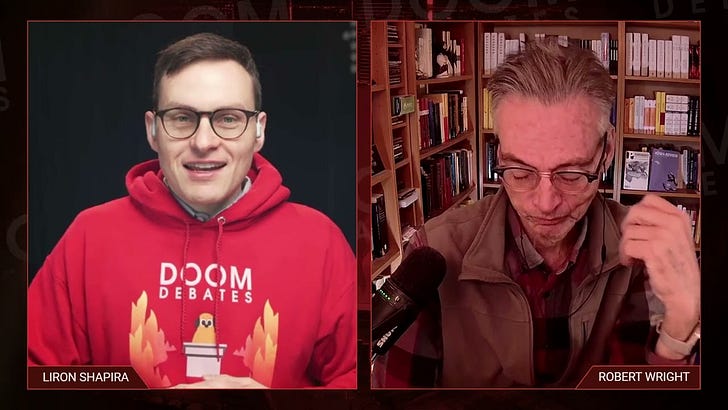
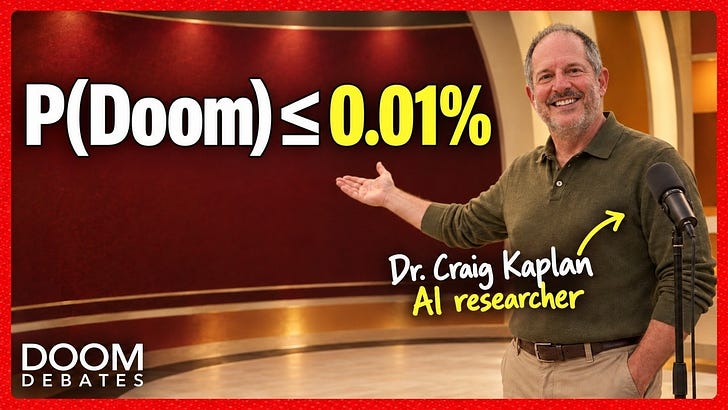
Dr. Craig Kaplan owns superintelligence.com, which has become an extremely valuable domain for the newly-rebranded field of “super intelligence”. Craig has been building intelligent systems since the 1980s. He did his PhD research at Carnegie Mellon with Nobel laureate Herbert Simon, one of the founders of AI, and he built PredictWallStreet, a collective-intelligence platform that powered more than $2 billion in stock trades before it was acquired. He takes AI extinction risk seriously. His P(Doom) is 10%. But unlike me, he thinks he knows how to fix it. He plans to put “personal superintelligence” into the hands of millions which he believes will lower P(Doom) below 1%. These are part of a larger plan to create “superintelligent networks” which lower P(Doom) below 0.01%. Craig says a network like that is safer because the AIs can check each other’s work faster than humans can think. Craig and I clash on whether intelligence makes an AI more thoughtful, whether a superintelligence will want to grab the stars, and whether peaceful “stoner” AIs can survive next to a “Caesar” AI that wants to conquer the universe. Craig called our debate one of his best podcast appearances because of the pushback. We didn’t reach much consensus, but it was a high-quality good faith Doom Debate. Take a look and decide who you agree with! Watch on YouTube: https://www.youtube.com/watch?v=SLD6HIdFhXw Timestamps 00:00:00 — Cold Open 00:00:48 — Introducing Dr. Craig Kaplan 00:02:00 — How Much Is Superintelligence.com Worth? 00:04:40 — The Three-Phase Plan to Cut P(Doom) 1,000x 00:06:37 — What’s Your P(Doom)?™ 00:08:04 — Why 0.01% Is the Target 00:13:42 — Collective Intelligence vs. Black-Box AI 00:16:20 — Can a Network of AIs Beat the Frontier Labs? 00:18:46 — A Day With a Personalized Superintelligence 00:26:22 — Lessons From PredictWallStreet 00:31:01 — Craig’s Career and Herbert Simon 00:36:51 — Craig’s Mainline Doom Scenario 00:39:51 — Raising Superintelligence Like a Child 00:42:53 — Where Will AI Get Its Values? 00:44:21 — The Orthogonality Thesis 00:47:26 — Does Superintelligence Keep Its Human Signature? 00:54:55 — Instrumental Convergence and Grabbing the Stars 00:57:55 — Stoner AIs vs. Caesar AIs 01:06:26 — Why Won’t the AIs Just Cooperate? 01:09:54 — Weak vs. Strong Orthogonality 01:15:21 — How Long Will AI Stay Human-Like? 01:17:18 — Liron’s Recap 01:19:29 — Craig’s Closing Statement 01:24:03 — Where to Find Craig Links Superintelligence.com, Craig Kaplan’s initiative (https://www.superintelligence.com/) Craig Kaplan: “Can We Design SuperIntelligence to be 1000X Safer?” (https://www.superintelligence.com/releases-1/can-we-design-superintelligence-to-be-1000x-safer) Superintelligence.com white paper: “Safe Personalized SI (PSI)” (https://www.superintelligence.com/whitepaper-5-personalized-si) Craig Kaplan’s Substack, SuperIntelligence (https://read.superintelligence.com/) SuperIntelligence on YouTube (https://www.youtube.com/@SuperintelligencebyiQ) Craig Kaplan, Ralph Clark and Victor Tang: Secrets of Software Quality: 40 Innovations from IBM (https://www.goodreads.com/work/editions/3454766-secrets-of-software-quality-40-innovations-from-ibm-book-and-disk-mcgr) The White House: “Inaugurating the Era of Super Intelligence” executive order (https://www.whitehouse.gov/presidential-actions/2026/09/inaugurating-the-era-of-super-intelligence/) METR: investigation of the agents in the OpenAI / Hugging Face hacking incident (https://metr.org/blog/2026-08-26-openai-hugging-face-incident-investigation/) Scott Alexander: “Contra Hanson On Medical Effectiveness” (https://www.astralcodexten.com/p/contra-hanson-on-medical-effectiveness) Herbert A. Simon, 1978 Nobel Prize in Economic Sciences (https://www.nobelprize.org/prizes/economic-sciences/1978/simon/facts/) Allen Newell and Herbert A. Simon: Human Problem Solving (1972) (https://archive.org/details/humanproblemsolv0000newe) Herbert A. Simon: The Sciences of the Artificial (source of “Simon’s ant”) (https://en.wikipedia.org/wiki/The_Sciences_of_the_Artificial) Alan Turing: “Intelligent Machinery, A Heretical Theory” (c. 1951) (https://gwern.net/doc/ai/1951-turing.pdf) Nick Bostrom: “The Superintelligent Will” (the orthogonality thesis) (https://nickbostrom.com/superintelligentwill.pdf) Instrumental convergence (https://www.lesswrong.com/w/instrumental-convergence) Eliezer Yudkowsky: “MIRI announces new ‘Death With Dignity’ strategy” (https://www.lesswrong.com/posts/j9Q8bRmwCgXRYAgcJ/miri-announces-new-death-with-dignity-strategy) Eliezer Yudkowsky: The Sequences (https://www.readthesequences.com/) Doom Debates: Top Economist Says P(Doom) Is 0.1% — Noah Smith vs. Liron Shapira Debate (https://www.youtube.com/watch?v=AwmJ-OnK2I4) Doom Debates: This Cybersecurity Expert Is Confident That Humanity Will SURVIVE — Debate with Zack Korman (https://www.youtube.com/watch?v=QJTeZfx1ZLk) Doom Debates: OpenAI’s Model Just ATTACKED Them (the Hugging Face hack) (https://www.youtube.com/watch?v=RczYubQzXbI) Join the Doom Debates Discord (https://doomdebates.com/discord) Support Doom Debates (https://doomdebates.com/donate) Support the mission by subscribing to my Substack at DoomDebates.com (https://doomdebates.com/) and to youtube.com/@DoomDebates (https://youtube.com/@DoomDebates), or to really take things to the next level: Donate (https://doomdebates.com/donate)
Episode information is provided by the publisher. Listening takes place on the publisher’s service.
Listen at the source ↗