English-language podcasts

PBS Space Time

Supersymmetric Particle Found?
22 min

Listen through the publisher, then discuss the episode here or arrange an in-person Roundtable. Your city determines where to meet.

Roundtables are designed for groups of four, with a shared subject and room for everyone to speak. Come for discussion, with no dating expectation.

PBS Member Stations rely on viewers like you. To support your local station, go to: http://to.pbs.org/DonateSPACE ↓ More info below ↓ Uploaded 14-11-18 With the large hadron collider running out of places to look for clues to a deeper theory of physics, we need a bigger particle accelerator. We have one - the galaxy. Watch Two Cents here! You can further support us on Patreon at https://www.patreon.com/pbsspacetime Get your own Space Time t­-shirt at http://bit.ly/1QlzoBi Tweet at us! @pbsspacetime Facebook: facebook.com/pbsspacetime Email us! pbsspacetime [at] gmail [dot] com Comment on Reddit: http://www.reddit.com/r/pbsspacetime Physics is currently in a weird place. Historically, no matter how crazy our theories got, there were always new ways to test them. Your theory predicts a new particle? Build a particle accelerator big enough to see it. But once your collider spans entire countries – like the Large Hadron Collider in Switzerland – there’s only so much larger you can go - at least on the surface of the Earth. The LHC has thoroughly tested the standard model of particle physics. The last component of that model – the Higgs boson – was verified in 2013. But the standard model isn’t the end of the story – there MUST be a more fundamental theory that explains the origins of this rich family of particles. Proposals for such grand unified theories proliferate, unconstrained by even the tiniest hint of new physics from the LHC. Help translate our videos! Previous Episode: Why String Theory is Right | Space Time Hosted by Matt O'Dowd Written by Matt O'Dowd Graphics by Luke Maroldi Assistant Editing and Sound Design by Mike Petrow Made by Kornhaber Brown (www.kornhaberbrown.com) Special thanks to our Patreon Big Bang, Quasar and Hypernova Supporters: Big Bang David Nicklas CoolAsCats Anton Lifshits Fabrice Eap Justin Lloyd Juan Benet Quasar Tambe Barsbay Mark Rosenthal Dean Fuqua James Flowers Vinnie Falco Hypernova Chuck Zegar Jordan Young Joseph Salomone John Hofmann Martha Hunt Matthew O’Connor Ratfeast Brent Mullins Donal Botkin Edmund Fokschaner Max Levine Thanks to our Patreon Gamma Ray Burst Supporters: Alexander Rodriguez Alexey Eromenko Brandon Cook Brandon Labonte Daniel Lyons David Crane Fabian Olesen Fauzan Ardhana Greg Allen Greg Weiss Jack Frosch James Hughes JJ Bagnell Jon Folks Joseph Emison Josh Thomas Kevin Warne Malte Ubl Mark Vasile Nathan Leniz Nicholas Rose Nick Virtue Scott Gossett Shannan Catalano Shawn Azman Tommy Mogensen سلطان الخليفي

Episode information is provided by the publisher. Listening takes place on the publisher’s service.

Listen at the source ↗

Featured places to meet in Palo Alto, CA

Explore these places and arrange a conversation through ThinkMatch.

City guide for Palo Alto, CA

More from PBS Space Time

PBS Space Time

The Secrets of Feynman Diagrams

19 min

Viewers like you help make PBS (Thank you ) . Support your local PBS Member Station here: https://to.pbs.org/DonateSPACE Uploaded 26-07-17 Unlock the secrets of Feynman Diagrams. Part 5 in our Quantum Field Theory series. And if you're submitting an answer to our challenge question email your answer by August 2nd to pbsspacetime [AT] gmail.com with the subject line "Feynman Diagram Challenge." You can further support us on Patreon at https://www.patreon.com/pbsspacetime Get your own Space Time t­shirt at http://bit.ly/1QlzoBi Tweet at us! @pbsspacetime Facebook: facebook.com/pbsspacetime Email us! pbsspacetime [at] gmail [dot] com Comment on Reddit: http://www.reddit.com/r/pbsspacetime Help translate our videos! https://www.youtube.com/timedtext_cs_... Previous Episode: The Real Star Wars Feynman’s path integral shows us that, to properly calculate the probability of a particle traveling from point A to point B, we need to add up the contributions from all conceivable paths between tho

Discuss this episode

PBS Space Time

How Vacuum Decay Would Destroy The Universe

17 min

Sign Up on Patreon to get access to the Space Time Discord! Uploaded 18-08-21 The universe is going to end. But of all the possible ends of the universe vacuum decay would have to be the most thorough - because it could totally rewrite the laws of physics. Today I hope to help you understand exactly how terrified you should be. Check out the Space Time Merch Store Sign up for the mailing list to get episode notifications and hear special announcements! Hosted by Matt O'Dowd Written by Matt O'Dowd Graphics by Leonardo Scholzer, Yago Ballarini, Pedro Osinski, Adriano Leal and Stephanie Faria GFX Visualizations: Ajay Manuel Directed by Andrew Kornhaber Assistant Producer: Setare Gholipour Executive Producers: Eric Brown and Andrew Kornhaber End Credits Music by J.R.S. Schattenberg: https://www.youtube.com/user/MultiDroideka Special thanks to Our Patreon Sponsors Big Bang Supporters Ari Paul Kyle Bulloch Charlie Mrs. Tiffany Poindexter Leo Koguan Sandy Wu Matthew Miller Scott Gray Ahmad Jo

Discuss this episode

PBS Space Time

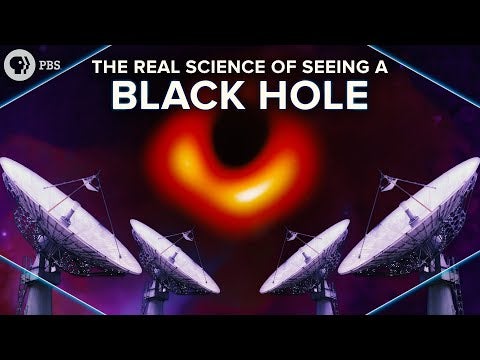
The Real Science of the EHT Black Hole

16 min

You can learn more about CuriosityStream at https://curiositystream.com/spacetime Uploaded 01-05-19 PBS Member Stations rely on viewers like you. To support your local station, go to: http://to.pbs.org/DonateSPACE How do you take a picture of a black hole and what can we learn from it? Our first ever actual bona fide photo of a black hole, made by the Event Horizon Telescope and revealed to the world in a press conference on April 10th. Since then it’s got plenty of coverage, because … I mean look at it. It’s a freaking black hole. It’s black, it’s holey, it’s everything we hoped it would be. Now that the giddiness has subsided and I personally have stopped spending hours on end staring at a black spot, we can take a breath and actually look at the real science here and discuss exactly how a picture like this could be taken and what we can learn from it. Check out the new Space Time Merch Store! Support Space Time on Patreon Need a Black Hole Refresher #Blackhole #astrophysics #spaceti

Discuss this episode

Community Poll

Retraining programs should provide financial support as well as new skills.

Share your view, then see how readers voted. No sign-in required. This poll is shared across stories.

Do you agree or disagree?

Choose one answer

Common Quandary

A Common Quandary to discuss

Another conversation to explore, separate from this news story.

The company printer sits idle all day. Can you print two hundred wedding invitations?

Your office has a fast color printer that is rarely used, and supplies are ordered automatically. Printing your wedding invitations after hours would save substantial money. Personal use is technically prohibited but routinely ignored for small jobs.

When does an insignificant workplace perk become taking?

Explore this quandary