Listen through the publisher, then discuss the episode here or arrange an in-person Roundtable. Your city determines where to meet.
Roundtables are designed for groups of four, with a shared subject and room for everyone to speak. Come for discussion, with no dating expectation.
To Learn more about ExpressVPN, visit: https://www.expressvpn.com/spacetime Uploaded 16-05-19 PBS Member Stations rely on viewers like you. To support your local station, go to: http://to.pbs.org/DonateSPACE We live in the stelliferous era. Somewhere between 10 and 1000 billion trillion stars fill the observable universe with light. But there was a time before the first star ignited. A time we call the cosmic dark ages. Check out the new Space Time Merch Store! Support Space Time on Patreon Need a Black Hole Refresher #theuniverse #astrophyics #spacetime Hosted by Matt O'Dowd Written by Matt O'Dowd Graphics by Aaron Havley Directed by Andrew Kornhaber Produced By: Kornhaber Brown In astronomy we study things that are very far away. It’s a powerful challenge because even the brightest objects are almost impossibly faint when you view them from the other side of the universe. But there’s an up side. If the light from some space object took billions of years to get to us then we see that object as it was billions of years ago. In this way we can peer back in time and literally see the past in motion. In fact we’re able to see some of the first stars and galaxies to ever form. But if we look beyond, both in distance and in time, there is … nothing. Darkness. For the hundred million years or so between the formation of the first atom and the formation of the first star there were no light sources in the universe. These were the cosmic dark ages. It’s a period of cosmic history rarely discussed because it’s hellishly difficult to observe. Fortunately scientists are devilishly clever. So what do we know about the time before stars? Special Thanks to our Patreon Supporters! Big Bang Supporters: Anton Lifshits David Nicklas Fabrice Eap Juan Benet Quasar Supporters: Mark Rosenthal Tambe Barsbay Vinnie Falco Hypernova Supporters: Antoine Brugier Chuck zegar Danton Spivey Donal Botkin Edmund Fokschaner Hank S John Hofmann Jordan Young Joseph Salomone kkm Mark Heising Matthew Matthew O'Connor Gamma Ray Burst Supporters: Adrien Moyneux Alexey Eromenko Andreas Nautsch Antonio Ruiz Bradley Jenkins Brandon Labonte Carlo Mogavero Daniel Lyons David Behtala DFaulk Dustan Jones Geoffrey Short James Flowers James Quintero John Funai John Pollock Jonah Jonathan Nesfeder Joseph Dillman Joseph Emison Josh Thomas Kevin Warne Kyle Hofer Malte Ubl Mark Vasile Nathan Hitchings Nick Virtue Paul Rose Ryan Jones Scott Gossett Sigurd Ruud Frivik Tim Stephani Tommy Mogensen Yurii Konovaliuk سلطان الخليفي
Episode information is provided by the publisher. Listening takes place on the publisher’s service.
Investigate the theories surrounding cosmic dust bunnies and discover how the tiny particles could hold the key to the formation of life on Earth. Uploaded 05-09-19 -- Consider the spot where you’re sitting. Travel backwards in time and it might’ve been submerged at the bottom of a shallow sea, buried under miles of rock or floating through a molten landscape. But go back about 4.6 billion years, and you’d be in the middle of an enormous cloud of dust and gas orbiting a newborn star. What exactly is this cosmic dust? Lorin Matthews investigates. Lesson by Lorin Swint Matthews, directed by Frederic Siegel (Team Tumult). Sign up for our newsletter: http://bit.ly/TEDEdNewsletter Support us on Patreon: http://bit.ly/TEDEdPatreon Find us on Twitter: http://bit.ly/TEDEdTwitter Peep us on Instagram: http://bit.ly/TEDEdInstagram View full lesson: https://ed.ted.com/lessons/the-dust-bunnies-that-built-our-planet-lorin-swint-matthews Thank you so much to our patrons for your support! Without you
What if everything you've been chasing was already inside you? It took me 40 years to understand that happiness isn't somewhere in the future, it's here, in this moment. As a younger woman, I avoided pain, resisted it, distracted myself from it. What I know now is that pain doesn't break us. It rearranges us. And on the other side of it is something I wouldn't trade for anything, lived wisdom, inner comfort, and a clarity that simply cannot be rushed. Uploaded 04-03-26 In this conversation with @lewishowes, I share what I wish I had known decades sooner: about fulfillment, presence, the gift hidden inside our most difficult moments, and why it might just be the simplest things that wake us up the most. Watch more videos like this How To End Self Sabotage with 1 Simple Choice: https://youtu.be/-0Ln4-h4LQQ Do This When You Feel Triggered and Your Life Will Transform: https://youtu.be/h7YylJ3nuok Creating Moments of Stillness in the Chaos: https://youtu.be/eR6e50AmeRY Turning Towards Fear
Explore how the Hubble Space Telescope reveals the Universe, from iconic images to major discoveries, and how it complements the James Webb Space Telescope. "ASTROMAN: the Dark Sky Guardian" is a podcast channel that aims to explore popular science in multiple disciplines and research on interdisciplinary approaches, such as sustainability, dark-sky protection, astrophotography, space exploration, astronomy innovation, inclusive science communication, and STEAM Education by integrating science and arts. Exodus Chun-Long Sit, also known as the ASTROMAN, is a transmedia astronomy educator, popular science author, STEAM educator, and science communicator in Hong Kong. He is recently the National Astronomy Education Coordinator (Chair of Hong Kong, China) of the International Astronomical Union and President of Starrix. He was also an International Committee Member of the Dark Sky International, regularly organizing public lectures at the Hong Kong Space Museum and the Hong Kong Science Mu
The gate doesn't have a lock. It doesn't have a key. There's nobody standing on the other side waiting to wave you through. Uploaded 09-09-26 The gate was open the whole time. You just couldn't see it, because you were staring at the ground, waiting for your feet to feel light. You've been standing there for years, warming up for a race you never run. Here is the truth: readiness is not a feeling you receive. It is a decision you make. The people who built the things you wish you'd built didn't feel more ready than you do — they just stopped waiting to feel it. This seminar unpacks the single mechanic behind why you never feel ready — and why willingness, not readiness, is what actually builds a life. CHAPTERS 0:00 Intro — The gate was open the whole time 2:04 The classroom lie: prepare, then perform 4:24 Fear wearing the mask of wisdom 6:36 Readiness is a quality you bring, not a state you arrive at 8:24 The glass never fills — skill comes from use 11:36 The cruel arithmetic of the wa
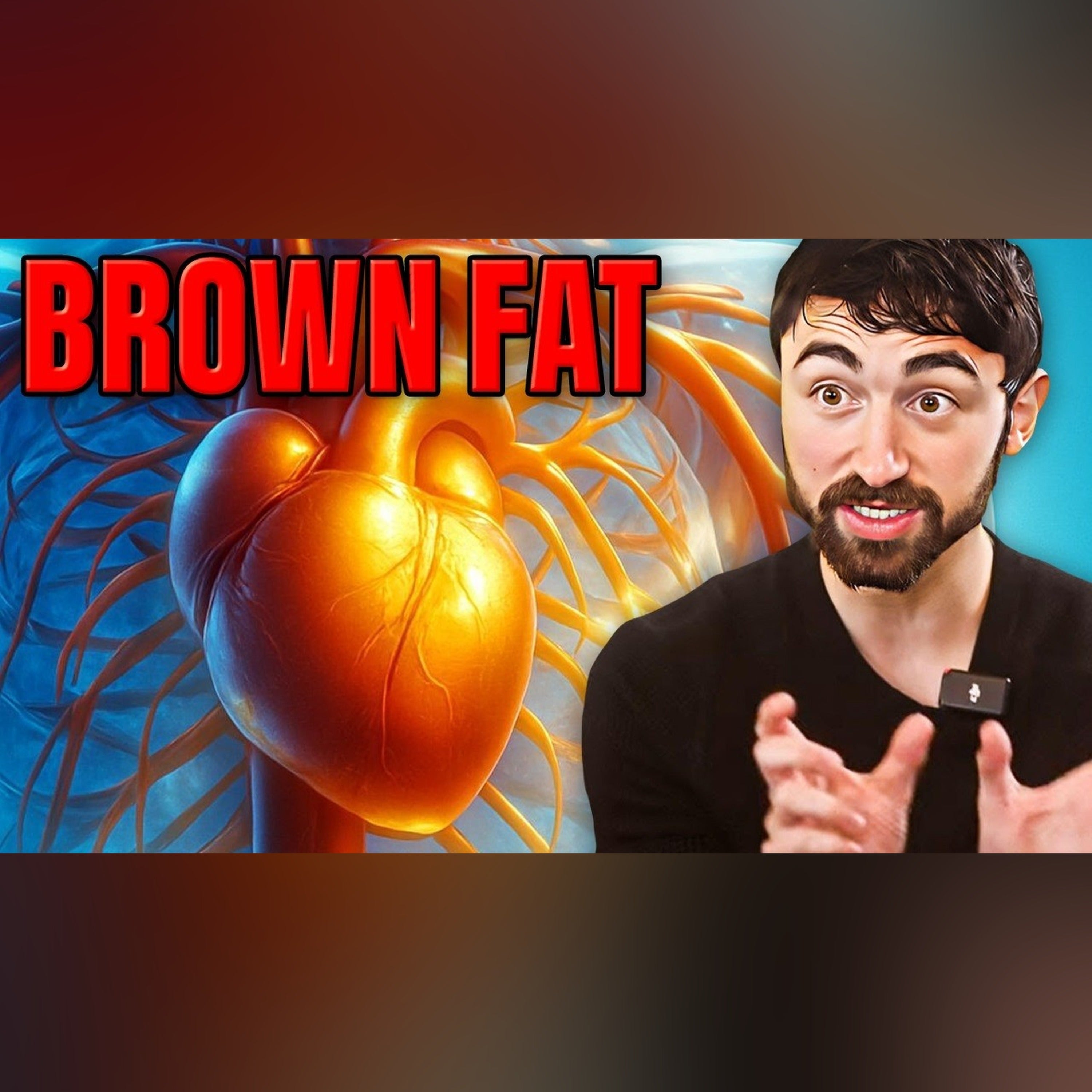
For all references and a written breakdown, see the associated StayCurious Metabolism Newsletter: https://staycuriousmetabolism.substack.com/p/the-fat-derived-hormone-that-could?r=40ekz2 Exciting new research in 2025 suggests that a fat-derived hormone called 12,13-diHOME may help to reverse age-related decline in cardiac function and slowing heart aging. The best part? You can boost it naturally — not with drugs or supplements, but with a simple lifestyle intervention that’s accessible today. In this video, we break down the latest metabolic health and longevity science on how this lipid hormone made by brown fat cells declines with age, how that hormonal drop contributes to cardiovascular aging, and what evidence-based lifestyle interventions can increase 12,13-diHOME to more youthful levels. If you care about heart health, reversing aging, and boosting metabolic resilience, this is essential science you should know. CHAPTER *Call our service line at 815-STAY-CUR (815-782-9287) or vi
Scientists are rethinking how particles behave when moving at extreme speeds through matter. New research into quark-gluon plasma, the exotic fluid that existed moments after the Big Bang, reveals unexpected patterns in particle motion that challenge traditional physical models. The findings could offer a powerful new way to investigate the properties of the universe’s earliest matter. This episode includes AI-generated content.
Viewers like you help make PBS (Thank you ) . Support your local PBS Member Station here: https://to.pbs.org/DonateSPACE Uploaded 26-07-17 Unlock the secrets of Feynman Diagrams. Part 5 in our Quantum Field Theory series. And if you're submitting an answer to our challenge question email your answer by August 2nd to pbsspacetime [AT] gmail.com with the subject line "Feynman Diagram Challenge." You can further support us on Patreon at https://www.patreon.com/pbsspacetime Get your own Space Time tshirt at http://bit.ly/1QlzoBi Tweet at us! @pbsspacetime Facebook: facebook.com/pbsspacetime Email us! pbsspacetime [at] gmail [dot] com Comment on Reddit: http://www.reddit.com/r/pbsspacetime Help translate our videos! https://www.youtube.com/timedtext_cs_... Previous Episode: The Real Star Wars Feynman’s path integral shows us that, to properly calculate the probability of a particle traveling from point A to point B, we need to add up the contributions from all conceivable paths between tho
Sign Up on Patreon to get access to the Space Time Discord! Uploaded 18-08-21 The universe is going to end. But of all the possible ends of the universe vacuum decay would have to be the most thorough - because it could totally rewrite the laws of physics. Today I hope to help you understand exactly how terrified you should be. Check out the Space Time Merch Store Sign up for the mailing list to get episode notifications and hear special announcements! Hosted by Matt O'Dowd Written by Matt O'Dowd Graphics by Leonardo Scholzer, Yago Ballarini, Pedro Osinski, Adriano Leal and Stephanie Faria GFX Visualizations: Ajay Manuel Directed by Andrew Kornhaber Assistant Producer: Setare Gholipour Executive Producers: Eric Brown and Andrew Kornhaber End Credits Music by J.R.S. Schattenberg: https://www.youtube.com/user/MultiDroideka Special thanks to Our Patreon Sponsors Big Bang Supporters Ari Paul Kyle Bulloch Charlie Mrs. Tiffany Poindexter Leo Koguan Sandy Wu Matthew Miller Scott Gray Ahmad Jo
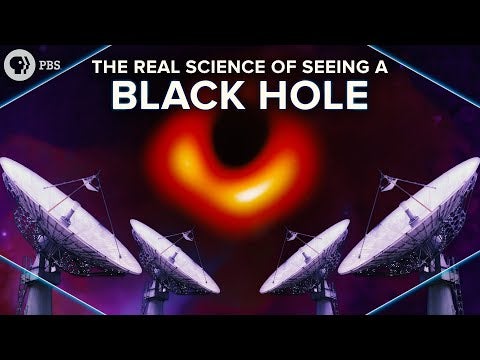
You can learn more about CuriosityStream at https://curiositystream.com/spacetime Uploaded 01-05-19 PBS Member Stations rely on viewers like you. To support your local station, go to: http://to.pbs.org/DonateSPACE How do you take a picture of a black hole and what can we learn from it? Our first ever actual bona fide photo of a black hole, made by the Event Horizon Telescope and revealed to the world in a press conference on April 10th. Since then it’s got plenty of coverage, because … I mean look at it. It’s a freaking black hole. It’s black, it’s holey, it’s everything we hoped it would be. Now that the giddiness has subsided and I personally have stopped spending hours on end staring at a black spot, we can take a breath and actually look at the real science here and discuss exactly how a picture like this could be taken and what we can learn from it. Check out the new Space Time Merch Store! Support Space Time on Patreon Need a Black Hole Refresher #Blackhole #astrophysics #spaceti
Keeping a league competitive is more important than maximizing rewards for its strongest teams.
Share your view, then see how readers voted. No sign-in required. This poll is shared across stories.
Do you agree or disagree?
Common Quandary
A Common Quandary to discuss
Another conversation to explore, separate from this news story.
Your father is becoming a dangerous driver. Would you report him behind his back?
Your father values the independence his car gives him. He has not caused an accident, but his reactions have noticeably slowed and several recent drives frightened you. He refuses an assessment.