The Government's New Terrorism List Is Insane w/ Ken Klippenstein
27 min
Listen through the publisher, then discuss the episode here or arrange an in-person Roundtable. Your city determines where to meet.
Roundtables are designed for groups of four, with a shared subject and room for everyone to speak. Come for discussion, with no dating expectation.
SUPPORT MY WORK: Support my work on Patreon: http://patreon.com/taylorlorenz A new government intelligence report identifies "climate doomers," preppers, and people just generally pessimistic about society as potential extremist threats as the US government turns ordinary political beliefs and online speech into terror threats. Independent journalist Ken Klippenstein joins me on this week's Free Speech Friday to discuss his reporting on the Trump administration's expanding definition of domestic extremism, the government's growing surveillance powers, and what this means for free speech in America. We dig into how the counterterrorism apparatus built after 9/11 is increasingly focused on Americans at home, why the White House is treating certain criticism of US foreign policy as potential foreign influence, and how artificial intelligence is transforming government surveillance. We also discuss the TikTok ban, the erosion of internet anonymity, online ID verification, facial recognition, Flock surveillance cameras, and why laws supposedly designed to protect children could create powerful new tools for monitoring everyone. In this episode: Why a government intelligence report is raising concerns about the surveillance of climate doomers, preppers, and other pessimistic Americans How the Trump administration is expanding its approach to domestic extremism and national security threats Why White House counterterrorism official Sebastian Gorka's comments about the First Amendment are raising alarms How AI is allowing the government to analyze unprecedented amounts of online activity What the TikTok ban reveals about the politics of foreign influence and censorship Why mandatory ID verification and age verification could undermine online privacy How the surveillance powers established after 9/11 continue to expand Why both Democrats and Republicans are embracing policies that threaten internet freedom Support Free Speech Friday on Patreon: https://www.patreon.com/c/taylorlorenz #KenKlippenstein #FreeSpeech #Surveillance #Trump #ArtificialIntelligence
Episode information is provided by the publisher. Listening takes place on the publisher’s service.
What happens when the CEO of one of the world's most influential AI companies becomes the target of a foreign intelligence operation? And what does that mean for the future of artificial intelligence, corporate leadership, and global technology security? In this episode of TechDaily.ai, host David and guest Sophia examine a dramatic Nvidia leadership story described in the episode: the November 23, 2026, reinstatement of CEO Jensen Huang following an alleged foreign intelligence targeting incident. The discussion explores the reported unanimous board decision, the involvement of senior United States government officials, and the sweeping corporate governance changes described as part of Nvidia's response to growing national security concerns. As AI infrastructure becomes increasingly important to global economic and technological competition, the conversation raises a critical question: Are the executives leading the AI revolution becoming high-value targets in an international intelli
Monday AI news covers NVIDIA's board reversing course on Jensen Huang, a slide in AI stocks, Google's changing homepage, and a security study on leaked AI credentials. Minutes before air, NVIDIA's board voted unanimously to reinstate Jensen Huang as CEO. A week earlier it had said it would not consider doing so, and its investigating committee continues its work. The conversation moves through Friday's drop in AI stocks, Google AI Mode shopping with Target, and Google's new task features alongside assistants like Duet and Dot. Other topics include data privacy concerns with AI texting startups, an OpenAI paper on perplexity as a measure of model confidence, a new Google homepage built around AI conversations, which appeared and disappeared between refreshes in what looks like an A/B test, and Dragos research using canary tokens that found exposed AWS credentials were the ones most often used. The show closes on Australia elevating AI to a national security challenge, Thinking Machines
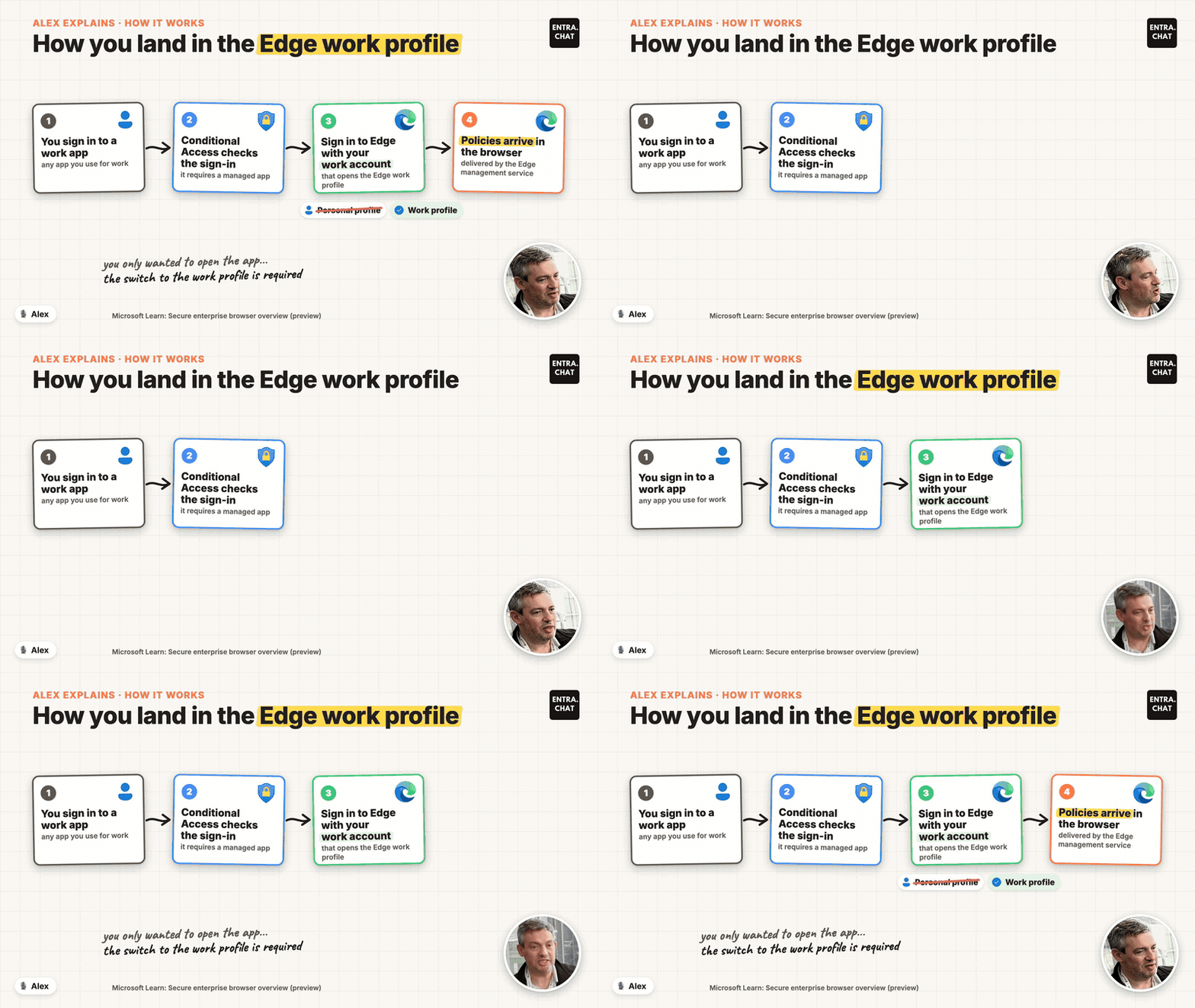
This episode was recorded in person at Microsoft Ignite. A big thank you to Increment (https://www.increment.inc/) and IDFusion (https://idfusion.io/) for sponsoring my travel to the event so I could record it there. Giving a contractor, a newly acquired team or a BYOD user access to your private web apps has meant a VPN client, a managed laptop or a virtual desktop. Microsoft now has a preview that builds Global Secure Access into Microsoft Edge for Business: the user signs in to Edge with their work account and gets your private apps and protected internet access, with nothing else to install. Recorded at Microsoft Ignite with the people who built it: Arunesh Chandra (Head of Product, Microsoft Edge for Business), Narendra Acharya (Head of Engineering), Patrizio Chiquini (Product Manager) and Alex Pavlovsky (Product Architect, Global Secure Access). This episode also starts a new monthly Global Secure Access series on Entra.Chat, co-hosted by Andres Canello (Ex-Microsoft Entra PM), w
A fake job interview helped open the door to a reported $6.3 billion theft from Binance. The FBI attributed the heist to North Korea, which has used cryptocurrency theft to raise revenue and evade sanctions. This week, former federal prosecutor Maya Song joins Frank Cilluffo to explain why tracing stolen cryptocurrency is easier than getting it back, what prosecutors need to turn an attribution into a criminal case, and how companies and law enforcement can work together to limit the damage after a breach. Main Topics The fake recruiting scheme the led to $6.3B loss The theft and fraudulent IT work funding North Korea Tracing, freezing, and recovering stolen cryptocurrency Public attribution and the evidence needed for an indictment When companies should contact law enforcement How indictments and asset seizures can disrupt future operations Key Quotes "Law enforcement generally, when it comes to the cybercrime threat, they have at the federal level taken an attitude of deter, disrupt,
Before diving into today’s interview, Michael shares show updates for the new year—including Chris’s return and a regular Tuesday/Wednesday release cadence—followed by breaking news on Jensen Huang returning to NVIDIA after a $2 trillion stock drop. Michael also unpacks why Frontier Labs are lobbying to conflate "open" models with national security risks following Anthropic's $81B+ IPO, why local communities are pushing back on tax-subsidized data centers, and how enterprise AI token spend is starting to eclipse monthly payroll. Then, Ryan Sipes of Thunderbird joins the show to discuss Thunderbolt, Mozilla’s open-source, self-hostable AI client. Ryan explains how organizations are using Thunderbolt as an on-premise, air-gapped, or confidential-compute replacement for ChatGPT and Claude, how interactive "mini apps" are moving AI workflows beyond basic chat, and why businesses need to own their AI stack rather than rent it. Key Topics Covered Show Updates: Chris returns in the new year w
Zvi Mowshowitz said it would not happen, and then it did: after a phone call from President Trump, Nvidia’s board brought Jensen Huang back as CEO, and three trillion dollars returned to the stock market in a day. Zvi explains where his own prediction went wrong, why the market treated one man as too big to fail, and what the “Trump Put” means for national security and export controls. He also covers the newest reporting on the affairs, the alleged spy and the chip smuggling, the war on the New York Times, the coming investigations, and a few things that are somehow real. This has been an Askwho Casts audio conversion. Thanks for listening. * 00:00 - Introduction * 03:03 - Table of Contents * 03:41 - I Got This One Wrong * 04:58 - How Did It Happen? * 09:55 - Donald Trump Intervened Personally to Install Jensen Huang at Nvidia * 12:05 - The Trump Put * 19:59 - The Whole Affairs * 21:05 - Better to Be Feared Than Loved * 27:26 - The Law of No Evidence * 30:10 - The War Against the Press
Jensen Huang wants to return to Nvidia, but can he pull it off? SUPPORT MY WORK: Support my work on Patreon: http://patreon.com/taylorlorenz Washington Post technology reporter Gerrit De Vynck joins me for this week's Power User to break down Jensen Huang’s departure, the campaign to bring him back as Nvidia CEO, and the financial and political interests behind the fight. We discuss the reported affairs and national security concerns surrounding Jensen's exit, the questions about Alice Huang and Megaspeed, and how Chinese AI companies have accessed advanced Nvidia chips through overseas data centers. We dig into the distinction between allegations of chip smuggling and renting remote access to computing power, and what remains unresolved. We also examine why Silicon Valley is rallying around Jensen, how Nvidia’s investments and financing arrangements helped fuel the AI industry, and what a change in leadership could mean for the companies that depend on it. Could Huang pull off a comeb
SUPPORT MY WORK: Support my work on Patreon: http://patreon.com/taylorlorenz A massive covert influence network of fake social media accounts was caught defending Nvidia, praising CEO Jensen Huang, and attacking critics of US chip exports to China. Then, over 100 accounts suddenly vanished. Now, a new investigation has uncovered ties between this coordinated campaign and an Israeli influence operation previously implicated in other covert online campaigns. Investigative journalist Tyler Johnson, founder of The Midas Project, joins me for this week's Free Speech Friday to reveal how he uncovered the network, who's operating the fake accounts, and why the scandal raises serious questions about corporate propaganda, artificial intelligence, and political influence. The investigation identified fake personas posing as ordinary Americans, from nurses and artists to sports fans and parents, while promoting Nvidia, defending Jensen Huang amid his latest controversy, and targeting critics of t
NVIDIA CEO Jensen Huang is caught in the center of one of the biggest corporate, geopolitical, and personal scandals in Silicon Valley history. SUPPORT MY WORK: Support my work on Patreon: http://patreon.com/taylorlorenz Jensen Huang was allegedly involved with a Chinese spy, potentially leaking crucial information and inciting a national security crisis. Stephen Witt, the author of Jensen Huang's biography The Thinking Machine, joins me on this week's Power User to explain what really happened and what it could mean for the future of NVIDIA and the AI industry. Jensen Huang spent decades building NVIDIA into one of the most powerful companies in the world. He also cultivated an image as a devoted husband, father, and disciplined tech executive. But after admitting to cheating on his wife of roughly 40 years, Huang is facing scrutiny over his alleged relationship with Alice Huang, a former executive at Megaspeed whom U.S. intelligence officials reportedly suspect of working for China.
Mental-health support should be available before a person reaches a crisis.
Share your view, then see how readers voted. No sign-in required. This poll is shared across stories.
Do you agree or disagree?
Common Quandary
A Common Quandary to discuss
Another conversation to explore, separate from this news story.
Your anonymous gift could inspire millions more if you reveal your name. Do you?
A donor wants to make a transformative gift without recognition. The charity believes announcing the gift and the donor's identity would encourage matching contributions and help far more people.
Can the opportunity to create more good outweigh a preference for privacy?