English-language podcasts

Sleepy Facts

The Most Relaxing Facts About Human Emotions to Fall Asleep To

136 min

Listen through the publisher, then discuss the episode here or arrange an in-person Roundtable. Your city determines where to meet.

Roundtables are designed for groups of four, with a shared subject and room for everyone to speak. Come for discussion, with no dating expectation.

In this calm and sleepy facts episode, we turn inward to explore the quiet science of human emotions, the invisible forces that color every moment of every day and connect us to one another in ways we rarely stop to notice. We begin with what an emotion actually is, a brief, automatic response involving changes in the body, shifts in attention, and an urge to act, and then we journey into the neuroscience behind feeling, from the amygdala's rapid threat detection to the vagus nerve's gentle role in calming the body back down. We discover that certain facial expressions are recognized across every culture on Earth, that newborns can distinguish between happy and sad voices within days of birth, and that emotional tears contain stress hormones and natural painkillers not found in any other kind of tear. From there we explore the individual emotions themselves, learning why the brain tends to return to a baseline level of happiness even after the best and worst events, why sadness slows the body and mind to create space for reflection, and how fear can be learned in a single moment but takes much longer to unlearn. We visit the subtler, harder to name feelings too, like nostalgia, once classified as a disease but now understood as a bittersweet emotion that strengthens social bonds, and awe, the quiet expansion that comes from standing in the presence of something vast. We learn how simply naming an emotion can reduce its intensity, how sleep gently reorganizes the feelings of the day, and how the body carries emotions in ways most people never notice, from a quickening heartbeat to the slow release of tension in the shoulders after a long sigh. Let these 500 quiet facts about human emotions carry you peacefully to sleep.

Episode information is provided by the publisher. Listening takes place on the publisher’s service.

Listen at the source ↗

Featured places to meet in Palo Alto, CA

Explore these places and arrange a conversation through ThinkMatch.

City guide for Palo Alto, CA

More from Sleepy Facts

Sleepy Facts

The Most Relaxing Facts About the Sun to Fall Asleep To

132 min

In this calm and sleepy facts episode, we turn toward the nearest star, the quiet, golden engine that has risen and set over every day of every life ever lived on Earth. We begin with the basics of what the Sun actually is, a G type main sequence star roughly 4.6 billion years old, containing 99.86 percent of all the mass in the solar system, and then we journey into its core, where hydrogen nuclei are fused into helium at temperatures around 15 million degrees Celsius. We follow the energy produced by that fusion as it makes its extraordinary journey outward, taking tens of thousands of years to travel from the core to the surface, absorbed and re emitted countless times before finally emerging as the sunlight that reaches Earth in just over eight minutes. We explore the mysterious corona, the Sun's outer atmosphere, which is somehow far hotter than the surface itself, a puzzle scientists are still working to solve. From there we move into the restless side of the Sun, learning about

Discuss this episode

Sleepy Facts

8 Hours of the Most Relaxing Facts About Nature to Fall Asleep To

514 min

In this calm and sleepy facts episode, we spend eight peaceful hours exploring some of the quietest wonders of the natural world. We begin beneath a gathering thunderstorm, following warm air as it rises into towering clouds and learning how a single flash of lightning can briefly heat the air to several times the temperature of the surface of the Sun. From there we settle into the hidden world of hibernation, where animals slow their breathing and their heartbeats to just a few beats a minute and wait out the long winter in stillness. Next, we wander among the trees, discovering how they lift water hundreds of feet into the air without a single moving part and quietly record each passing year in rings of wood. Finally, we cross the deserts, where the heat of the day gives way to cold, clear nights and some dunes hum softly as the sand slides down their slopes. Each story unfolds slowly and gently, with no sudden sounds, so the whole night can pass in calm and quiet wonder. Let these c

Discuss this episode

Sleepy Facts

The Most Relaxing Facts About Exoplanets to Fall Asleep To

147 min

In this calm and sleepy facts episode, we journey far beyond our own solar system to explore the thousands of worlds orbiting distant stars, places we have only recently learned to find and are only just beginning to understand. We start with the basics of what an exoplanet is and how astronomers detect them, from the gentle dimming of a star as a planet passes in front of it to the tiny gravitational wobble a hidden world imprints on its sun. We visit the extraordinary harvest of the Kepler space telescope, which revealed that planets are not rare exceptions but the rule, scattered across nearly every star in the Milky Way. Along the way we encounter strange and extreme worlds, gas giants so close to their stars that they complete an orbit in mere days, tidally locked planets with one face locked in permanent daylight and the other in endless night, and rogue planets drifting alone through interstellar space with no star to call home. We explore the habitable zone, the narrow region a

Discuss this episode

Community Poll

Rebuilding after a disaster should sometimes mean changing where or how people live.

Share your view, then see how readers voted. No sign-in required. This poll is shared across stories.

Do you agree or disagree?

Choose one answer

Common Quandary

A Common Quandary to discuss

Another conversation to explore, separate from this news story.

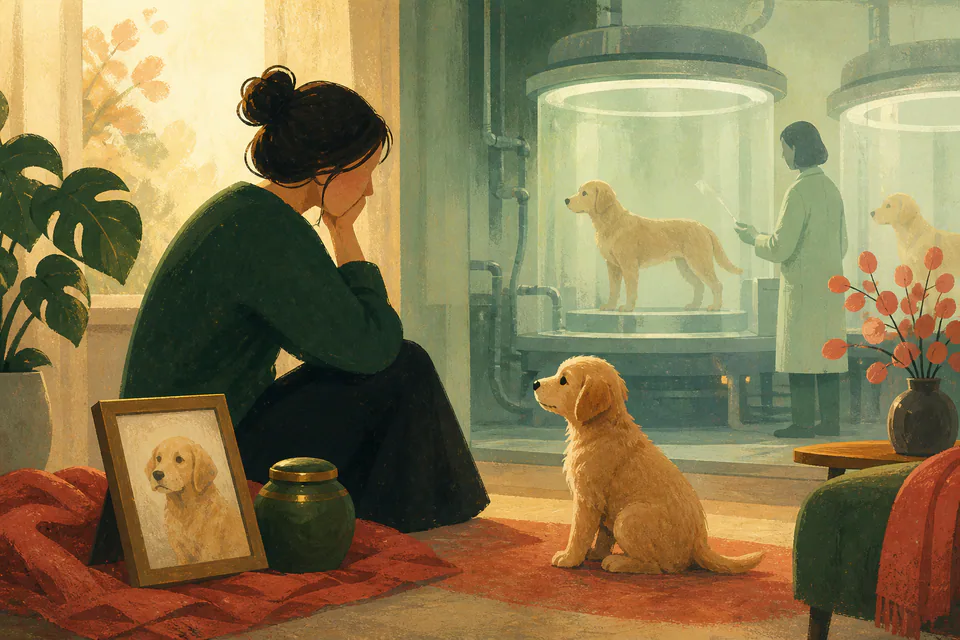
You can clone the best dog you ever had. Would you?

After a beloved dog dies, its owner can afford to have it cloned. The procedure is legal and improving, but it uses animals as surrogates and will not recreate the original dog's memories or personality.

What do our obligations to animals permit us to create for our own comfort?

Explore this quandary