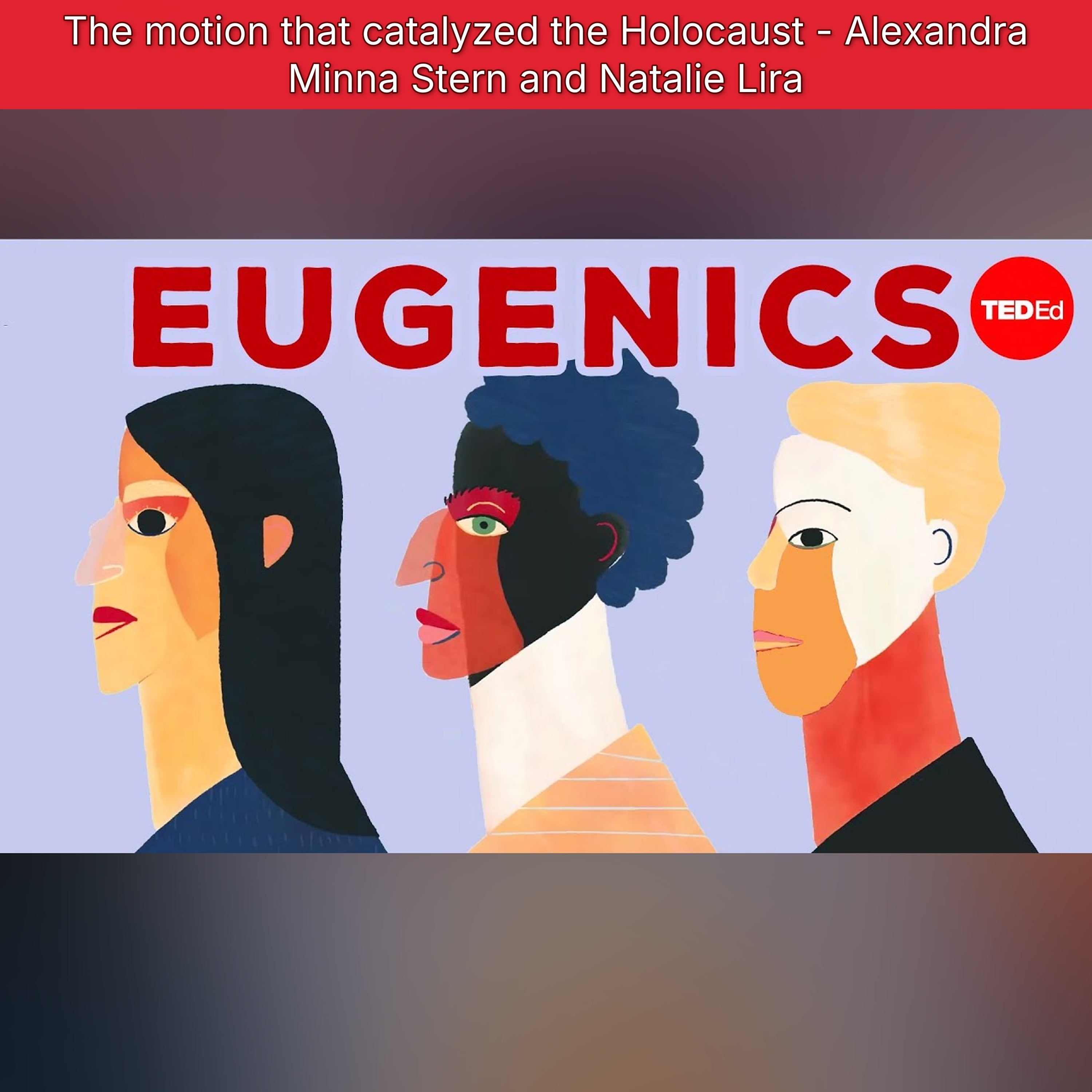
The motion that catalyzed the Holocaust - Alexandra Minna Stern and Natalie Lira
Listen through the publisher, then discuss the episode here or arrange an in-person Roundtable. Your city determines where to meet.
Roundtables are designed for groups of four, with a shared subject and room for everyone to speak. Come for discussion, with no dating expectation.
Trace the history of the eugenics movement in the US, and discover how the belief in ideal genetics led to forced sterilizations. -- Since ancient Greece, humans have controlled populations via reproduction, retaining some traits and removing others. But in the 19th century, a new scientific movement dedicated to this endeavor emerged: eugenics. Scientists believed they could improve society by ensuring that only desirable traits were passed down. Alexandra Minna Stern and Natalie Lira detail the history of eugenics in the US. Lesson by Alexandra Minna Stern and Natalie Lira, directed by Héloïse Dorsan-Rachet. Support Our Non-Profit Mission ---------------------------------------------- Support us on Patreon: http://bit.ly/TEDEdPatreon Check out our merch: http://bit.ly/TEDEDShop ---------------------------------------------- Connect With Us ---------------------------------------------- Sign up for our newsletter: http://bit.ly/TEDEdNewsletter Find us on Twitter: http://bit.ly/TEDEdTwitter Peep us on Instagram: http://bit.ly/TEDEdInstagram ---------------------------------------------- Keep Learning ---------------------------------------------- View full lesson: https://ed.ted.com/lessons/the-movement-that-inspired-the-holocaust-alexandra-minna-stern-and-natalie-lira Dig deeper with additional resources: https://ed.ted.com/lessons/the-movement-that-inspired-the-holocaust-alexandra-minna-stern-and-natalie-lira#digdeeper (https://ed.ted.com/lessons/the-movement-that-inspired-the-holocaust-alexandra-minna-stern-and-natalie-lira) Animator's website: https://www.heloisedr.com (https://www.heloisedr.com/) & https://www.instagram.com/helo.dr/?hl=fr ---------------------------------------------- Thank you so much to our patrons for your support! Without you this video would not be possible! Xiao Yu, Melissa Suarez, SpartacusDMR, Brian A. Dunn, Francisco Amaya, Daisuke Goto, Matt Switzler, Leonardo Monrroy, Maryam, Bethany Connor, Jeremy Shimanek, Mark Byers, Avinash Amarnath, Xuebicoco, Rare Media, Rayo, Po Foon Kwong, NinjaBoffin, Jesse Jurman, Scott Markley, Elija Peterson, Ovidiu Mrd, paul g mohney, Aravind Battaje, Steven Razey, Nathan Giusti, Helen Lee, Anthony Arcis Benedict, Karthik Balsubramanian, John Hong, Annastasshia Ames, Sean, Amy Lopez, Vinh-Thuy Nguyen, Liz Candee, Ugur Doga Sezgin, Anthony Arcis, Karmi Nguyen, John C. Vesey, Yelena Baykova, Harshita Jagdish Sahijwani, Nick Johnson, Carlos H. Costa, Robert Patrick, Jennifer Kurkoski, Ryan B Harvey, Abhishek Bansal, Akinola Emmanuel, Jose Arcadio Valdes Franco and Sebastiaan Vleugels.
Episode information is provided by the publisher. Listening takes place on the publisher’s service.
Listen at the source ↗