Listen through the publisher, then discuss the episode here or arrange an in-person Roundtable. Your city determines where to meet.
Roundtables are designed for groups of four, with a shared subject and room for everyone to speak. Come for discussion, with no dating expectation.
In which John Green teaches you about the War of 1812. The War of 1812 was fought between the United States and its former colonial overlord England. It started in, you guessed it 1812. The war lasted until 1815, and it resolved very little. John will take you through the causes of the war, tell you a little bit about the fighting itself, and get into just why the US Army couldn't manage to make any progress invading Canada. And yes, Canadians, we're going to talk about the White House getting burned down. The upshot: no territory changed hands, and most of the other bones of contention were solved prior to the actual war. Although nothing much changed for the US and England, the Native Americans were the big losers. Tecumseh was killed, and the Indian tribes lost a lot of their territory. Watch as John lays it all out for you. Chapters: Introduction: The War of 1812 00:00 Causes for The War of 1812 - British Impressment of American Sailors 0:44 Henry Clay and the Warhawks 2:13 Americans Wanted Canada 3:02 Mystery Document 3:42 Expansion into Native American Territory 4:19 Tecumseh and the Battle of Tippecanoe 4:57 The U.S.'s First Declaration of War 6:32 Battles of The War of 1812 7:19 The Treaty of Ghent 9:45 Outcomes of The War of 1812 10:23 The Hartford Convention 11:03 American Nationalism After The War of 1812 11:31 Credits 12:09 Crash Course is on Patreon! Want to find Crash Course elsewhere on the internet? Facebook - http://www.facebook.com/YouTubeCrashCourse Twitter - http://www.twitter.com/TheCrashCourse Instagram - https://www.instagram.com/thecrashcourse/ CC Kids: http://www.youtube.com/crashcoursekids
Episode information is provided by the publisher. Listening takes place on the publisher’s service.
Best books for Prompt Engineering with GPT-3 and LLMs - Crash Course in AGIEpisode release date: 27 Dec 2022Spreading awareness about the works of some of the leading educators in the AI revolution. Core Ideas: Metamodernism: Narratives and emergence view of reality - Reduce suffering - Increase prosperity - Increase understanding mantra: Seek knowledge. ELABORATE: Add depth and detail to understanding, weaving comprehensive and nuanced explanations.DISCLAIMER: This is a community-driven show. ----------------Best books for Prompt Engineering with GPT-3 and LLMs - Crash Course in AGIEpisode release date: 27 Dec 2022Spreading awareness about the works of some of the leading educators in the AI revolution. Core Ideas: Metamodernism: Narratives and emergence view of reality - Reduce suffering - Increase prosperity - Increase understanding mantra: Seek knowledge. ELABORATE: Add depth and detail to understanding, weaving comprehensive and nuanced explanations.DISCLAIMER: This is a community
PBS Member Stations rely on viewers like you. To support your local station, go to: http://to.pbs.org/DonateSPACE ↓ More info below ↓ Uploaded 11-11-20 Sign Up on Patreon to get access to the Space Time Discord! Physicists have a long history of sticking our noses where they don’t belong - and one of our favorite places to step beyond our expertise is the question of consciousness and free will. Sometimes our musings are insightful, sometimes incoherent, and usually at least somewhat naive. Which a fair description of this show, so of course Space Time needs to weigh in physics and free will.. Check out the Space Time Merch Store Hosted by Matt O'Dowd Written by Matt O'Dowd and Bahar Gholipour Graphics by Leonardo Scholzer, Yago Ballarini, and Pedro Osinski Directed by: Andrew Kornhaber Assistant Producer: Setare Gholipour Executive Producers: Eric Brown and Andrew Kornhaber End Credits Music by J.R.S. Schattenberg: https://www.youtube.com/channel/UCRl6-nb4iOnsij-vnpAjp0Q Special Thank
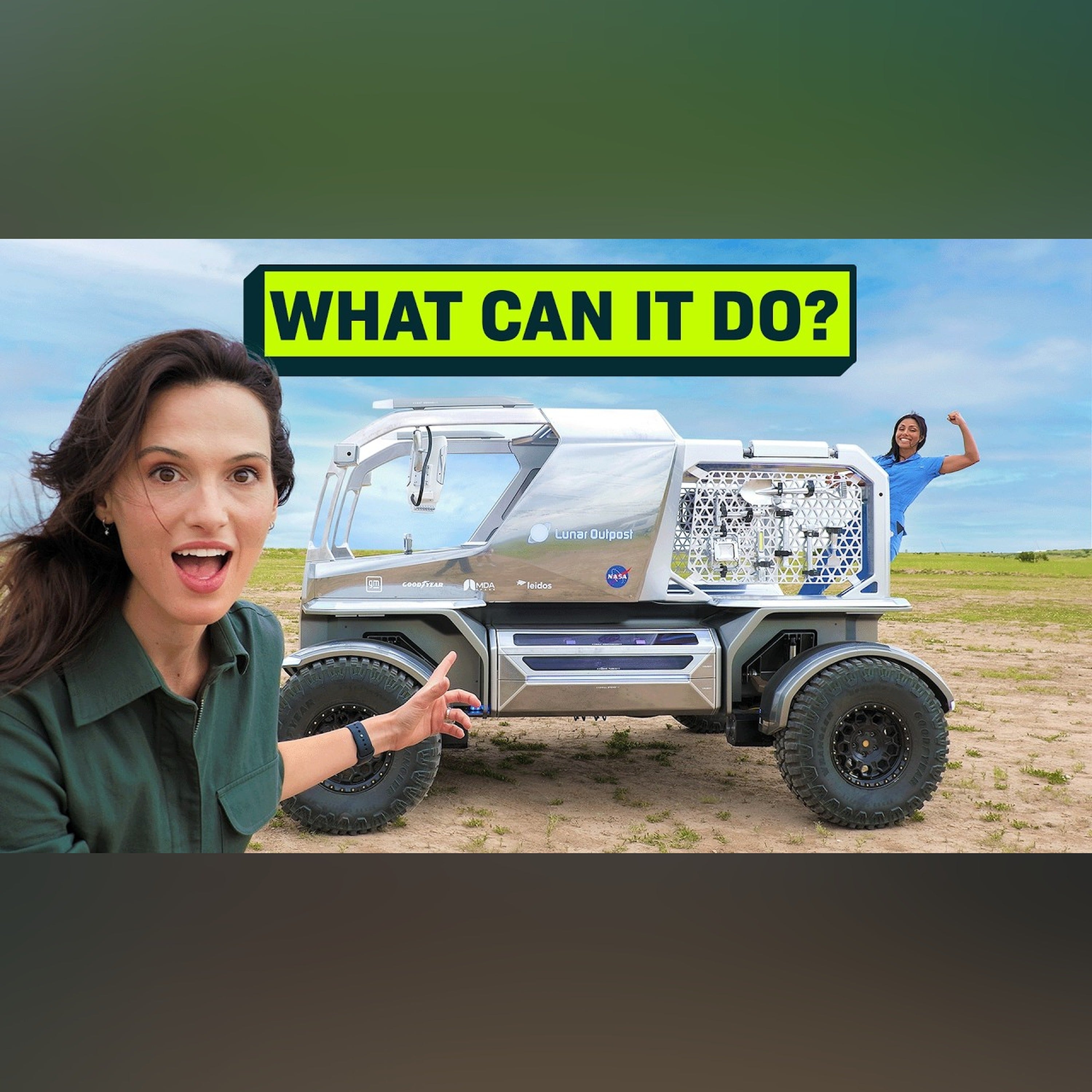
This truck is going to the moon. So we put it to the test… Get an exclusive 15% discount on Saily data plans. Use code CLEO at checkout. Download Saily app or go to https://saily.com/cleo This is the world’s first “space truck.” It’s going to the moon to help us go farther, faster, and discover places we’ve never been… Because humans are about to go back to the moon for the first time in 50 years! And no one but its builders have ever driven it… until today. In this video I'm going to put this brand new space truck to the test in a series of 5 challenges. And I've invited someone who knows a thing or two about challenges: YouTube daredevil and host of Challenge Accepted… Michelle Khare! Let’s go. Chapters: 0:00 This is the world’s first space truck 0:38 Introducing Michelle Khare! 01:04 What is a space truck? 01:52 How do astronauts drive? 02:21 First impressions! 02:47 Moon truck v normal truck 04:47 How fast can you drive on the moon? 05:18 Will we crash? 08:36 Can we break the lunar
Join NCI University today to master human behavior and influence: Uploaded 02-11-22 Too much time has passed, and I've wanted a map for human influence and persuasion, so I built one - and it works everywhere. THE FOCUS VIDEO: https://www.youtube.com/watch?v=n5poKK4lR5c Join me at an upcoming course! Looking back, everyone can locate failure and success. What most people don't realize is that you can also trace back success and failure to human behavior factors alone. These skills are so vital to life that I've dedicated my life to exploring and building this field into a transformational system that will radically transform the RESULTS you get from the world. I hope to see you in the next one! ️ C Chapters: 0:00 - Introduction 1:43 - The essence of mapping human Behavior TAGS: persuasion, influence, psychology, Chase Hughes, behavior panel, Scott rouse, greg Hartley, mark Bowden, Spidey, hypnosis, profiling, body language, sales
This week on The Necessary Conversation, it's Chad, Haley, and Mary Lou. Bob is still recovering but sent in a video message about Trump calling Putin his friend that we watch together. 🇷🇺 Trump held the first-ever three-way talks with Putin and Xi, called it a "12 out of 10," and produced nothing. Then at a press conference he called Putin his friend — and when asked if Putin is a friend to America, the president of the United States said, "I can't speak to America." That same day, Trump's friend Putin launched massive strikes into Ukraine, hit Poland with two missiles — an act of war against a NATO ally — then struck near a Ukrainian restaurant and drone-bombed the first responders, killing a 7-year-old child and a 20-year-old paramedic. We watch Bob's video and ask Mary Lou: is Russia our friend? 🇨🇳 The House Foreign Affairs Committee revealed Trump's Commerce Department approved nearly 880,000 advanced AI chips for Chinese military-linked companies including Alibaba, Tencent, a
This is a Grave Talks CLASSIC EPISODE! In the heart of Calgary stands one of the city’s most infamous historic properties—Deane House. Built in 1906 by Captain Richard Burton Deane, the home’s history was marked by tragedy almost immediately, when Deane’s wife died during its construction. Decades later, the darkness deepened. In 1971, a brutal murder-suicide unfolded within its walls, casting a shadow that many believe still lingers today. Visitors and investigators report full-bodied apparitions, unexplained noises, sudden cold spots, and overwhelming feelings of unease. Some say they’ve encountered more than one spirit inside the historic residence. Others believe the energy there feels layered—built from grief, violence, and unresolved history. On this episode of The Grave Talks, we explore the chilling past of The Deane House, the paranormal experiences that continue to be reported, and the lingering question: what—if anything—still walks its halls? #DeaneHouse #HauntedCalgary #Ha
The majority of the universe is made up of a currently mysterious entity that pervades space: dark energy. We don’t know exactly what it is, but we do know that dark energy accelerates the expansion of space. We think this means the Universe will expand forever, even as our view of it shrinks while space expands faster all the time. Check out the Crash Course Astronomy solar system poster here: http://store.dftba.com/products/crashcourse-astronomy-poster If you want to learn more about the creation and death of the universe, watch Crash Course Big History here: https://youtube.com/playlist?list=PL8dPuuaLjXtMczXZUmjb3mZSU1Roxnrey -- Chapters: Introduction: The Expanding Universe 00:00 The Expansion of Space is Accelerating 2:17 What is Dark Energy? 4:19 Will the Universe Expand Forever? The Geometry of the Universe 5:20 The Cosmic Horizon of the Observable Universe 6:50 Review 10:20 -- GEOMETRY OF THE UNIVERSE RESOURCES Geometry: Expanding faster than light: General expansion: -- PBS Di
Have you ever wondered where cured meats like salami or pepperoni get their bright red color? Of course its from organic chemistry! A chemical called nitric acid gives them that bright color, while also increasing their shelf. It's also involved in some other interesting reactions. In this episode of Crash Course Organic Chemistry we'll see how nitrous acid reacts with primary amines to form diazonium salts, we'll learn about alkyldiazonium salts and aryldiazonium salts, and see what conditions are necessary for nucleophilic aromatic substitutions. Series Sources: Brown, W. H., Iverson, B. L., Ansyln, E. V., Foote, C., Organic Chemistry; 8th ed.; Cengage Learning, Boston, 2018. Bruice, P. Y., Organic Chemistry, 7th ed.; Pearson Education, Inc., United States, 2014. Clayden, J., Greeves, N., Warren., S., Organic Chemistry, 2nd ed.; Oxford University Press, New York, 2012. Jones Jr., M.; Fleming, S. A., Organic Chemistry, 5th ed.; W. W. Norton & Company, New York, 2014. Klein., D., Organ
Like a trendy dance, a fighting combo, or a secret handshake, organic reactions can be broken down into simpler steps. In this episode of Crash Course Organic Chemistry, we’ll specifically be looking at alkene addition reactions, and with each new reaction ask ourselves three questions to help us puzzle through the mechanism and understand what’s going on. Episode Sources: Le Couteur, P, Burreson, J. Napoleon’s Buttons: 17 molecules that changed history., Penguin, New York, 2004, Chapter 1. Whipps, H., “How the Spice Trade Changed the World,” https://www.livescience.com/7495-spice-trade-changed-world.html Last accessed, 3/28/2020. Henriques, Martha, “How spices changed the ancient world,” http://www.bbc.com/future/bespoke/made-on-earth/the-flavours-that-shaped-the-world/ Last accessed, 3/28/2020. Hashimoto, K., Yaoi, T., Koshiba, H., Yoshida, T., Maoka, T., Fujiwara, Y., Yaamoto, Y, Mori, K., “Photochemical Isomerization of Piperine, a Pungent Constituent of Pepper”, Food Sci. Technol.
An adaptation should be free to depart substantially from the original work.
Share your view, then see how readers voted. No sign-in required. This poll is shared across stories.
Do you agree or disagree?
Common Quandary
A Common Quandary to discuss
Another conversation to explore, separate from this news story.
A better public school is one borrowed address away. Would you use it?
Your child is struggling at the assigned school. A grandparent lives inside the boundary of a much stronger public school and offers to let you use their address. The desired school has limited places and verifies residency unevenly.
Can a parent's duty justify taking an opportunity allocated by an unfair boundary?