Listen through the publisher, then discuss the episode here or arrange an in-person Roundtable. Your city determines where to meet.
Roundtables are designed for groups of four, with a shared subject and room for everyone to speak. Come for discussion, with no dating expectation.
Merriam-Webster's Word of the Day for November 16, 2026 is: travesty • \TRAV-uh-stee\ • noun Travesty refers to something that is shocking, upsetting, or ridiculous because it is not what it is supposed to be, but is instead a distorted or badly inferior imitation of it. The word is often used in the phrase “a travesty of.” // The investigation into the causes of the accident was a complete travesty. See the entry > (https://www.merriam-webster.com/dictionary/travesty) Examples: “This case is an example of the failure of our judicial system’s lack of common sense, good judgment and morality. It is nothing less than a travesty of justice.” — Richard Votapka (letter to the editor), The Stuart (Florida) News, 18 Mar. 2026 Did you know? When disaster strikes, keeping track of which word to use seems pretty unimportant. But you don’t want to describe disastrous events as travesties, because they’re not: they’re tragedies (https://www.merriam-webster.com/dictionary/tragedy). Travesties are terrible too, but travesty refers specifically to something that is done in a way that makes a mockery of what it’s supposed to be: for example, a contest won by the judge’s spouse could be considered a travesty. And a trial in which the defendant wasn’t allowed to present evidence could be described as a “travesty of justice.” Travesty, which can also function as a verb meaning “to make a travesty of” or “to parody,” comes from the French travestir, meaning “to disguise.” Its roots, however, wind back through Italian to the Latin vestire, meaning “to clothe” or “to dress.” Other descendants of vestire include vestment (https://www.merriam-webster.com/dictionary/vestment), divest (https://www.merriam-webster.com/dictionary/divest), and invest (https://www.merriam-webster.com/dictionary/invest).
Episode information is provided by the publisher. Listening takes place on the publisher’s service.
To check the transcript: https://www.buzzsprout.com/2379282 Imagine someone who has lived abroad for many years. One evening, they're talking to a friend about their hometown. They mention the streets they used to walk down, the familiar voices, and the little things they never thought they'd miss. Their friend asks: “Why do you get so emotional whenever you talk about your hometown? Do you want to move back?” They reply: “It's not that simple. It goes deeper than that. I miss a version of my life that doesn't exist there anymore.” Hello everyone, and welcome to Daily English. Today's expression is “It goes deeper than that.” We use this expression when something is more complicated, meaningful, or emotionally significant than it first appears. In other words, there's something beneath the surface that people might not immediately recognize. In our opening example, the person isn't necessarily longing to return to their hometown. What they miss might be their childhood, the people they
You went back. Maybe not to the same person, but to the idea of them. You rehearsed the conversation again in your mind. You thought of better words, sharper examples, a clearer way to say the thing you'd already said. You kept trying to win an argument that was already over, with a person who had already walked away. Uploaded 13-10-26 That hunger to be understood is one of the most natural things in the world. And it is also one of the quietest thieves of a person's peace that I know of. You explain yourself to one person, feel relief for a day, and then someone else shakes their head, and you're back building the case for your own life all over again. Here is the truth: it is not another person's job to understand you. It is your job to understand yourself. And once you've done that interior work, the opinions of people who don't understand you go from feeling like a verdict to feeling like weather. This seminar unpacks the single mechanic behind why you keep over-explaining your lif
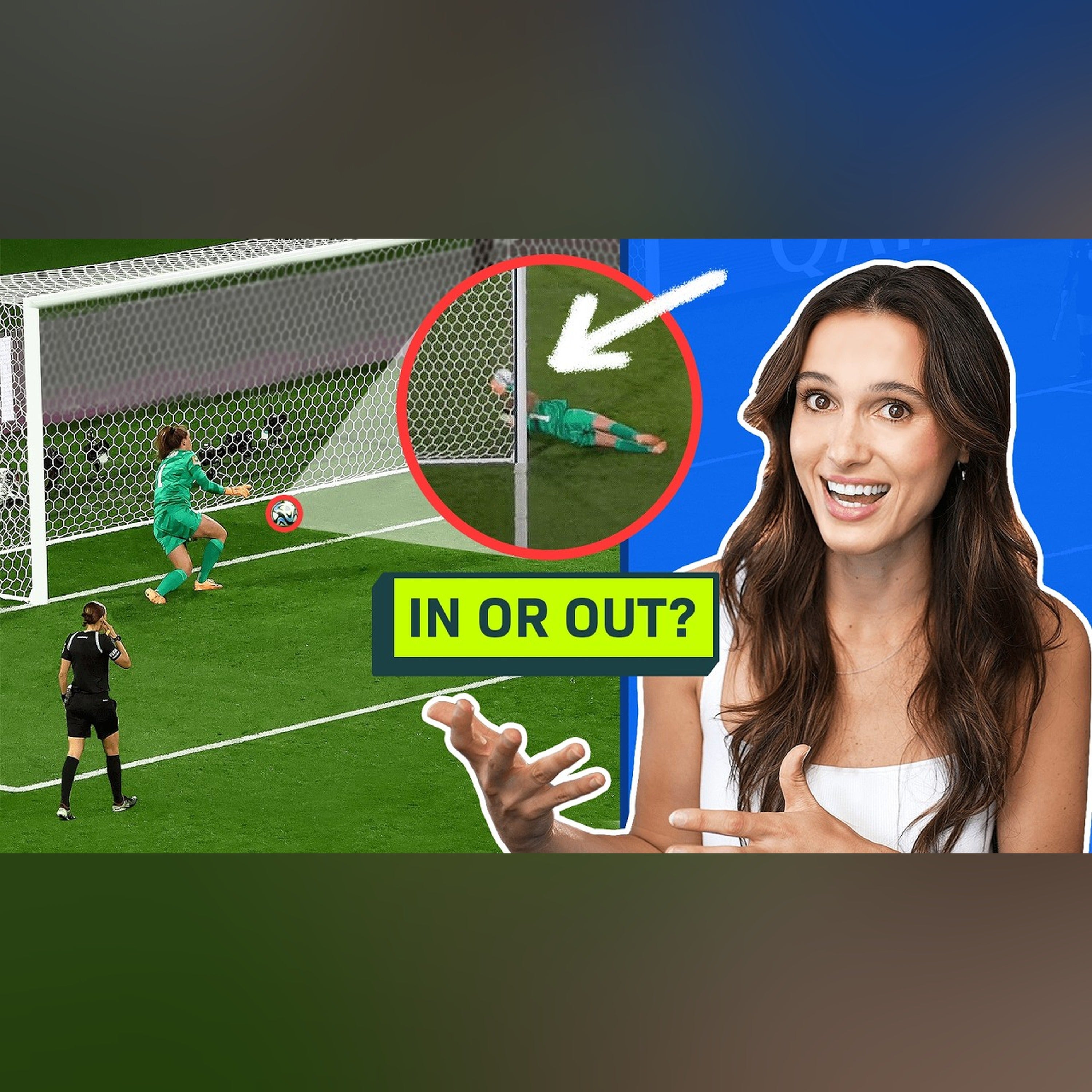
Are AI referees ruining sports? Or making them better? If you’re watching the 2023 US Open, you’re seeing automated referee calls. After years of controversy about human accuracy, tennis has used a system called Hawkeye to not only check human calls… but now to replace human referees. And this robot ref revolution isn’t just happening in tennis. It’s taking over the sports world. Soccer, basketball, baseball, they are all using machines to improve the calls being made on the field. The World Cup in particular has invested in these tools, from VAR (video assistant referee) to semi-automated offside and goal-line technology. The stakes are high. The difference between a right or wrong call can be a championship, or millions of dollars in prizes, endorsements, ticket sales. For the most part, fans like tech that makes calls more objective. HOWEVER… there is a big chunk of sports fans who would strongly disagree, who think that robot refs are ruining the game. Thing is, this tech isn’t goi
DISCOVER GRAD SCHOOL: https://nci.university/home-v2?utm_source=chase_youtube&utm_medium=social_video&utm_campaign=nci4_promo (https://nci.university/home-v2) Uploaded 02-05-26 LEARN ABOUT NCI LEVEL 2: https://nci.university/nci-2?utm_source=chase_youtube&utm_medium=social_video&utm_campaign=nci2_promo (https://nci.university/nci-2) There’s a moment in every conversation where everything gets decided. It happens before logic. Before persuasion. Before anyone thinks they’re “in control.” And most people miss it completely. That’s why conversations feel unpredictable… Why people react in ways that don’t make sense… Why you can say the right thing — and still lose the room. Because the outcome was already set. This video breaks down the hidden structure behind human interaction: * how conversations organize themselves before words matter * how frames control behavior without force * how categories decide what’s allowed (and what isn’t) * how identity and metaphor quietly shape every respo
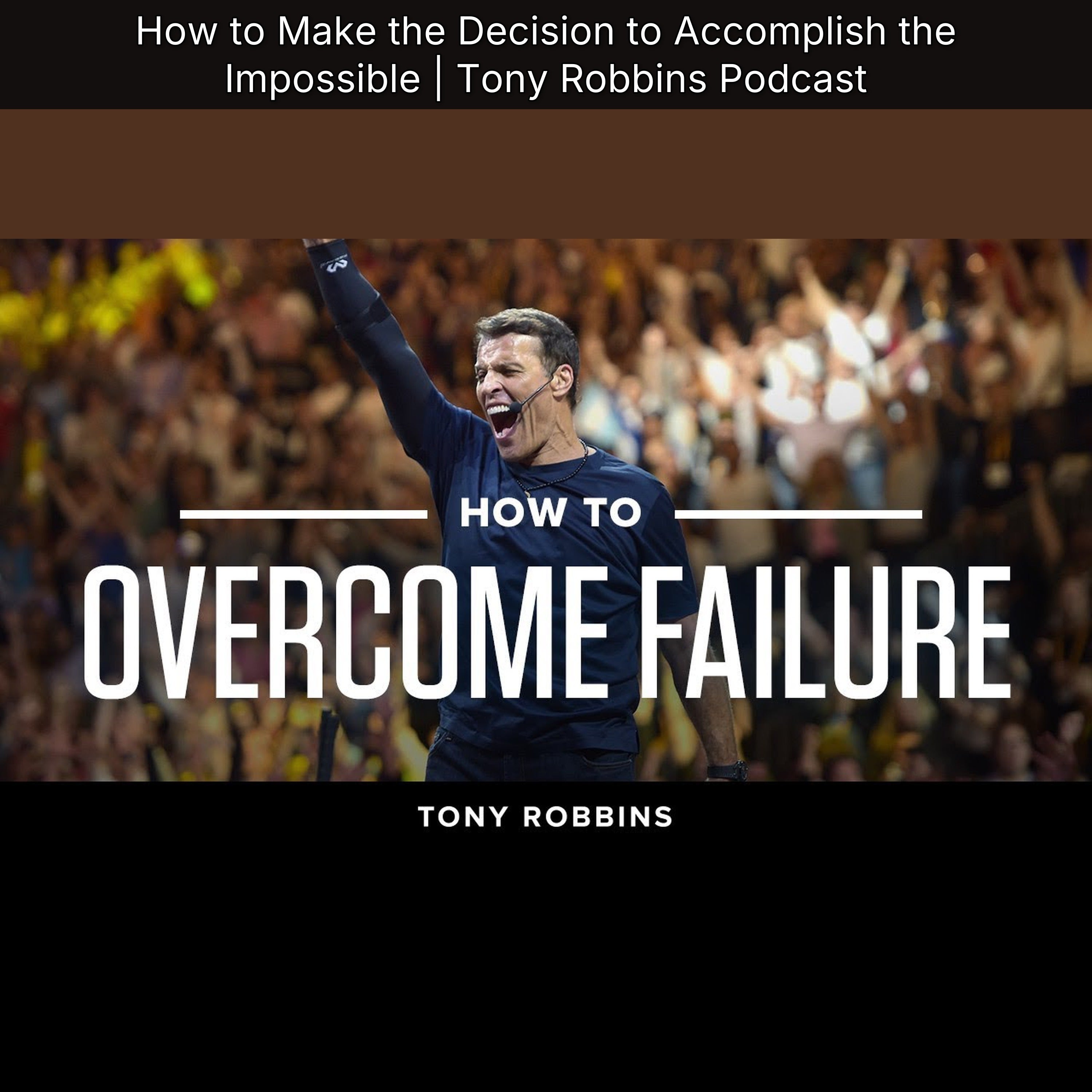
How to Make the Decision to do the Impossible - Tony Robbins Podcast The fear of failure affects millions of people around the world – whether they admit it or not! Many people have big dreams, but they fail to act because they’re so afraid of disappointment. In this episode of the Tony Robbins podcast, Tony, Mary Buckheit and Siri Lindley discuss how to overcome fear of failure to pursue your greatest passion. Siri Lindley is a top-tier athlete who graduated from Brown University. After playing three collegiate sports, she graduated and became the number one triathlete on the planet. Top athletes can be a prime example of overcoming fear of failure. Olympians decide from a young age that they are willing to compete with people from across the globe to be the best in their sport. What drives these people to pursue excellence? What’s their mindset like? Whether you’re an athlete or a business owner, you have to learn how to overcome failure. Because no matter what, you will fail. You mi
A.I. for Building Self-esteem: Seeing Yourself More Clearly and Kindly, a practical, beginner-friendly look at how artificial intelligence can help you see yourself a little more clearly and kindly. Building Self-esteem? Press play on Episode 427 of A.I. for Beginners and learn exactly how artificial intelligence, especially ChatGPT, alongside a journaling app, can help you see yourself a little more clearly and kindly. WHAT YOU WILL LEARN IN THIS EPISODE - Why building self-esteem is so hard to handle alone, and what is actually going on underneath it - A specific way to use a journaling app to work through it, step by step - An example prompt you can copy word for word: "Help me notice when I'm judging myself far harsher than I'd judge a friend" - A second practical technique, with another ready-to-use prompt: "Help me write down three qualities I actually like about myself, beyond achievements" WHO THIS EPISODE IS FOR - Anyone currently working on building self-esteem - Anyone curio
Merriam-Webster's Word of the Day for November 21, 2026 is: meet-cute • \MEET-kyoot\ • noun Meet-cute refers to a cute, charming, or amusing first encounter between romantic partners. A meet-cute can be such an encounter as shown in a movie or television show, or one that happens in real life. // Their meet-cute felt as if it came straight out of a romantic comedy. See the entry > (https://www.merriam-webster.com/dictionary/meet-cute) Examples: “Two women, Dylan and Melanie, cross paths on an artificial beach in a near-apocalyptic meet-cute: one has emerged from the underwater pod in which she was raised, the other works at a luxury resort as a bartender… and may also be a robot.” — Natalie Zutter, Literary Hub, 2 Jan. 2026 Did you know? Isn’t it cute how two words can be introduced to each other and become an inseparable pair soon after? Well, that’s exactly what happened when meet and cute got together in the early 1950s. The duo was spotted in The New York Times Book Review in 1952
Merriam-Webster's Word of the Day for November 20, 2026 is: ruthless • \ROOTH-lus\ • adjective Ruthless means "having no pity." It describes people, behaviors, circumstances, etc. regarded as cruel or merciless. // Wolves and other large carnivores are often portrayed (and feared) as ruthless predators even as they play vital roles in their ecosystems. See the entry > (https://www.merriam-webster.com/dictionary/ruthless) Examples: "One of Shakespeare's most powerful and enduring tragedies, 'Macbeth' remains an urgent and gripping story. Ambition and prophecy collide as a fateful prediction drives Macbeth into a ruthless pursuit of power, destroying everything in his path." — The Daily Gazette (Schenectady, New York), 25 Sept. 2026 Did you know? Ruthless can be defined as "without ruth" or "having no ruth." So what, then, is ruth? The noun ruth (https://www.merriam-webster.com/dictionary/ruth), which is now considerably less common than ruthless, means "compassion for the misery of anot
Merriam-Webster's Word of the Day for November 19, 2026 is: upbraid • \up-BRAYD\ • verb To upbraid someone is to speak to them in an angry or critical way in response to something they have done wrong—in other words, to scold them. // The teacher upbraided the class after discovering the chalkboard erasers had been clapped all over the walls. See the entry > (https://www.merriam-webster.com/dictionary/upbraid) Examples: “An industrious ant spends all summer gathering food for the cold months, while a lazy grasshopper dances and sings. Once winter hits, the grasshopper is cold and hungry, and goes begging for food from the ant, who refuses to share any of its bounty, upbraiding the grasshopper for failing to plan.” — David A. Graham, The Atlantic, 17 Apr. 2026 Did you know? First things first: do not confuse upbraid with topknot lest you be upbraided for it. Topknot is a noun referring to a hairstyle, while upbraid is a verb (and an ancient one at that) meaning “to criticize or scold se
Customers should receive clear explanations when a company cannot provide its promised service.
Share your view, then see how readers voted. No sign-in required. This poll is shared across stories.
Do you agree or disagree?
Common Quandary
A Common Quandary to discuss
Another conversation to explore, separate from this news story.
An AI wrote the perfect condolence message for you. Is it still from the heart?
Your friend is grieving. You want to reach out, but words fail you, so you ask an AI to draft a condolence message. It expresses exactly what you feel. You revise it and send it without mentioning the help.