English-language podcasts

Composers Datebook

Varese and Zappa

2 min

Listen through the publisher, then discuss the episode here or arrange an in-person Roundtable. Your city determines where to meet.

Roundtables are designed for groups of four, with a shared subject and room for everyone to speak. Come for discussion, with no dating expectation.

Synopsis The Nov. 7, 1950, issue of Look magazine included a record review of a new LP of music by avant-garde composer Edgard Varèse. “Varèse is unlike anything else in music, and well worth knowing,” the review suggested. Frank Zappa, a young Californian just short of his 10th birthday, was fascinated by the Look magazine photo of Varèse accompanying the review, which made the composer look a little like a mad scientist in vintage horror films. The young Zappa felt compelled to hunt down the record and begin composing music himself. For his 15th birthday, he chose to spend a $5 gift from his parents on a long-distance phone call to Varèse, who he correctly guessed must live in New York’s Greenwich Village. Today, Zappa is best remembered as the head of the iconoclastic rock band of the ‘60s and ‘70s the Mothers of Invention, but in 1983, he also conducted works of Varèse at a San Francisco concert honoring the composer’s centenary, and always acknowledged Varèse as a major influence. One of his final projects, recorded in 1993, the last year of his life, was an orchestral tribute to Varèse. Music Played in Today's Program Edgar Varèse (1883-1965): Ionisation; New York Philharmonic; Pierre Boulez, conductor; Sony 45844 Frank Zappa (1940-1993): Dog Breath Variations; Cincinnati Conservatory Wind Symphony; Eugene Corporon, conductor; Mark 1116

Episode information is provided by the publisher. Listening takes place on the publisher’s service.

Listen at the source ↗

Featured places to meet in Palo Alto, CA

Explore these places and arrange a conversation through ThinkMatch.

City guide for Palo Alto, CA

More from Composers Datebook

Composers Datebook

Revolución diamantina

2 min

Synopsis In August, 2019, thousands of women took to the streets of Mexico City to protest the outrageous police indifference to violent crimes against women, which largely went unpunished. Their protest became known as the “revolución diamantina” (glitter revolution), since they showered Mexico City’s security chief with pink glitter during their inaugural demonstration. Their protest inspired Mexican composer Gabriela Ortiz to collaborate with her compatriot, Pulitzer Prize-winning Mexican author Cristina Rivera Garza, in the creation of a ballet score that would chronicle their history and honor their action. The result of their collaboration was Revolución Diamantina, a 42-minute work of surprising power and beauty. Ortiz said, “It was up to me to imagine the music by using not only aesthetic languages already known to me, but by taking risks, learning, and experimenting with new tools. In this ballet, it has been my hope that the audience will explore different pathways that radic

Discuss this episode

Composers Datebook

Shostakovich and his string quartets

2 min

Synopsis In 1974, St. Petersburg was still called Leningrad and still part of what we now call the former Soviet Union. Back then, the most famous living Soviet composer was Dmitri Shostakovich, whose health was rapidly failing from the cancer that would claim his life the following year. On today’s date in 1974, Shostakovich’s String Quartet No. 15, his final, was given its premiere performance by the Taneyev Quartet. The work was supposed to have been premiered by the Beethoven Quartet, but its cellist died unexpectedly, and, mindful of his own mortality, Shostakovich was reluctant to postpone the scheduled premiere. After all, he might not be around by the time the Beethoven Quartet found a replacement cellist. When his String Quartet No. 1 had premiered in 1938, Shostakovich had described that work as “joyful, merry, lyrical” and “springlike.” His String Quartet No. 15, on the other hand, is obviously a “winter work,” written by someone who knows he might never see another spring.

Discuss this episode

Composers Datebook

The Beeb

2 min

Synopsis On today’s date in 1922, the British Broadcasting Corporation began daily radio transmissions from London, at first offering just news and weather — the latter read twice, in case anyone wanted to take notes. The following month, on Dec. 23, 1922, the BBC broadcast its first orchestral concert. Over time, the BBC became affectionately nicknamed “the Beeb,” or, less affectionately “Auntie,” due to the upper-middle class, slightly patronizing tone of its music announcers in the 1940s and ‘50s. That said, Auntie has proven to be hip in one aspect: The BBC has been a major commissioner of and advocate for new music by a wide range of composers — and not just British ones. In 2007, for example, the BBC Symphony premiered the Doctor Atomic Symphony, by American composer John Adams, live on-air at a BBC Proms Concert at the Royal Albert Hall. And it’s not just famous, big-name composers who get an airing on the Beeb either. Each year, BBC Radio 3 hosts a competition for teenage compo

Discuss this episode

Community Poll

Workers should retain the right to strike even when a dispute inconveniences the public.

Share your view, then see how readers voted. No sign-in required. This poll is shared across stories.

Do you agree or disagree?

Choose one answer

Common Quandary

A Common Quandary to discuss

Another conversation to explore, separate from this news story.

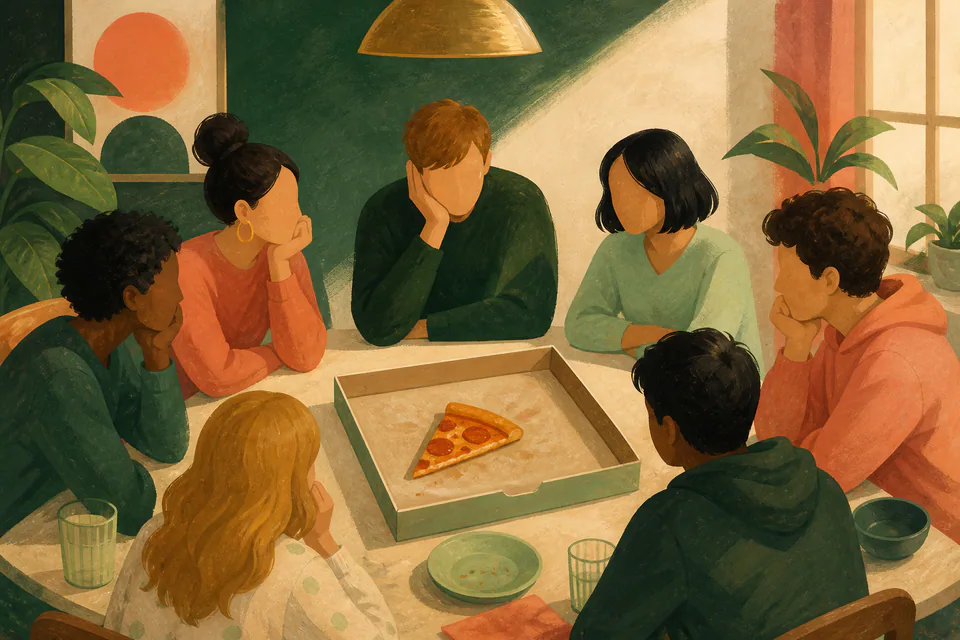
One slice of pizza remains and everyone is pretending not to want it. Can you take it?

Six friends have been circling the last slice of pizza for twenty minutes. Nobody claims it when you ask, yet two people keep glancing at the box. You are still hungry and paid the same share as everyone else.

Does politeness require leaving something that nobody will openly claim?

Explore this quandary